

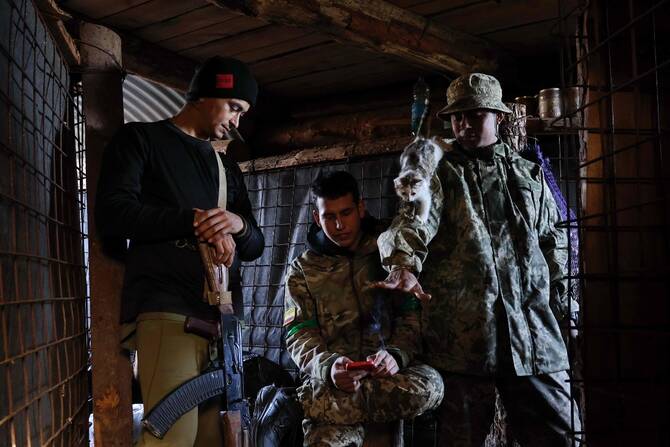
You’re late: Ukrainian soldiers say NATO lags in technological arms race

Short Url
Updated 19 November 2025
Follow

You’re late: Ukrainian soldiers say NATO lags in technological arms race

  • In a recent analysis, the US-based Center for Strategic and International Studies noted that “The last three years of warfare have dramatically accelerated technology innovation”

UNDISCLOSED: Ukrainian soldiers frowned as they pored over a small device plugged into a computer — a drone interceptor captured from the Russian side.
The green device with a dome-shaped nose and 30-centimeter wingspan epitomises the technological arms race playing out between Kyiv and Moscow as their troops battle on the sprawling front line.
Deployed in their hundreds by both sides every day, drones have become the chief technology of the war, scouting out enemy positions and packed with explosives to crash down into soldiers, vehicles and equipment.
They have transformed the front line into a 15-kilometer (9-mile) deep kill-zone and overhauled the very strategy of modern warfare.
Ukraine first deployed drone interceptors in spring 2024, having judged them effective against the thousands of Russian Geran-2 attack drones that bombard Ukrainian cities and infrastructure every month.
The specimen showed that Moscow has now caught up.
“They copied our model,” said Konstantin, the 27-year-old deputy commander of an anti-aircraft unit in Ukraine’s 3rd Army Corps.
But Russia printed theirs from a single block of material, meaning it is “faster and cheaper to produce.”
The 3D-printed interceptors, which race toward larger drones to take them out mid-air, have been a turning point in both the technology and economics of air defense.
US Patriot missiles, which Ukraine has and wants more of, cost about $3 million a shot.
Konstantin held up a Ukrainian drone interceptor that he said cost just $2,000 to make.
Such a price is more viable when facing hundreds of targets a day, and Ukraine’s defense ministry has ordered their mass production.

- ‘Chess’ -

But such is the pace of change that there are concerns about whether Ukraine’s models are up to date.
Russian attack drones have recently shown signs of being able to evade interceptors by using AI-driven sensors.
“We need to adapt every month, sometimes even faster,” Konstantin told AFP.
Earlier this year his unit was the first to shoot down a Russian attack drone using a small explosive drone that is usually used on ground targets.
“We thought, okay why not, let’s try?“
“It’s like a chess game. You always need to think ahead,” he added.
In a recent analysis, the US-based Center for Strategic and International Studies noted that “The last three years of warfare have dramatically accelerated technology innovation.”
Both sides are now locked in a “highly iterative game of cat and mouse,” seeking a brief upper hand by using artificial intelligence and tools to extend the range.

- Video games -

The dominance of technology has also changed the profile of a typical soldier.
Konstantin’s drone lab resembles a tech manufacturing startup — screens covered with lines of code and the smell of melted plastic from the 3D printers.
The young men working there, some with long hair, are engineers, pilots and computer scientists.
The younger the soldier, or the more video games they have played, the better drone pilot they tend to make, Konstantin said.
“They, like, play a lot of games with a controller, so they’re used to, you know, different controls.”

- ‘Late’ -

Soldiers say Ukraine’s front line has become a laboratory for military innovation, and Kyiv pitches itself as being at the forefront of low-cost, cutting-edge technology.
Now it hopes to leverage that expertise with its European partners, after years of reliance on whatever weapons its Western backers agreed to send.
And experts say drone warfare appears to have outdated some of NATO’s strengths, such as in heavy equipment and centralized logistics.
Some considered an incursion of Russian drones over Poland in September a wake-up call for the Western military alliance’s readiness.
To Konstantin, NATO’s techniques are “no longer very effective.”
“Their vision is really different from what’s happening here.”
Ukraine’s Foreign Minister Andriy Sybiga made the same observation earlier this month.
“The modern arms race is not about nukes — it is about millions of cheap drones,” he said.
Moscow fires several thousand drones at Ukraine every month, having massively ramped up production since the start of the war.
That should instill a sense of urgency not only in Kyiv, but across Europe, said Betsik, the brigade’s main commander.
“You’re not even in the future,” he said.
“You’re not in the present, either. You’re late.”


US vaccine advisers say not all babies need a hepatitis B shot at birth

Updated 6 sec ago
Follow

US vaccine advisers say not all babies need a hepatitis B shot at birth

  • Vaccine advisers named by Kennedy reverse decades-long recommendation
  • Kennedy’s advisory committee decided to recommend the birth dose only for babies whose mothers test positive
  • President Donald Trump posted a message calling the vote a “very good decision”

NEW YORK: A federal vaccine advisory committee voted on Friday to end the longstanding recommendation that all US babies get the hepatitis B vaccine on the day they’re born.
A loud chorus of medical and public health leaders decried the actions of the panel, whose current members were all appointed by US Health Secretary Robert F. Kennedy Jr. — a leading anti-vaccine activist before this year becoming the nation’s top health official.
“This is the group that can’t shoot straight,” said Dr. William Schaffner, a Vanderbilt University vaccine expert who for decades has been involved with ACIP and its workgroups.
Several medical societies and state health departments said they would continue to recommend them. While people may have to check their policies, the trade group AHIP, formerly known as America’s Health Insurance Plans, said its members still will cover the birth dose of the hepatitis B vaccine.
For decades, the government has advised that all babies be vaccinated against the liver infection right after birth. The shots are widely considered to be a public health success for preventing thousands of illnesses.
But Kennedy’s Advisory Committee on Immunization Practices decided to recommend the birth dose only for babies whose mothers test positive, and in cases where the mom wasn’t tested.
For other babies, it will be up to the parents and their doctors to decide if a birth dose is appropriate. The committee voted 8-3 to suggest that when a family elects to wait, then the vaccination series should begin when the child is 2 months old.
President Donald Trump posted a message late Friday calling the vote a “very good decision.”

The acting director of the Centers for Disease Control and Prevention, Jim O’Neill, is expected to decide later whether to accept the committee’s recommendation.
The decision marks a return to a health strategy abandoned more than three decades ago
Asked why the newly-appointed committee moved quickly to reexamine the recommendation, committee member Vicky Pebsworth on Thursday cited “pressure from stakeholder groups,” without naming them.
Committee members said the risk of infection for most babies is very low and that earlier research that found the shots were safe for infants was inadequate.
They also worried that in many cases, doctors and nurses don’t have full conversations with parents about the pros and cons of the birth-dose vaccination.
The committee members voiced interest in hearing the input from public health and medical professionals, but chose to ignore the experts’ repeated pleas to leave the recommendations alone.
The committee gives advice to the director of the Centers for Disease Control and Prevention on how approved vaccines should be used. CDC directors almost always adopted the committee’s recommendations, which were widely heeded by doctors and guide vaccination programs. But the agency currently has no director, leaving acting director O’Neill to decide.
In June, Kennedy fired the entire 17-member panel earlier this year and replaced it with a group that includes several anti-vaccine voices.
Hepatitis B and delaying birth doses
Hepatitis B is a serious liver infection that, for most people, lasts less than six months. But for some, especially infants and children, it can become a long-lasting problem that can lead to liver failure, liver cancer and scarring called cirrhosis.
In adults, the virus is spread through sex or through sharing needles during injection drug use. But it can also be passed from an infected mother to a baby.
In 1991, the committee recommended an initial dose of hepatitis B vaccine at birth. Experts say quick immunization is crucial to prevent infection from taking root. And, indeed, cases in children have plummeted.
Still, several members of Kennedy’s committee voiced discomfort with vaccinating all newborns. They argued that past safety studies of the vaccine in newborns were limited and it’s possible that larger, long-term studies could uncover a problem with the birth dose.
But two members said they saw no documented evidence of harm from the birth doses and suggested concern was based on speculation.
Three panel members asked about the scientific basis for saying that the first dose could be delayed for two months for many babies.
“This is unconscionable,” said committee member Dr. Joseph Hibbeln, who repeatedly voiced opposition to the proposal during the sometimes-heated two-day meeting.
The committee’s chair, Dr. Kirk Milhoan, said two months was chosen as a point where infants had matured beyond the neonatal stage. Hibbeln countered that there was no data presented that two months is an appropriate cut-off.
Dr. Cody Meissner also questioned a second proposal — which passed 6-4 — that said parents consider talking to pediatricians about blood tests meant to measure whether hep B shots have created protective antibodies.
Such testing is not standard pediatric practice after vaccination. Proponents said it could be a new way to see if fewer shots are adequate.
A CDC hepatitis expert, Adam Langer, said results could vary from child to child and would be an erratic way to assess if fewer doses work. He also noted there’s no good evidence that three shots pose harm to kids.
Meissner attacked the proposal, saying the language “is kind of making things up.”
Health experts say this could ‘make America sicker’
Health experts have noted Kennedy’s hand-picked committee is focused on the pros and cons of shots for the individual getting vaccinated, and has turned away from seeing vaccinations as a way to stop the spread of preventable diseases among the public.
The second proposal “is right at the center of this paradox,” said committee member Dr. Robert Malone.
Some observers criticized the meeting, noting recent changes in how they are conducted. CDC scientists no longer present vaccine safety and effectiveness data to the committee. Instead, people who have been prominent voices in anti-vaccine circles were given those slots.
The committee “is no longer a legitimate scientific body,” said Elizabeth Jacobs, a member of Defend Public Health, an advocacy group of researchers and others that has opposed Trump administration health policies. She described the meeting this week as “an epidemiological crime scene.”
Republican Sen. Bill Cassidy, a liver doctor who chairs the Senate health committee, called the committee’s vote on the hepatitis B vaccine “a mistake.”
“This makes America sicker,” he said, in a post on social media.
The committee heard a 90-minute presentation from Aaron Siri, a lawyer who has worked with Kennedy on vaccine litigation. He ended by saying that he believes there should no ACIP vaccine recommendations at all.
In a lengthy response, Meissner said, “What you have said is a terrible, terrible distortion of all the facts.” He ended by saying Siri should not have been invited.
The meeting’s organizers said they invited Siri as well as a few vaccine researchers — who have been vocal defenders of immunizations — to discuss the vaccine schedule. They named two: Dr. Peter Hotez, who said he declined, and Dr. Paul Offit, who said he didn’t remember being asked but would have declined anyway.
Hotez, of the Texas Children’s Hospital in Houston, declined to present before the group “because ACIP appears to have shifted its mission away from science and evidence-based medicine,” he said in an email to The Associated Press.