Spain, Belgium, Switzerland, Scotland and Austria secure automatic World Cup spots

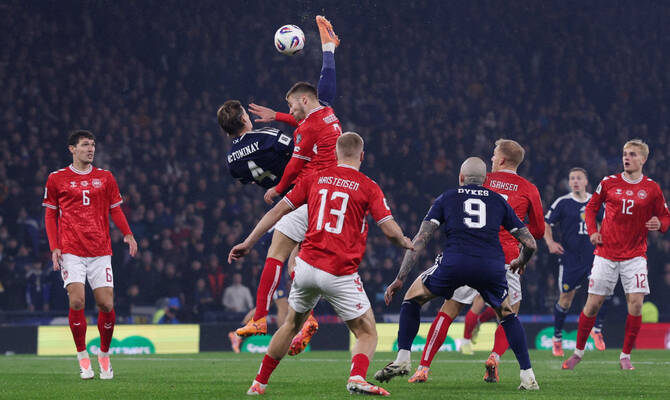
Scotland’s Scott McTominay scores their first goal with a stunning bicycle kick during the FIFA World Cup UEFA Qualifiers Group C match between Scotland and Denmark at Hampden Park, Glasgow, Scotland, Tuesday. (Reuters)
Short Url
Updated 19 November 2025
Follow

Spain, Belgium, Switzerland, Scotland and Austria secure automatic World Cup spots

  • Five automatic spots were still available in Europe
  • The 12 group winners qualified directly, while the runners-up will participate in playoffs along with the four best-ranked group winners of the 2024-25 Nations League that did not finish first or second in their groups

LONDON: A stunning bicycle kick and two stoppage-time goals sealed Scotland’s dramatic return to the World Cup after a 28-year wait.

Austria needed a late equalizer to also make it back to football’s showcase event for the first time since 1998, while top-ranked Spain clinched their spot after equaling Italy’s 31-match unbeaten record in competitive games in Europe.

Belgium and Switzerland also secured their places for the 2026 World Cup as European qualifying finished Tuesday. Five automatic spots were still available in Europe.

Scotland beat 10-man Denmark 4-2 in a winner-take-all match in Group C, with Scott McTominay scoring a superb bicycle kick goal three minutes into the match, sending the Hampden Park crowd into raptures.

A draw would have given Denmark the group win and the Danes were in good position after Patrick Dorgu equalized in the 82nd, but Kieran Tierney put the hosts ahead again three minutes into added time. Kenny McLean then sealed Scotland’s qualification eight minutes into stoppage time when he chipped goalkeeper Kasper Schmeichel from the halfway line.

“We’ve been on a journey. I spoke to them about it pre-match, about how this is the opportunity we’ve waited for. What a night, eh?” Scotland coach Steve Clarke said. “This was the chance, one game. This was like a playoff final. We put everything on the line. There’s always one last step and it’s always the hardest.”

Denmark, which saw Rasmus Kristensen sent off in the 62nd, finished second in the group, two points behind Scotland.

A 1-1 home draw against Bosnia and Herzegovina was enough for Austria to win Group H and return to the World Cup after a 28-year wait, while Belgium routed Liechtenstein 7-0. Switzerland qualified after a 1-1 draw at Kosovo.

The 12 group winners qualified directly, while the runners-up will participate in playoffs along with the four best-ranked group winners of the 2024-25 Nations League that did not finish first or second in their groups.

The playoffs will be played on March 26 and March 31. The World Cup will be played in the US, Mexico and Canada from June 11-July 19.

Spain’s record

Mikel Oyarzabal scored the equalizer in the 62nd minute and Spain drew 2-2 with Turkiye at home to extend their unbeaten streak — which began in a match against Italy in the semifinals of the Nations League in 2023 — to 31 matches in Europe, according to UEFA and Spain’s soccer federation. Italy’s record came between 2018 and 2021. It ended with a 2-1 loss to Spain in the Nations League final.

The only way La Roja would have lost first place was if they were defeated by seven goals or more. Turkiye were second in the group.

“We wanted to finish without conceding a goal. A bittersweet taste, but we’re happy to qualify for the World Cup,” said Dani Olmo, who scored for Spain four minutes into the match in Seville.

Already eliminated Bulgaria beat Georgia 2-1 at home.

Belgium’s rout

Belgium reached their fourth straight World Cup by trouncing Liechtenstein to win Group J. Charles De Ketelaere and Jeremy Doku each scored a pair of goals.

Second-place went to Wales after it routed North Macedonia 7-1 at home with a hat trick by Harry Wilson. A draw would have been enough for North Macedonia. Both North Macedonia and Wales were secured in the playoffs through the Nations League.

Switzerland in

Switzerland drew with Kosovo to win Group B and secure their sixth straight World Cup appearance. Switzerland arrived in good position and could have guaranteed their spot even if they had lost by five goals. Kosovo, seeking their first World Cup appearance, had already secured second place.

Sweden, who will be in the playoffs through the Nations League, drew 1-1 with Slovenia.

Already eliminated Greece and Belarus drew 0-0.

Austria hang on

In another winner-take-all match, Austria held Bosnia and Herzegovina to a draw at home to win Group H and make it back to the World Cup for the first time since 1998 in France. Michael Gregoritsch scored the equalizer that Austria needed to qualify in the 77th.

“It was difficult. It was really difficult,” Austria coach Ralf Rangnick said. “Conceding a goal naturally made it even more difficult. But then we threw everything into it and were eventually rewarded. If Bosnia play like this, they will progress too.”

Bosnia and Herzegovina, who last played at the World Cup in 2014 in Brazil, ended second and will be in the playoffs.

Third-place Romania, in the playoffs through the Nations League, routed San Marino 7-1 at home.


Australia depth shows up England’s Ashes ‘failures’

Updated 5 sec ago
Follow

Australia depth shows up England’s Ashes ‘failures’

SYDNEY: A well-drilled Australia are on the cusp of retaining the Ashes after just six days of cricket — not bad for a team lambasted by England great Stuart Broad before the series began as its weakest since 2010.
The hosts take a 2-0 lead into the third Test at Adelaide on December 17 needing only a draw to keep the famous urn and pile more humiliation on Ben Stokes’s tourists.
Australia have put themselves on the brink despite missing injured pace spearheads Pat Cummins and Josh Hazlewood, with the performances of stand-ins Michael Neser and Brendan Doggett a reflection of their depth.
“The great and the healthiest thing for Australian cricket right now is that they’ve got almost a second XI or an Australia ‘A’ side that could come in and play some outstanding cricket too,” said former Australia Test quick Brett Lee.
“The guys who have had their opportunity, the Doggetts and the Nesers, have stood up. They’ve taken their opportunity and taken it with both hands, which is brilliant.”
The strength of the country’s talent pool was driven home by Australia ‘A’ crushing England’s second-tier side by an innings and 127 runs at Allan Border Field while Stokes’s men were being thrashed down the road in the second Test at the Gabba.
Young prospects Fergus O’Neill, Cooper Connolly and Campbell Kellaway stood out, while discarded Test batsman Nathan McSweeney fired a double-century reminder to selectors.
It is a far cry from the pre-Ashes war-of-words where England were hyped as having their best chance in a generation to win a series in Australia, with seamer Broad’s comments coming back to haunt him.
“It’s probably the worst Australian team since 2010 when England last won and it’s the best English team since 2010,” said Broad, who retired in 2023 and is now working as a pundit.
“It’s actually not an opinion, it’s fact.”
At the time, he pointed to questions over the make-up of Australia’s batting line-up and a perceived lack of bowling depth.
Both have been blown out of the water.

On the go

Australia went into the first Test in Perth dogged by uncertainty, with the uncapped Jake Weatherald as Usman Khawaja’s sixth opening partner since David Warner retired nearly two years ago.
In a quirk of fate, Khawaja was unable to bat in the first innings because of back spasms with Marnus Labuschagne replacing him.
But it was when he pulled out again in the second innings and Travis Head stepped up that the tide turned on England with his stunning 69-ball match-winning century.
“Ever since Travis Head stuck his hand up to open when Khawaja got hurt in Perth, Australia have looked like a different team,” said Australian legend Glenn McGrath.
Labuschagne said Head and Weatherald’s confidence trickled down to the lower order in Brisbane, where himself, Steve Smith and Alex Carey all blasted quick-fire half centuries.
It leaves selectors with a dilemma for the third Test: recall now-fit 85-Test veteran Khawaja or persist with Weatherald and Head, whose home ground is Adelaide.
Smith, who stood in for Cummins as skipper in the first two Tests, attributed Australia’s success so far to being able to adapt “in real time.”
“We play ‘live’. We adapt on the go, instead of getting back in the sheds and going, ‘We should have done this’,” he said.
“Sometimes it’s just playing the long game. I think we’ve just adapted so well the last couple of years, and played in real time, I suppose.”
For former Australia captain Greg Chappell, Australia’s success has been as much about England’s failures.
While their aggressive “Bazball” approach might be suited to flat English pitches and small grounds, it has been brutally exposed by the bigger boundaries and demanding conditions in Australia.
“The failure that has ensued across the first two Tests is a whole-of-system one, a catastrophic breakdown of both the game plan and its execution,” he wrote in a column.
“While the players have been the immediate culprits, the off-field leaders —  Brendon McCullum and Ben Stokes — are equally responsible for not recognizing the different challenges presented by Test cricket in Australia.”