

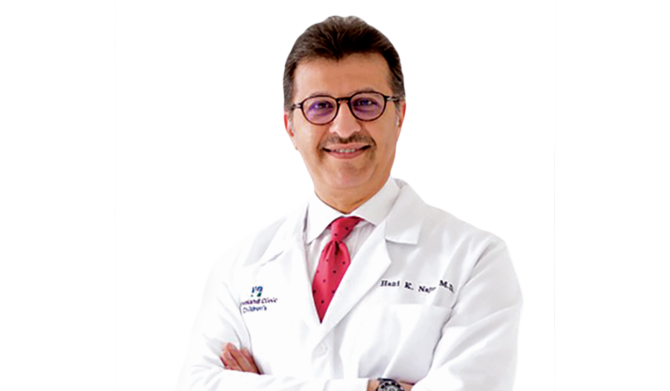

CHICAGO: Saudi cardiothoracic surgeon Dr. Hani Najm was recently named vice president of the prestigious American College of Cardiology, to begin in March.
Later next year, he will become the organization’s president, one of only three surgeons to hold such a position in the influential 75-year-old ACC.
A pediatric and congenital heart surgeon, Najm is credited with inventing not only several surgical cardiac procedures to save the lives of young children, but also developing a special heart valve for infants that grows with them.
I represent many great minds in Saudi Arabia. Yes, we produce oil and that’s great, but Saudi Arabia also produces great minds
Dr. Hani Najm, Cardiothoracic surgeon
He also recently removed a tumor from a fetus in the mother’s womb, saving his life and keeping him to term.
“I removed at five months of pregnancy a tumor from a fetus that would’ve died from heart failure. During the surgery, we reached the fetus by opening the abdomen, then the uterus of the mother and then the chest of the fetus. And then I removed the tumor,” Najm told Arab News.
“She delivered a healthy baby. Without this unprecedented surgery, the fetus would never have survived.”
Najm said all his successes and achievements are a direct result of the support he has received from the Saudi government.
“Saudi Arabia is far more than the narrow public image of money and oil. Saudi Arabia is about developing the human and brain power. This has been the investment of Saudi Arabia for decades,” he added.
“Oil in Saudi Arabia has been put to proper investment to benefit the world. I’m a product of Saudi education and Saudi vision.
“Saudi government support helped me get the best training in Canada, then returned to practice becoming proficient in heart surgery.
“This brought me to this level where I was recruited by the best heart center in the world, the Cleveland Clinic.
“I represent many great minds in Saudi Arabia. Yes, we produce oil and that’s great, but Saudi Arabia also produces great minds.”
Defective heart valves in newborns are not uncommon, but there were no available prosthetic valves for babies, Najm said, so he patented one.
“I devised a heart valve that can be implanted in a baby, which starts at 8 mm and grows or expands to 15 mm as the baby continues to grow,” he added.
For his many achievements, Najm became the first recipient of the Great Arab Minds Award given in medicine.
The award is often called the Arab Nobel Prize, and was initiated in 2023 by Sheikh Mohammed bin Rashid Al-Maktoum, vice president and prime minister of the UAE.
Najm began his studies at King Saud University’s medical school. He was then supported on a Saudi scholarship to complete his training in Canada as a pediatric and adult heart surgeon. On his return, he became deputy chairman of the King Abdulaziz Cardiac Center in Riyadh.
“The government of Saudi Arabia has been investing in selected achievers for decades by supporting them for scholarships in the best universities or medical centers in the world. There are thousands of physicians and individuals in other disciplines who’ve been sent abroad for further training and leadership,” Najm said.
“I was in a scholarship to Canada where I spent 10 years training in general surgery, cardiothoracic surgery, pediatric heart surgery, as well as earning a master’s degree in cardiovascular sciences.
“This has equipped me with the ability to provide excellent care for patients as well as the ability to do research.”
After his studies, he practiced in Saudi Arabia for almost 17 years before he was tapped to serve as chairman of pediatric and congenital heart surgery, and as executive co-director of the Pediatric and Adult Congenital Heart Center at the Cleveland Clinic.
“I’m very proud of where I came from and where I am. I can still connect to my native country of Saudi Arabia, where I was born. I also realize and recognize that I’ve been supported through my education … thanks to Saudi Arabia,” said Najm.
“This has led to having such a successful career, and to be able to provide the best care for children who suffer from heart disease.”


