

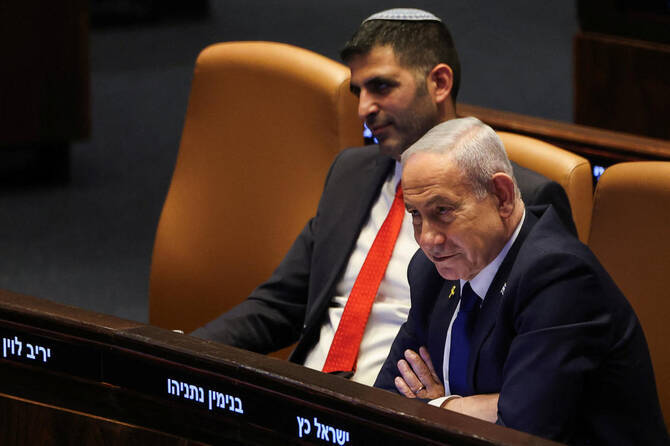
After UN vote, Netanyahu calls for Hamas’ expulsion from the region

Israeli Prime Minister Benjamin Netanyahu on Tuesday called for Hamas to be expelled from the region, a day after the U.N. Security Council endorsed President Donald Trump's plan to end the war that offers the Palestinian militant group amnesty. (Reuters/File)
Short Url
Updated 18 November 2025
Follow

After UN vote, Netanyahu calls for Hamas’ expulsion from the region

  • Netanyahu publicly endorsed the plan during a White House visit in late September
  • “Israel extends its hand in peace and prosperity to all of our neighbors” and calls on neighboring countries to “join us in expelling Hamas and its supporters from the region,” he said

TEL AVIV/CAIRO: Israeli Prime Minister Benjamin Netanyahu on Tuesday called for Hamas to be expelled from the region, a day after the UN Security Council endorsed President Donald Trump’s plan to end the war that offers the Palestinian militant group amnesty.
Netanyahu publicly endorsed the plan during a White House visit in late September. However, his latest remarks appear to show that there are differences with the United States on the path forward. Hamas has also objected to parts of the plan.
Diplomats say privately that entrenched positions on both the Israeli and Hamas sides have made it difficult to advance the plan, which lacks specific timelines or enforcement mechanisms. Still, it has received strong international backing.
Netanyahu on Tuesday published a series of posts on X in response to the UN vote. In one post, he applauded Trump and in another wrote the Israeli government believes the plan would lead to peace and prosperity because it calls for the “full demilitarization, disarmament, and deradicalization of Gaza.”
“Israel extends its hand in peace and prosperity to all of our neighbors” and calls on neighboring countries to “join us in expelling Hamas and its supporters from the region,” he said.
Asked what the prime minister had meant by expelling Hamas, a spokesperson said that it would mean “ensuring there is no Hamas in Gaza as outlined in the 20-point plan, and Hamas has no ability to govern the Palestinian people inside the Gaza Strip.”

PLAN DOES NOT CALL FOR HAMAS’ EXPULSION
Trump’s 20-point plan includes a clause saying that Hamas members “who commit to peaceful coexistence and to decommission their weapons will be given amnesty” and members who wish to leave will be given safe passage to third countries.
Another clause says Hamas will agree to not having any role in Gaza’s governance. There is no clause that explicitly calls for the Islamist militant group to disband or to leave Gaza.
The plan says reforms to the West Bank-based Palestinian Authority may ultimately allow conditions “for a credible pathway to Palestinian self-determination and statehood.”
Ahead of the UN vote, Netanyahu said on Sunday that Israel remained opposed to Palestinian statehood after protests by far-right coalition allies over a US-backed statement indicating support for a pathway to Palestinian independence.
Netanyahu also opposes any Palestinian Authority involvement in Gaza.

MULTINATIONAL FORCE FOR POST-WAR GAZA
The Security Council resolution authorized a multinational force that Trump’s plan says will be temporarily deployed to Gaza to stabilize the territory. The resolution’s text also says member states could join a “Board of Peace” that would oversee reconstruction and economic recovery inside Gaza.
Hamas has criticized the resolution as failing to “live up to the demands and political and humanitarian rights” of the Palestinian people, who it said rejected an international guardianship mechanism of Gaza.
Any international force must only be deployed along Gaza’s borders to monitor the ceasefire and under UN supervision, Hamas said in a statement, warning that such a force would lose its neutrality if it tried to disarm the militant group.
Reham Owda, a Palestinian political analyst from Gaza, said the Hamas statement should be viewed as an objection, rather than complete rejection, in an attempt to negotiate mechanisms for the international force and the role of the board of peace.
A ceasefire between Israel and Hamas came into effect on October 10 as part of Trump’s multi-phased plan to end the war. Israel has partially withdrawn its forces but still controls 53 percent of Gaza and the sides have accused each other of violations.
Abu Abdallah, a businessman displaced in central Gaza, said Palestinians would support the deployment of international forces if it meant that Israel would fully withdraw its forces.
“Hamas can’t decide our fate alone, but we also don’t want to get rid of one occupation, Israel, and get another international occupation,” he said by phone.


Syria’s Sharaa calls for united efforts to rebuild a year after Assad’s ouster

Updated 08 December 2025
Follow

Syria’s Sharaa calls for united efforts to rebuild a year after Assad’s ouster

  • Sharaa’s Islamist-led alliance launched a lightning offensive in late November last year, taking the capital Damascus on December 8

DAMASCUS: President Ahmed Al-Sharaa on Monday urged Syrians to work together to rebuild their country, still marred by insecurity and divisions, as they marked a year since the ousting of longtime ruler Bashar Assad.
The atmosphere in Damascus was jubilant as thousands of people took to the streets of the capital, AFP correspondents said, after mosques in the Old City began the day broadcasting celebratory prayers at dawn.
“What happened over the past year seems like a miracle,” said Iyad Burghol, 44, a doctor, citing developments including a warm welcome in Washington by President Donald Trump for Sharaa, a former jihadist who once had a US bounty on his head.
“People are demanding electricity, lower prices and higher salaries” after years of war and economic crisis, Burghol said.
“But the most important thing to me is civil peace, security and safety,” he added, taking a photo of people carrying a huge Syrian flag and sending it to his friends abroad.
Sharaa’s Islamist-led alliance launched a lightning offensive in late November last year, taking the capital Damascus on December 8 after nearly 14 years of war and putting an end to more than five decades of the Assad family’s iron-fisted rule.
Since then Sharaa has managed to restore Syria’s international standing and has won sanctions relief, but he faces major challenges in guaranteeing security, rebuilding crumbling institutions, regaining Syrians’ trust and keeping his fractured country united.
“The current phase requires the unification of efforts by all citizens to build a strong Syria, consolidate its stability, safeguard its sovereignty, and achieve a future befitting the sacrifices of its people,” Sharaa said following dawn prayers at Damascus’s famous Umayyad Mosque.
He was wearing military garb as he did when he entered the capital a year ago.

‘Heal deep divisions’

As part of the celebrations in Damascus, hundreds of military personnel marched down a major thoroughfare as helicopters flew overhead and people lined the streets to watch.
Sharaa and several ministers were in attendance, state media reported.
Monday’s events, including an expected speech by Sharaa, are the culmination of celebrations that began last month as Syrians began marking the start of last year’s lightning offensive.
Multi-confessional Syria’s fragile transition has been shaken this year by sectarian bloodshed in the country’s Alawite and Druze minority heartlands, alongside ongoing Israeli military operations.
In a statement, United Nations Secretary-General Antonio Guterres said that “what lies ahead is far more than a political transition; it is the chance to rebuild shattered communities and heal deep divisions.”
“It is an opportunity to forge a nation where every Syrian — regardless of ethnicity, religion, gender or political affiliation — can live securely, equally, and with dignity,” he said in the statement, urging international support.
On Sunday, the UN Independent International Commission of Inquiry on Syria, which investigates international human rights law violations since the start of the war, warned the country’s transition was fragile and said that “cycles of vengeance and reprisal must be brought to an end.”
The US-backed Kurdish-led Syrian Democratic Forces that control swathes of northeast Syria said Monday that “the next phase requires launching a real, inclusive dialogue... and establishing a new social contract that guarantees rights, freedoms and equality.”
The Kurdish administration in the northeast has announced a ban on public gatherings on Monday, citing security concerns, while also banning gunfire and fireworks.
Under a March deal, the Kurdish administration was to integrate its institutions into the central government by year-end, but progress has stalled.
On Saturday, a prominent Alawite spiritual leader in Syria urged members of his religious minority, to which the Assad family also belongs, to boycott the celebrations, in protest against the “oppressive” new authorities.