

Nigeria school kidnapping draws fresh US ire

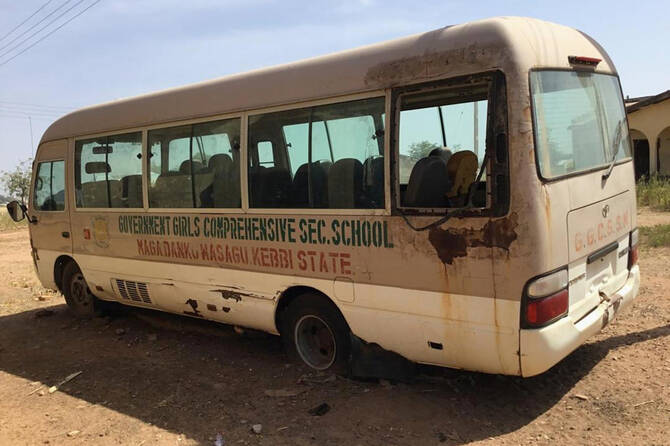
A view of the school bus of the Government Girls Comprehensive Secondary School, where gunmen on Monday attacked the school dormitory and abducted schoolgirls, is seen in Kebbi, Nigeria, Nov. 18, 2025. (AP)
Short Url
Updated 18 November 2025
Follow

Nigeria school kidnapping draws fresh US ire

  • “You must continue day and night fighting. We must find these children,” Major General Waidi Shaibu, recently promoted to chief of army staff, told troops deployed to Kebbi State
  • Shaibu urged the soldiers to “leave no stone unturned” in the search for the schoolgirls

LAGOS: A top Nigerian general has ordered his troops to fight “day and night” to rescue 25 schoolgirls whose kidnapping in the northwest has been seized on by US President Donald Trump’s followers.
The early Monday morning raid on a secondary school in Kebbi State was the latest abduction of schoolchildren in Muslim-majority northern Nigeria, more than a decade after Boko Haram’s infamous kidnapping of 276 girls in the northeast sparked international uproar.
It has become another flashpoint to draw the ire of the US right following Trump’s threats of military intervention over the alleged killing of Nigeria’s Christians.
“You must continue day and night fighting. We must find these children,” Major General Waidi Shaibu, recently promoted to chief of army staff, told troops deployed to Kebbi State.
Shaibu urged the soldiers to “leave no stone unturned” in the search for the schoolgirls.
Though police rushed to the Government Girls Comprehensive Secondary School in the town of Maga, the gang had managed to scale the fence and abduct the students after killing the school’s vice-principal.
Kebbi is caught between the jihadist threat from neighboring Niger and criminal gangs who loot villages while kidnapping and killing residents across the north of Africa’s most populous country.

- US tensions -

Kebbi State police told AFP on Tuesday that the abducted schoolchildren were all Muslim.
But Republican Riley Moore of the US House of Representatives, in a post on X urging his followers to pray for the 25 girls, echoed Trump’s claims of the persecution of Christians.
“While we don’t have all the details on this horrific attack, we know that the attack occurred in a Christian enclave in Northern Nigeria,” Moore wrote.
Trump at the start of November said he had asked the Pentagon to map out a possible plan of attack in Nigeria because radical Islamists are “killing the Christians and killing them in very large numbers.”
Nigeria has rejected that narrative, insisting that the country’s various security crises have left more Muslims dead.
Nigeria is the scene of numerous conflicts, including jihadist insurgencies, which kill both Christians and Muslims, often indiscriminately.
Foreign Minister Yusuf Tuggar told AFP on Monday that Nigeria was in talks with the United States about security.
Asked whether he thought Washington would send the military to strike, Tuggar said: “No, I do not think so.”
“Because we continue to talk, and as I said, the discussion has progressed. It’s moved on from that.”

- ‘Dragged me outside’ -

Amina Hassan, the wife of the murdered vice-principal, Hassan Makuku, told Nigerian television she had tried to wake her husband up after hearing noise outside their house at 3:30 am (0230 GMT), before the gunmen burst in.
“We started struggling with them and one of them pulled out his gun and shot my husband, then he dragged me by my hand outside the house and I told them to leave me alone, that I would not go with them since they have killed the father of my children,” Hassan said.
“I was still arguing with them when my daughter came out, then they left me and went to her and took her with them,” she said, adding that her daughter managed to escape into the bush after the attackers got distracted by the schoolgirls.
Monday’s raid was the second mass school abduction in Kebbi in four years, following a June 2021 incident when bandits took more than 100 students and staff members from a government college.
Those students were released in batches over two years after parents raised ransoms. Some of the students were forcefully married off and returned with babies.


Backlash as Australia kills dingoes after backpacker death

Updated 3 sec ago
Follow

Backlash as Australia kills dingoes after backpacker death

  • The euthanization program has stirred debate about how to manage the local population of dingoes
  • Wildlife experts said killing the animals was the wrong response and may threaten the island’s dingo population
SYDNEY: Australian authorities have sparked a backlash by killing a group of dingoes linked to the death of a young Canadian woman on an island in the country’s east.
The Queensland government said six animals were put down after 19-year-old backpacker Piper James’s body was found on January 19 at a beach on the World Heritage-listed island of K’gari.
The euthanization program has stirred debate about how to manage the local population of dingoes, a sandy-colored canine believed to have first arrived in Australia 4,000 to 5,000 years ago.
An autopsy conducted on James’ body found evidence “consistent with drowning” but also detected injuries corresponding to dingo bites.
“Pre-mortem dingo bite marks are not likely to have caused immediate death,” said a spokesperson for the Coroners Court of Queensland.
The coroner’s investigation into the cause of death was expected to take several weeks.
In response, the Queensland government said a pack of 10 dingoes involved would be euthanized after rangers had observed some “aggressive behavior.”
Six of the dingoes had already been euthanized, the state’s environment minister, Andrew Powell, told reporters Sunday.
“Obviously, the operation will continue,” he said.
The traditional owners of K’gari, the Butchulla people, said the state’s failure to consult with them before euthanizing the dingoes — or wongari in their language — was “unexpected and disappointing.”
“Once again, it feels as though economic priorities are being placed above the voices of the people and traditional owners, which is frustrating and difficult to accept,” the Butchulla Aboriginal Corporation said in a statement to Australian media this week.
‘You are food’
Wildlife experts said killing the animals was the wrong response and may threaten the island’s dingo population, estimated at just 70-200 animals.
Given their small numbers, killing a pack of 10 animals would harm the population’s genetic diversity, said Mathew Crowther, professor of quantitative conservation biology at the University of Sydney.
“There’s no moral from the dingoes’ point of view. They’re just being wild animals, doing wild things,” Crowther said.
Dingoes tend to lose their fear of people as they interact with tourists, some of whom defy advice against feeding the animals.
“That’s the worst thing you can do to a wild animal,” Crowther said.
“They just relate humans to food, and if you don’t give them food, well, you are food — that’s basically how it is.”
Dingoes are wild, predatory animals and need to be treated with respect, said Bill Bateman, associate professor in the school of molecular and life sciences at Curtin University.
The canines are more likely to attack children or people who are alone, and may be triggered when people turn their backs or run, he said.
“These are important animals, and therefore we need to change the way we deal with them, otherwise we’re just going to keep reacting to these attacks and driving the population of dingoes down,” Bateman said.
Wildlife managers, rangers, Indigenous people and tourism operators need to work together so that humans and dingoes can coexist on the island, he said.
Todd James, the father of Piper, has described on social media how his family’s hearts were “shattered” by her death.
News of the dingoes’ euthanization was “heart-wrenching,” he told Australian media, adding however that he recognized it may be necessary for safety because of the pack’s behavior.