

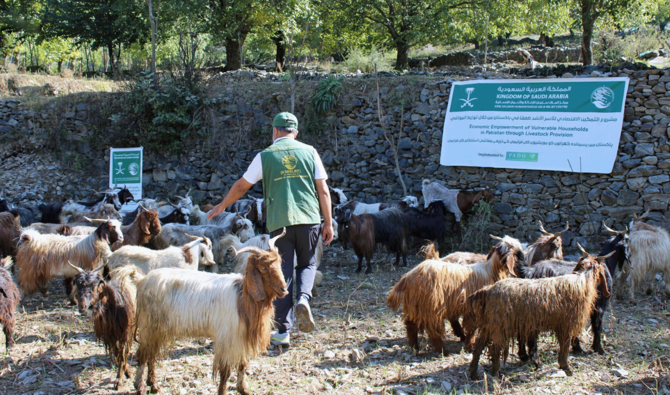
KSrelief completes first phase of livestock project for vulnerable families in northwest Pakistan

In this picture released by KS relief on November 18, 2025, a worker walks past a herd of goats in Pakistan northwestern province. (KS relief).
Short Url
Updated 18 November 2025
Follow

KSrelief completes first phase of livestock project for vulnerable families in northwest Pakistan

  • Saudi agency provides two vaccinated goats, four bags of silage and training to vulnerable families in four Khyber Pakhtunkhwa districts
  • KSrelief says is planning to implement phase two and three of same livestock project in KP’s Swat, Swabi, Haripur and Mansehra cities

ISLAMABAD: Saudi Arabia’s King Salman Humanitarian Aid and Relief Center (KSrelief) announced on Tuesday that it has completed the first phase of a livestock program it launched earlier to empower vulnerable families in Pakistan, saying the package has benefitted 1,000 households. 

KSrelief launched the program, titled: ‘Economic Empowerment of Vulnerable Households in Pakistan through Livestock Provision Project’ last month. The Saudi agency aims to reduce poverty and promote self-reliance among Pakistani families affected by economic hardship and natural disasters by providing livestock, poultry and practical training in animal care and small-scale income generation.

The first phase of the program was implemented by the Peach and Development Organization in collaboration with the Relief, Rehabilitation and Settlement Department (RRSD) of the provincial disaster management authority across four districts of the northwestern Khyber Pakhtunkhwa (KP) province. KSrelief said around 7,250 individuals benefited from the first phase. 

“Under this phase, 1,000 beneficiary households from Lower Chitral, Upper Chitral, Lower Dir and Upper Dir received a livelihood support package consisting of two vaccinated goats, four bags of silage and training provided by the Livestock Department to enable sustainable livestock-based income generation,” KSrelief said in a press release. 

KSrelief said it is planning the second and third phase of the project, which would focus on supporting vulnerable households in KP’s Swat, Swabi, Haripur and Mansehra cities. 

These households will be given 25 poultry birds per family, along with a complete poultry kit and training on poultry management and income generation. 

“Additionally, families in Charsadda, Mardan, and Nowshera will be assisted with cattle, silage and hands-on training in animal care and dairy production to strengthen their livelihood opportunities,” the Saudi agency added. 

KSrelief said its livestock project continues to promote self-reliance, improved nutrition and long-term economic stability among vulnerable communities in Pakistan. 

Saudi Arabia, through KSrelief, has been one of Pakistan’s largest humanitarian partners, contributing to flood recovery, health, education and livelihood programs across the country. The livestock project expands that cooperation by helping rural households in KP, a province frequently affected by floods and displacement, to rebuild economic stability and reduce dependence on aid.


Pakistan remittances seen surpassing $40 billion in FY26 as Saudi Arabia leads November inflows

Updated 4 sec ago
Follow

Pakistan remittances seen surpassing $40 billion in FY26 as Saudi Arabia leads November inflows

  • The country’s November remittances rose 9.4 percent year-on-year to $3.2 billion, official data show
  • Economic experts say rupee stability and higher use of formal channels are driving the upward trend

ISLAMABAD: Pakistan’s workers’ remittances are expected to exceed the $40 billion mark in the current fiscal year, economic experts said Tuesday, after the country recorded an inflow of $3.2 billion in November, with Saudi Arabia once again emerging as the biggest contributor.

Remittances are a key pillar of Pakistan’s external finances, providing hard currency that supports household consumption, helps narrow the current-account gap and bolsters foreign-exchange reserves. The steady pipeline from Gulf economies, led by Saudi Arabia and the United Arab Emirates, has remained crucial for Pakistan’s balance of payments.

A government statement said monthly remittances in November stood at $3.2 billion, reflecting a 9.4 percent year-on-year increase.

“The growth in remittances means the full-year figure is expected to cross the $40 billion target in fiscal year 2026,” Sana Tawfik, head of research at Arif Habib Limited, told Arab News over the phone.

“There are a couple of factors behind the rise in remittances,” she said. “One of them is the stability of the rupee. In addition, the country is receiving more inflows through formal channels.”

Tawfik said the trend was positive for the current account and expected inflows to remain strong in the second half of the fiscal year, noting that both Muslim festivals of Eid fall in that period, when overseas Pakistanis traditionally send additional money home for family expenses and celebrations.

The official statement said cumulative remittances reached $16.1 billion during July–November, up 9.3 percent from $14.8 billion in the same period last year.

It added that November inflows were mainly sourced from Saudi Arabia ($753 million), the United Arab Emirates ($675 million), the United Kingdom ($481.1 million) and the United States ($277.1 million).

“UAE remittances have regained momentum in recent months, with their share at 21 percent in November 2025 from a low of 18 percent in FY24,” said Muhammad Waqas Ghani, head of research at JS Global Capital Limited. “Dubai in particular has seen a steady pick-up, reflecting improved inflows from Pakistani expatriates owing to some relaxation in emigration policies.”