

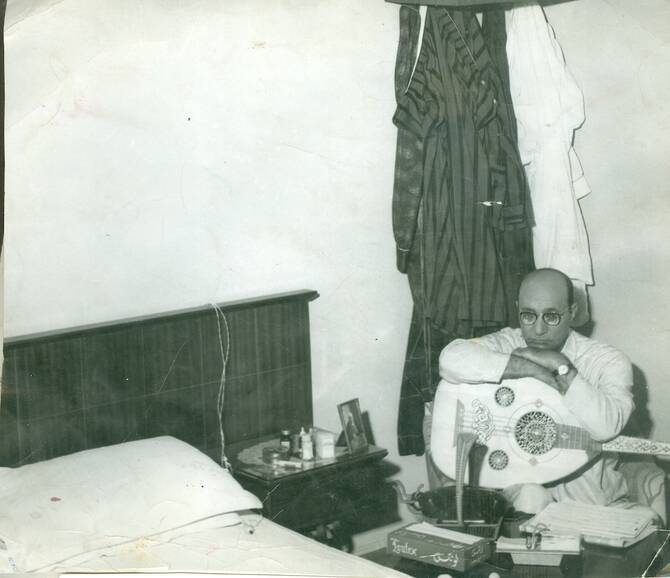

DUBAI: The late Egyptian singer and composer Mohamed Abdelwahab is to be honored in London next month at a special show celebrating his life and work, jointly organized by his grandson Omar Khalil.
One of the biggest names in modern Egyptian music, Abdelwahab was a prolific composer, with the songs “Ya Jarata Al Wadi” and “Ya Msafeir Wahdak” among his best-known works. Recognized for combining the musical heritage of the Middle East with Western instruments, he died in 1991 at the age of 89.

Abdelwahab was a prolific composer, with the songs “Ya Jarata Al Wadi” and “Ya Msafeir Wahdak” among his best-known works. (Supplied)
Khalil, who is working with Saudi producer Mona Khashoggi, said the show, to be held on Nov. 23 at Theatre Royal Drury Lane, would be a celebration of his grandfather’s legacy.
“The best way to revive and extend (his legacy) is to offer it to younger generations,” he said.
“Another thing is to also introduce his music to Western audiences, because Abdelwahab was known to have blended and created a bridge between East and West through his music.
“It was very important for him to not change or not alter the identity of Arabic music while contributing to its evolution through modernization, through creativity and through the blending of different cultures.”

Khalil said the show, to be held on Nov. 23 at Theatre Royal Drury Lane, would be a celebration of his grandfather’s legacy. (Supplied)
Soprano Fatma Said and conductor Nader Abbassi will lead the performance, which Khalil said would focus primarily on the music but also include some commentary to guide the audience through the composer’s story.
Abdelwahab’s songs have been performed by some of the biggest names in Arabic music, past and present, including Umm Kulthum, Fairuz, Nagat El-Saghira, Layla Mourad and Abdel Halim Hafez.
Despite Abdelwahab’s undoubted fame on home soil, Khalil said he wanted the performance to appeal to a broader audience and especially younger people who might not be familiar with the composer’s work.

A concert for Abdelwahab. (Supplied)
“We’ve chosen songs that don’t sound too Middle Eastern or Arabic because heavy Arabic music can be intimidating at times.”
Said and Abbassi were specifically chosen for their ability to “to transmit this music to non-Arab audiences, although they’re also a great vehicle to translate it to Arab audiences,” Khalil said.
“Fatma has grown up in a house that was filled with Adelwhab … but then went on to become an opera singer, a soprano, a classical music singer, which means that she is extremely familiar with both worlds.”
It was also vital that his grandfather’s work continued to span the generations as the composer was “extremely dedicated to modernization, to modernizing music in general,” Khalil said.
“When he was asked once what his favorite composition was, his answer was, ‘the one I haven’t composed yet.’”


