HANOI: Heavy rain swept central Vietnam on Monday, triggering landslides and floods, killing at least seven, injuring dozens and stranding thousands.
The deluges have wreaked widespread destruction across a region already battered weeks ago by floods from record rainfall and the powerful typhoon Kalmaegi.
Rainfall through Wednesday is expected to reach 30–60 centimeters (12–24 inches) in parts of central Vietnam, with some areas likely to exceed 85 centimeters (33 inches).
Landslide causes bus crash
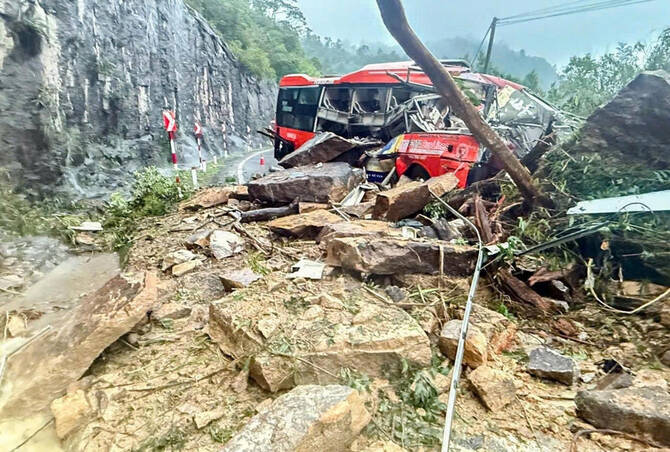
The hard-hit province of Khanh Hoa, a coastal region with hilly inland terrain, recorded one of its heaviest rainfall in years on Sunday night when earth and rocks collapsed on a bus traveling through the Khanh Le pass in the central highlands, state media reported.
The landslide crushed the front of the bus at around 9.30 p.m. local time, killing six people and trapping many passengers. Rescuers struggled for hours to reach the scene as heavy rain had also caused landslides on both sides of the pass, cutting off access. Rescue teams were only able to reach the bus after midnight, according to state media.
“Rocks and soil fell down with a loud bang. I was thrown on the roof of the bus before falling down,” Nguyen Long Cuong, the 39-year-old bus conductor, told state media VN Express.
The bus was carrying 32 people from Vietnam’s financial capital, Ho Chi Minh City and was traveling from Da Lat in Vietnam’s central highlands to the coastal city of Nha Trang. The injured were taken to a nearby hospital. State media said two of the dead bodies were still trapped under the debris as the treacherous terrain hindered the work.
The winding, 33-kilometer (20-mile) stretch carved into steep mountainsides is scenic and popular with tourists but prone to landslides in the rainy season.
The rains have triggered multiple landslides on major routes in Vietnam’s Central Highlands and traffic on several hilly passes has been suspended, state media said.
Also in Khanh Hoa, waterlogged soil collapsed on 10 workers at the Khanh Son pass on Sunday night, killing one and injuring another, while another remained missing, state media said. The seven others were able to flee to safety.
People stranded as floods hit
Flooding also hit the port city Cam Ranh and the coastal district of Cam Lam Sunday night, submerging more than 100 meters (328 ft) of railway lines under water and debris. Over 800 passengers on four trains were still stranded on Monday evening.
Flood waters inundated the Du Long Industrial Park on Monday, which houses several factories, including German and South Korean companies. Rains submerged factories by 1 meter (3.2 feet) of water and forced the power cuts, forcing thousands of workers to halt operations.
Torrential rain also flooded a national highway in the province of Dak Lak, prompting police to block the road and redirect traffic.
In the city of Hue, floods triggered landslides on Sunday in mountainous areas, blocking a major highway that runs from northern to southern Vietnam and cutting off several villages, isolating thousands, while in Quang Ngai province, rainfall of 150 to 235 mm (5.9–9.3 inches) collapsed a bridge over a stream, stranding 1,200 residents in remote hamlets.
On Sunday night, a tornado tore through the southern areas of Danang city and Quang Ngai province, ripping roofs from dozens of houses, uprooting trees and scattering debris.
Vietnam is among the world’s most flood-prone countries, with nearly half its population living in high-risk areas. Scientists warn that a warming climate is intensifying storms and rainfall across Southeast Asia, making floods and landslides increasingly destructive and frequent.

Heavy rain triggers landslides and floods in central Vietnam, killing seven
Short Url
https://arab.news/nh2bv
Heavy rain triggers landslides and floods in central Vietnam, killing seven
- The deluges have wreaked widespread destruction across a region already battered weeks ago by floods
- Vietnam is among the world’s most flood-prone countries, with nearly half its population living in high-risk areas
More than half the US threatened with ice, snow and cold in massive winter storm
Forecasters warned that the damage, especially in areas pounded by ice, could rival a hurricane
At least 177 million people were under watches or warnings for ice and snow and more than 200 million were under cold weather adviseries or warnings
WASHINGTON: It was too cold for school in Chicago and other Midwestern cities Friday as a huge, dayslong winter storm began to crank up that could bring snow, sleet, ice and bone-chilling temperatures as well as extensive power outages to about half the US population from Texas to New England.
Forecasters warned that the damage, especially in areas pounded by ice, could rival a hurricane. Airlines canceled thousands of flights, churches moved Sunday services online and the Grand Ole Opry in Nashville, Tennessee, decided to hold its Saturday night radio performance without fans. Carnival parades in Louisiana were canceled or rescheduled.
At least 177 million people were under watches or warnings for ice and snow and more than 200 million were under cold weather adviseries or warnings. In many places, those overlapped. Utility companies braced for power outages because ice-coated trees and power lines can keep falling long after a storm has passed.
“It’s going to be a big storm,” Maricela Resendiz said as she picked up chicken, eggs and pizzas at a Dallas store to get her, her 5-year-old son and her boyfriend through the weekend. Her plans: “Staying in, just being out of the way.”
Ice, snow and sleet could begin falling later Friday in Texas and Oklahoma. The storm was expected to slide into the South with freezing rain and sleet. Then it will move into the Northeast, dumping about a foot (30 centimeters) of snow from Washington, D.C., through New York and Boston, the National Weather Service predicted.
Arctic air is the first piece to fall in place
Arctic air that spilled down from Canada prompted schools throughout the Midwest to cancel classes Friday. With wind chills predicted to be as low as minus 40 degrees Fahrenheit (minus 40 Celsius) frostbite could set in within 10 minutes, making it too dangerous to walk to school or wait for the bus.
In Bismarck, North Dakota, where the wind chill was minus 41 Fahrenheit (minus 41 Celsius), Colin Cross cleaned out an empty unit for the apartment complex where he works.
“I’ve been here awhile and my brain stopped working,” said Cross, bundled up in long johns, two long-sleeved shirts, a jacket, hat, hood, gloves and boots.
Nationwide, more than 1,000 flights were delayed or canceled Friday, with well over half of them in Dallas, according to the flight tracking website FlightAware. About 2,300 Saturday flights were canceled.
In Oklahoma, Department of Transportation workers pretreated roads with salt brine while the Highway Patrol canceled troopers’ days off.
The federal government put nearly 30 search and rescue teams on standby. Officials have more than 7 million meals, 600,000 blankets and 300 generators placed throughout the area the storm was expected to cross, according to the Federal Emergency Management Agency.
Ice could take down power line
s and pipes could freeze
Once ice and snow end, the frigid air from the north will head south and east. It will take a while to thaw out, an especially dangerous prospect because ice can add hundreds of pounds to power lines and branches and make them more susceptible to snapping, especially if it’s windy.
In at least 11 Southern states from Texas to Virginia, a majority of homes are heated by electricity, according to the US Census Bureau.
A severe cold snap five years ago took down much of the power grid in Texas, leaving millions without power for days and resulting in hundreds of deaths. Gov. Greg Abbott said Thursday that won’t happen again, and utility companies were bringing in thousands of employees to help keep the power on.
Pipes are also at risk.
In Atlanta, where temperatures could dip to 10 degrees Fahrenheit (minus 12 Celsius) and stay below freezing for 36 hours, M. Cary & Daughters Plumbing co-owner Melissa Cary ordered all the pipe and repair supplies she could get. She said her daily calls could go from about 40 to several hundred.
“We’re out there; we can’t feel our fingers, our toes; we’re soaking wet,” Cary said. “I keep the hot chocolate and soup coming.”
Northeast prepares for heavy snow
The Northeast could see its heaviest snow in years.
Boston declared a cold emergency through the weekend, and Connecticut was working with neighboring New York and Massachusetts in case travel restrictions are needed on major highways.
Connecticut Gov. Ned Lamont urged people to go grocery shopping now and “stay home on Sunday.”
Philadelphia announced schools would be closed Monday. Superintendent Tony B. Watlington Sr. told students, “It’s also appropriate to have one or two very safe snowball fights.”
People are hunkering down
Stephen McDonald, who hasn’t had a home in three years, was hoping to get out of the cold in Jackson, Mississippi. But the Shower Power homeless shelter was adding spray foam insulation and ceiling heaters, keeping it closed until Saturday.
Friday night’s forecast called for lows near freezing. “Your hands get frozen solid, and they hurt real bad,” said McDonald,. “It’s not good.”
At the University of Georgia in Athens, sophomore Eden England was staying on campus to ride out the weather with her friends, even as the school encouraged students to leave dorms and go home because of concerns about losing power.
“I was texting my parents and we kind of just realized that whether I’m here or at home, it’s going to suck either way,” England said. “So I’d rather be with my friends, kind of struggling together if anything happens.”
At least 177 million people were under watches or warnings for ice and snow and more than 200 million were under cold weather adviseries or warnings
WASHINGTON: It was too cold for school in Chicago and other Midwestern cities Friday as a huge, dayslong winter storm began to crank up that could bring snow, sleet, ice and bone-chilling temperatures as well as extensive power outages to about half the US population from Texas to New England.
Forecasters warned that the damage, especially in areas pounded by ice, could rival a hurricane. Airlines canceled thousands of flights, churches moved Sunday services online and the Grand Ole Opry in Nashville, Tennessee, decided to hold its Saturday night radio performance without fans. Carnival parades in Louisiana were canceled or rescheduled.
At least 177 million people were under watches or warnings for ice and snow and more than 200 million were under cold weather adviseries or warnings. In many places, those overlapped. Utility companies braced for power outages because ice-coated trees and power lines can keep falling long after a storm has passed.
“It’s going to be a big storm,” Maricela Resendiz said as she picked up chicken, eggs and pizzas at a Dallas store to get her, her 5-year-old son and her boyfriend through the weekend. Her plans: “Staying in, just being out of the way.”
Ice, snow and sleet could begin falling later Friday in Texas and Oklahoma. The storm was expected to slide into the South with freezing rain and sleet. Then it will move into the Northeast, dumping about a foot (30 centimeters) of snow from Washington, D.C., through New York and Boston, the National Weather Service predicted.
Arctic air is the first piece to fall in place
Arctic air that spilled down from Canada prompted schools throughout the Midwest to cancel classes Friday. With wind chills predicted to be as low as minus 40 degrees Fahrenheit (minus 40 Celsius) frostbite could set in within 10 minutes, making it too dangerous to walk to school or wait for the bus.
In Bismarck, North Dakota, where the wind chill was minus 41 Fahrenheit (minus 41 Celsius), Colin Cross cleaned out an empty unit for the apartment complex where he works.
“I’ve been here awhile and my brain stopped working,” said Cross, bundled up in long johns, two long-sleeved shirts, a jacket, hat, hood, gloves and boots.
Nationwide, more than 1,000 flights were delayed or canceled Friday, with well over half of them in Dallas, according to the flight tracking website FlightAware. About 2,300 Saturday flights were canceled.
In Oklahoma, Department of Transportation workers pretreated roads with salt brine while the Highway Patrol canceled troopers’ days off.
The federal government put nearly 30 search and rescue teams on standby. Officials have more than 7 million meals, 600,000 blankets and 300 generators placed throughout the area the storm was expected to cross, according to the Federal Emergency Management Agency.
Ice could take down power line
s and pipes could freeze
Once ice and snow end, the frigid air from the north will head south and east. It will take a while to thaw out, an especially dangerous prospect because ice can add hundreds of pounds to power lines and branches and make them more susceptible to snapping, especially if it’s windy.
In at least 11 Southern states from Texas to Virginia, a majority of homes are heated by electricity, according to the US Census Bureau.
A severe cold snap five years ago took down much of the power grid in Texas, leaving millions without power for days and resulting in hundreds of deaths. Gov. Greg Abbott said Thursday that won’t happen again, and utility companies were bringing in thousands of employees to help keep the power on.
Pipes are also at risk.
In Atlanta, where temperatures could dip to 10 degrees Fahrenheit (minus 12 Celsius) and stay below freezing for 36 hours, M. Cary & Daughters Plumbing co-owner Melissa Cary ordered all the pipe and repair supplies she could get. She said her daily calls could go from about 40 to several hundred.
“We’re out there; we can’t feel our fingers, our toes; we’re soaking wet,” Cary said. “I keep the hot chocolate and soup coming.”
Northeast prepares for heavy snow
The Northeast could see its heaviest snow in years.
Boston declared a cold emergency through the weekend, and Connecticut was working with neighboring New York and Massachusetts in case travel restrictions are needed on major highways.
Connecticut Gov. Ned Lamont urged people to go grocery shopping now and “stay home on Sunday.”
Philadelphia announced schools would be closed Monday. Superintendent Tony B. Watlington Sr. told students, “It’s also appropriate to have one or two very safe snowball fights.”
People are hunkering down
Stephen McDonald, who hasn’t had a home in three years, was hoping to get out of the cold in Jackson, Mississippi. But the Shower Power homeless shelter was adding spray foam insulation and ceiling heaters, keeping it closed until Saturday.
Friday night’s forecast called for lows near freezing. “Your hands get frozen solid, and they hurt real bad,” said McDonald,. “It’s not good.”
At the University of Georgia in Athens, sophomore Eden England was staying on campus to ride out the weather with her friends, even as the school encouraged students to leave dorms and go home because of concerns about losing power.
“I was texting my parents and we kind of just realized that whether I’m here or at home, it’s going to suck either way,” England said. “So I’d rather be with my friends, kind of struggling together if anything happens.”
© 2026 SAUDI RESEARCH & PUBLISHING COMPANY, All Rights Reserved And subject to Terms of Use Agreement.


