

Looking back at more than 80 years of Saudi-US economic cooperation

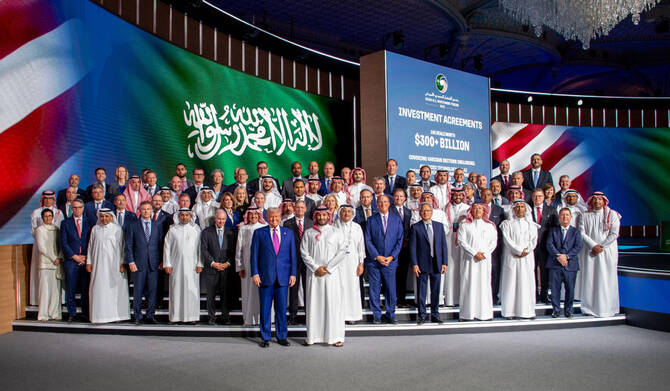
The Crown Prince and US President in a group picture with investors during the Saudi-US Investment Forum in Riyadh on May 13. (Supplied)
Short Url
Updated 17 November 2025
Follow

Looking back at more than 80 years of Saudi-US economic cooperation

  • Oil, defense, technology provided links in recent years
  • Diverse economic collaboration built on Vision 2030 initiatives

RIYADH: Saudi Arabia and the US have seen steadily growing economic ties throughout a relationship spanning more than 80 years, beginning with oil and expanding to defense and technology in recent years.

What began as a reliance on oil and gas has expanded to more diverse economic collaboration built on Vision 2030 initiatives.

Economic cooperation between the two nations was solidified in the early 1930s when King Abdulaziz granted the right of oil exploration to the American company Standard Oil through a 66-year contract. This led to the formation of the Arabian-American Oil Company, better known as Aramco.


US President George W. Bush dances with a sword with then Prince Salman bin Abdul Aziz (R), who was governor of Riyadh, during their tour of the Murabba Palace and National History Museum. (AFP file photo)

Saudi Arabia and the US signed an interim diplomatic trade agreement in 1932, establishing an initial framework for trade, according to the Saudi Press Agency.

Aramco’s Dammam Well No. 7 struck commercial quantities of oil in 1938, ushering in a new age in the Kingdom’s development.

In the early 1970s the two countries deepened their trading relationship. In 1972, the value of the Kingdom’s imported goods and materials from the US was $314 million, and the Kingdom’s exports were $194 million.


On Feb. 14, 1945, as World War II neared its end, President Franklin D. Roosevelt met King Abdulaziz aboard the USS Quincy in Egypt’s Great Bitter Lake, following the Yalta Conference. (Supplied/MOFA)

Economic relations between the two countries were underlined in June 1974 through the formation of the US-Saudi Arabian Joint Commission on Economic Cooperation, which provided US expertise to develop infrastructure to advance Saudi Arabia’s non-oil economic development.

The two countries agreed to increase the number of private US companies working on local projects in the Kingdom.

The two nations went on to maintain a steady and growing economic relationship with partnerships largely focusing on defense, energy, investment and technology.

The partners took a step forward in their economic cooperation in 2005 by formalizing a partnership in education with the King Abdullah Scholarship Program. This program allowed thousands of Saudi students to study in US universities, building a long-term foundation for a knowledge-based economy.

According to a White House fact sheet, Saudi Arabia is now one of the US’ largest trading partners in the Middle East.

The Kingdom’s direct investment in the US totaled $9.5 billion in 2023, and was focused on the transportation, real estate, and automotive sectors.

US-Saudi goods trade totaled $25.9 billion in 2024, with US exports at $13.2 billion and imports at $12.7 billion.

One recent major platform for economic cooperation was the Saudi-US Investment Forum held in Riyadh in May, at which Saudi Arabia signed deals with the US worth more than $300 billion.

Crown Prince Mohammed bin Salman, speaking at the forum, said the Kingdom was looking at $600 billion of investment opportunities, adding that he hoped this would rise to $1 trillion.

Minister of Communications and Information Technology Abdullah Alswaha, speaking to the Saudi Press Agency on the sidelines of the forum, said that the event reflected the Kingdom’s growing prominence on the global digital economy map, with the country the largest digital economy in the region and a key hub for investment in artificial intelligence and cloud computing.

Nov. 18 will mark another milestone in the Saudi-US relationship with the Saudi crown prince meeting US President Donald Trump in Washington.

The relationship between the countries, which was underlined by the meeting between King Abdulaziz Al-Saud and President Franklin D. Roosevelt on board the USS Quincy in 1945, has endured and prospered.

And these ties have witnessed continued economic expansion and moves into new sectors like technology.


Rooted in memory: How Rola Daftardar turns Saudi heritage into living art

Updated 5 sec ago
Follow

Rooted in memory: How Rola Daftardar turns Saudi heritage into living art

  • Ma Maison by Rola curates, produces home accessories
  • Aim to reflect Kingdom as ‘authentic, layered and artistic’

RIYADH: For Rola Daftardar, creativity is not simply about design — it is about memory, emotion and belonging.

Saudi by birth, originally from Madinah and raised in Jeddah, Daftardar carries a layered identity shaped further by her Lebanese mother. That blend of cultures, she says, taught her early on to see beauty in contrast and turn it into strength.

“My identity has always been a mix,” she said during a recent interview. “It taught me how to appreciate detail, emotion and storytelling through objects.”

From childhood, she was drawn to art and pieces with soul — objects that feel lived with rather than merely displayed. She went on to study arts, history and media, developing a philosophy that creativity is not only aesthetic but deeply emotional.

“Design is a way of sharing parts of myself,” she explained. “It’s storytelling through material, color and scent.”

Four years ago, that philosophy became Ma Maison by Rola — a brand that began as a personal creative outlet and gradually grew, season by season, into a carefully curated world of home accessories and tablescaping pieces.

Each year, she approaches her collections as chapters. “Every season has its own breath,” she said. “Every year carries a new intention.”

Her work comes most alive during Ramadan and national occasions, when gatherings take center stage and homes become spaces of shared ritual. Between winter and summer, ideas quietly bloom. But this year’s message feels especially personal.

Daftardar’s latest collection is deeply rooted in Saudi heritage, inspired by cities including Jeddah, Riyadh, AlUla and Taif — places she sees as emotional landscapes as much as geographic ones.

“With Saudi Arabia opening to the world, I felt a responsibility to present my country as I see it — authentic, layered and artistic,” she said.

Candles became the starting point of that story. More than fragrance, they are tributes to memory. Musk reflects the warmth of Jeddah, rose captures the calm elegance of Taif, and oud represents the depth and strength of Riyadh.

Hand-painted details and carefully chosen colors complete the sensory narrative.

The idea for her foldable side tables emerged during a walk along Jeddah’s corniche. Watching families gather spontaneously by the sea reminded her of the informal spaces that connect people — a feeling she also associates with historic Al-Balad.

“I wanted to create something simple and functional that carries that spirit of gathering,” she said.

The concept expanded to Diriyah — old and new — and to AlUla, where history and futurism coexist.

Yet it is tablescaping that remains closest to her heart. “I never choose pieces randomly,” she said. “I imagine the people around the table, the dishes being served, the conversations happening.”

For Daftardar, every bowl, riser and glass element forms part of a complete narrative. Every table tells a story.

Her ultimate aim is clear: to reflect Saudi Arabia as she feels it — warm, generous and deeply rooted. A place where modernity meets origin, and tradition evolves without losing its soul.

That is where Ma Maison by Rola lives — in the space between memory and modernity — and it is a story she is proud to tell.