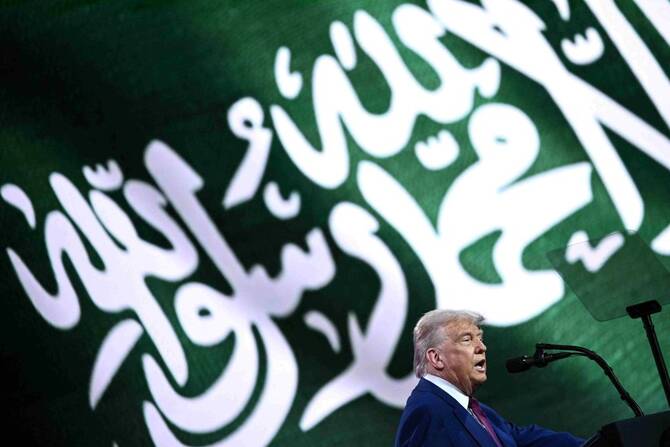
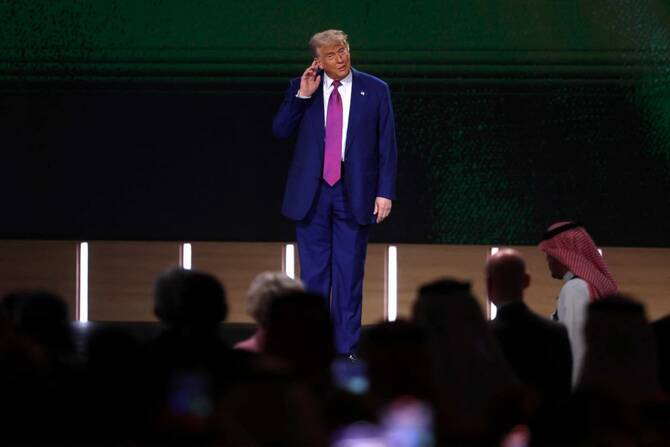
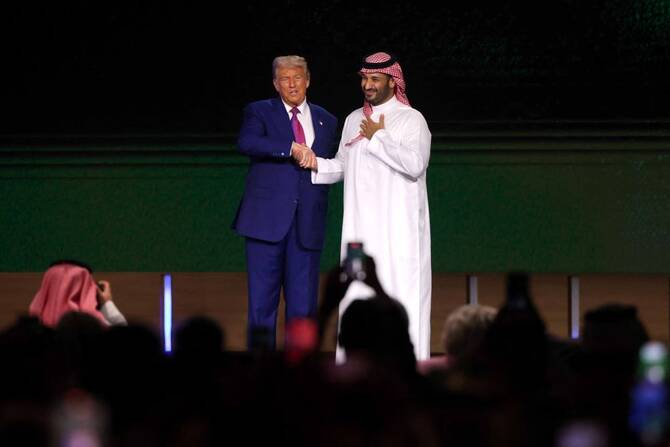

RIYADH: With Crown Prince Mohammed bin Salman’s state visit to the US coming up, we look back at President Donald Trump’s historic May 13 speech in Riyadh.
Trump had chosen Saudi Arabia as the first official state visit of his second administration, as he did with the first, signaling the importance he placed on strengthening ties with the Kingdom.
His freewheeling 48-minute address at the Saudi-US Investment Forum delved into the biggest regional issues of the day, and was littered with typical Trumpian off-the-cuff remarks.
The main takeaways were the president’s announcement to lift sanctions on Syria, his pledge to help rebuild Lebanon and his offer of an olive branch to Iran.
“If I can make a deal with Iran, I’ll be very happy, if we’re going to make your region and the world a safer place,” Trump said.
“But if Iran’s leadership rejects this olive branch and continues to attack their neighbors, then we will have no choice but to inflict massive maximum pressure.”
He called the sanctions on Syria “brutal and crippling,” adding that they had played an important function when imposed but that it was the country’s “time to shine.”
Since the speech, relations between the US and Syria have developed significantly, with the Levant country’s President Ahmed Al-Sharaa being hosted in the Oval Office on Nov. 10 and agreeing to join an anti-Daesh coalition, just days after sanctions on himself were lifted.
It was the first such visit by a Syrian president since the country gained independence in 1946.
As for Lebanon, a country with “tremendous people,” Trump in his Riyadh speech criticized the “victimizing” role that Hezbollah had played in the course of its history.
“My administration stands ready to help Lebanon create a future of economic development and peace with its neighbors,” he pledged.
The messaging pushed by Trump appeared carefully crafted to appeal to a Kingdom keen to advance its own agenda of self-reliance, self-determination and national pride.
A “great place” with “great people,” Trump remembered the “exceptional hospitality shown to us by King Salman” on his previous visit to Saudi Arabia.
He repeated well-worn observations about the country’s development, the “majestic skyscrapers, the towers that I see, the difference between now and eight years ago,” as plans were underway to develop a Trump Tower in Jeddah.
The president also noted how the Kingdom was becoming a hub of major events in sport, technology and business, noting that the “engines of Formula 1 racing now roar through the streets of Jeddah.”
But the crux of his rhetoric came when he poured esteem on the country’s people and its leaders.
He both gave them credit for achieving goals on their own terms, and also took a swipe at the Western foreign policy misadventures of the past.
“It’s crucial for the wider world to note this great transformation has not come from Western interventionalists or flying people in beautiful planes giving you lectures on how to live and how to govern your own affairs.
“No, the gleaming marvels of Riyadh and Abu Dhabi were not created by the so-called nation-builders, neocons or liberal nonprofits like those who spent trillions and trillions of dollars failing to develop Kabul, Baghdad, so many other cities.
“Instead, the birth of a modern Middle East has been brought by the people of the region themselves, the people that are right here, the people that have lived here all their lives — developing your own sovereign countries, pursuing your own unique visions, and charting your own destinies in your own way. It’s really incredible what you’ve done.
“In the end the so-called nation-builders wrecked far more nations than they built, and the interventionalists were intervening in complex societies that they did not even understand themselves. They told you how to do it, but they had no idea how to do it themselves.
“Peace, prosperity and progress ultimately came not from a radical rejection of your heritage, but rather from embracing your national traditions and embracing that same heritage that you love so dearly, and it’s something only you could do.
“You achieved a modern miracle the Arabian way. That’s a good way.”
Another standout moment that made waves on social media was when Trump voiced his ostensible admiration for the crown prince personally: “I do, I like him a lot. I like him too much. That’s why we give so much, too much. I like you too much. Great guy.”
When all was said, the oratory and the grand spectacle of Trump’s visit led to huge deals being done.
Agreements worth $300 billion were signed, the crown prince said that the Kingdom was looking at $600 billion of investment opportunities, hoping this would rise to $1 trillion.
The two countries signed memoranda of understanding in energy, defense, mineral resources and health, as well as a strategic economic partnership.