

At Baku talks, Pakistan, China push Digital Silk Road as next phase of economic corridor 

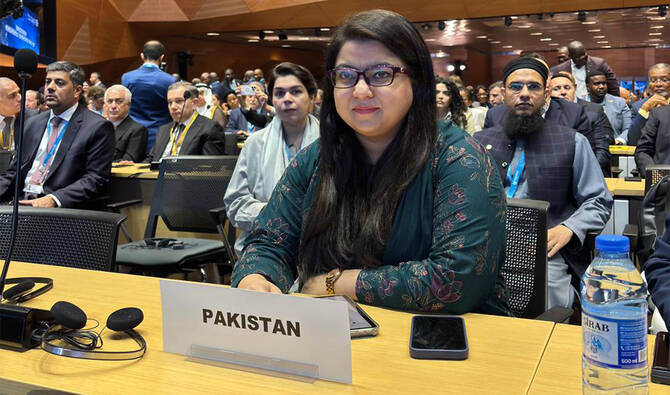
Pakistan IT Minister Shaza Fatima Khawaja is attending World Telecommunication Development Conference in Baku on November 17, 2025. (IT Ministry)
Short Url
Updated 17 November 2025
Follow

At Baku talks, Pakistan, China push Digital Silk Road as next phase of economic corridor 

  • Pakistan proposes new tech partnerships with China in 5G/6G, hardware manufacturing, ICT components, AI and cloud
  • Islamabad links digital cooperation to plans for industrial upgrading, skills development and regional data-transit role

ISLAMABAD: Pakistan has highlighted the Digital Silk Road as the next major phase of the China–Pakistan Economic Corridor (CPEC) while proposing new technology partnerships with Beijing, including joint ventures in 5G/6G, hardware manufacturing and ICT components, a statement from the Ministry of IT said on Monday. 

Launched in 2015, CPEC is a multibillion-dollar connectivity program linking western China to the Arabian Sea. The initiative has historically focused on energy projects, highways, power plants and the Gwadar port, with committed investments estimated at around $60 billion. As the two countries enter CPEC’s second phase, cooperation is expanding beyond physical infrastructure into technology, digital governance, manufacturing and skills development.

The Digital Silk Road — Beijing’s framework for cross-border connectivity in fiber, cloud services, data routing, smart manufacturing and emerging technologies — is increasingly positioned as the backbone of CPEC’s next stage. Pakistan says aligning with this digital track will help modernize local industry, deepen tech supply-chain integration with China and support its ambition to become a regional digital transit and services hub.

“[Pakistan IT Minister] Shaza Fatima Khawaja proposed joint ventures in 5G/6G, hardware manufacturing, and ICT components,” a statement from the IT ministry said after she met with Zhang Yunmeng, Vice Minister of China’s Ministry of Industry and Information Technology (MIIT), on the sidelines of the World Telecommunication Development Conference.

The ministry added that Pakistan had framed these proposals within its wider CPEC technology agenda:

“Khawaja highlighted the Pakistan–China Digital Silk Road as the next important phase of CPEC.”

As part of its digital cooperation agenda, Pakistan said it had asked China to partner on overcoming structural barriers that limit the ability of developing countries to enter global technology supply chains. According to the statement, Islamabad stressed the need for a joint initiative to help remove the “Systemic Diversity Barrier” in global tech sourcing, alongside cooperation in cybersecurity, AI and cloud computing through a bilateral talent exchange program. 

The ministry said the minister also proposed industrial digital upgrading under China’s “Intelligent Manufacturing” model to modernize local production and align Pakistan’s factories with emerging technologies.

Both sides discussed technical cooperation to make Pakistan a regional data transit hub through Pakistan–China fiber, and agreed to deepen their partnership in digital cooperation, the statement concluded. 


Pakistan court sentences rights lawyer Imaan Mazari and husband to 17 years over social media posts

Updated 4 sec ago
Follow

Pakistan court sentences rights lawyer Imaan Mazari and husband to 17 years over social media posts

  • Court says posts crossed ‘permissible boundary of dissent,’ convicts under multiple PECA sections
  • The ruling against the two draws a line between protected dissent and unlawful ‘anti-state narrative’

ISLAMABAD: A Pakistani court on Saturday sentenced human rights lawyer Imaan Zainab Mazari-Hazir and her husband, Hadi Ali Chattha, to a cumulative 17 years in prison over social media posts, ruling that their online activity crossed the lawful limits of dissent and amounted to an “anti-state narrative” under the country’s cybercrime law.

The ruling follows the couple’s arrest a day earlier while they were on their way to a court appearance, after which they were remanded to two weeks in judicial custody. Authorities had accused Mazari-Hazir and Chattha of violating the Prevention of Electronic Crimes Act (PECA) over posts on X that they said incited ethnic divisions and portrayed the military as being involved in “terrorism,” allegations both have consistently denied.

In a written verdict, Additional District and Sessions Judge Muhammad Afzal Majoka said the prosecution had proved its case against both defendants under Sections 9, 10 and 26-A of the Prevention of Electronic Crimes Act (PECA), while acquitting them of a separate hate-speech charge.

“The accused persons crossed the permissible boundaries under the law by their tweets, re-tweets and posts; thus, has committed the offense under section 9/10/26-A of PECA,” the court order said.

The court imposed five years’ rigorous imprisonment each under Section 9, 10 years under Section 10, and two years under Section 26-A, to be served cumulatively, alongside fines totaling Rs 36 million ($129,000) per person.

Benefit of time already spent in custody under Section 382-B of the Criminal Procedure Code was granted, the order said.

The court order also mentioned the social media posts, with the judge saying they included characterizations of Pakistan as a “terrorist state,” claims that detentions under the anti-terror law were illegal, praise for proscribed groups or individuals and allegations of judicial bias.

Such narratives, the order said, can erode “public confidence in core state institutions,” and courts distinguish protected dissent from anti-state speech by examining “intent, content, context, and foreseeable impact.”

While emphasizing that robust criticism was a feature of democracy, the court held that restrictions were justified when expression “crosses the permissible boundary of dissent and enters the domain of subversion, destabilization, or incitement against the State itself.”

Earlier on Saturday, Mazari-Hazir and Chattha appeared briefly via video link before boycotting the proceedings, alleging mistreatment in custody, according to local media reports.

The couple face multiple cases linked to protests and online speech, which rights groups and bar associations have criticized as part of a broader crackdown on critics, a claim the government denies.

“As you sow, so shall you reap,” Attaullah Tarar, Pakistan’s information minister, said in a post on X after the verdict, describing it as “the first official and final outcome under PECA.”

“One should fear God,” he added.