TOKYO/BEIJING: Japan on Monday moved to tamp down an escalating row with China over Taiwan that has prompted Beijing to urge its citizens to stay away from its East Asian neighbor.
The dispute erupted after Prime Minister Sanae Takaichi told Japanese lawmakers earlier this month that a Chinese attack on Taiwan threatening Japan’s survival could trigger a military response, a scenario previous administrations have avoided discussing in public to avoid provoking Beijing, which claims the self-ruled island.
Masaaki Kanai, the director general of the Japanese Foreign Ministry’s Asia and Oceania bureau, will meet his Chinese counterpart, Liu Jinsong, in Beijing this week, Japanese media reported on Monday. Kanai is expected to explain that Takaichi’s comment does not signal a shift in Japan’s security policy and urge China to refrain from actions that further damage ties, they said.
Taiwan sits just over 110 kilometers from Japan’s westernmost islands and near vital sea lanes Tokyo relies on for oil and gas shipments. Japan also hosts the largest concentration of US military power outside the United States.
“Various channels of communication are open,” Japan’s Chief Cabinet Secretary said at a regular press briefing when asked about Kanai’s reported China visit.
China’s travel warning, he added, “is incompatible with the broad direction of promoting a strategic, mutually beneficial relationship. We have made a firm request for the Chinese side to take appropriate steps.”
Takaichi may get a chance to speak directly to China’s Premier Li Qiang later this week, with both expected to attend the Group of 20 summit in South Africa from Friday.
Speaking to reporters in New Taipei on Monday, Taiwan President Lai Ching-te said China was carrying out a “multifaceted attack” on Japan.
“I call on the international community to continue paying close attention and I also urge China to exercise restraint and demonstrate the conduct befitting a major power, rather than becoming a troublemaker for regional peace and stability,” he said.
Leisure, retail shares take a hit
The row flared with Takaichi’s comment on November 7, a week after she met Chinese leader Xi Jinping and agreed to pursue stable ties.
The following day, China’s Consul General in Osaka, Xue Jian said “the dirty neck that sticks itself in must be cut off” in a now-deleted post on X. Japan summoned China’s ambassador to protest about his “extremely inappropriate” statement and several Japanese politicians called for Xue’s expulsion.
The rift widened on Thursday when China summoned Japan’s ambassador for the first time in more than two years to lodge a “strong protest” over Takaichi’s remarks.
On Friday, China said Japan would face a “crushing” military defeat if it intervened over Taiwan and voiced “serious concerns” about Japan’s security direction including ambiguity over its three non-nuclear principles not to develop, possess or host nuclear weapons.
A Reuters investigation in August found growing political and public willingness in Japan to ease that pledge, long a taboo in the only nation to suffer an atomic bombing.
A formation of Chinese coast guard ships on Sunday sailed through waters around a group of East China Sea islands controlled by Japan but claimed by China.
Known as the Senkaku in Tokyo and the Diaoyu in Beijing, they have been a flashpoint since Japan nationalized them in 2012. Japan’s coast guard said it drove the Chinese ships away.
US Ambassador to Japan George Glass has also waded into the row, posting a series of comments on X criticizing Xue’s remarks.
In his latest post on Saturday, he said it was time to move on, adding that “Halloween has been and gone” after the Chinese diplomat had labelled Takaichi “an evil witch.”
Chinese state-linked media continued to target Takaichi on Monday.
“Takaichi’s dangerous remarks, which have touched the nerves of all parties, were not only strategic recklessness, but also deliberate provocation,” the Communist Party’s People’s Daily said in an editorial.
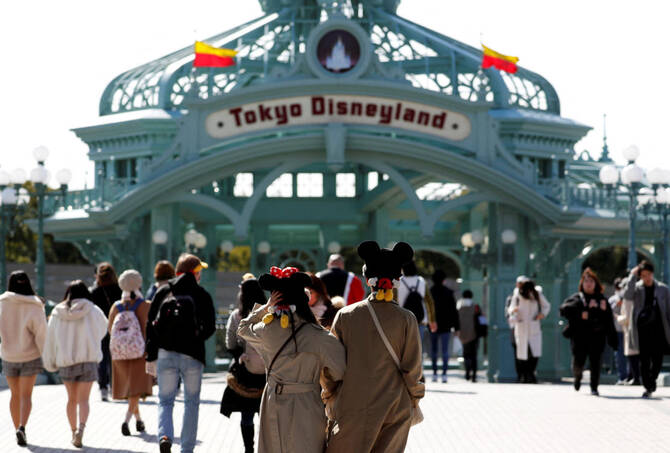
If the row drags on, a drop in Chinese visitors on the scale of the roughly 25 percent fall seen during the 2012 island dispute could deliver a significant economic hit, said Takahide Kiuchi, executive economist at Nomura Research Institute.
“A drop in visitor numbers on this scale would have a dampening effect exceeding half of Japan’s annual growth,” he said.


![]()

Japan seeks to calm escalating row with China over Taiwan
Short Url
https://arab.news/gtykb
Japan seeks to calm escalating row with China over Taiwan
- Taiwan sits just over 110 kilometers from Japan’s westernmost islands
- Japan also hosts the largest concentration of US military power outside the United States


Latest updates


© 2026 SAUDI RESEARCH & PUBLISHING COMPANY, All Rights Reserved And subject to Terms of Use Agreement.