

India and Pakistan blind women show spirit of cricket with handshakes

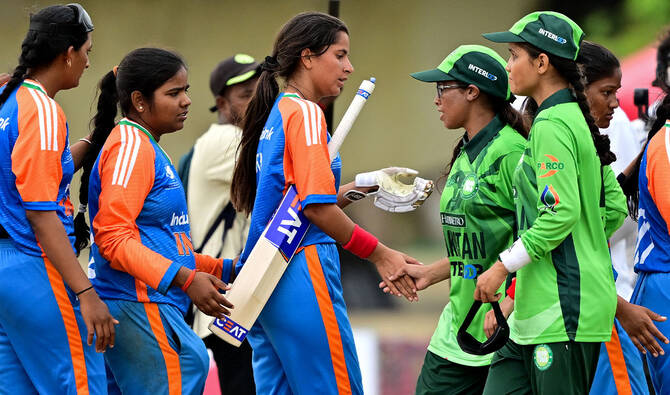
Pakistan's captain Nimra Rafique (3R) shakes hands with India's players at the end of the Women’s Blind Twenty20 World Cup 2025 match between India and Pakistan at the BOI Cricket Stadium in Katunayake on November 16, 2025. (AFP)
Short Url
Updated 16 November 2025
Follow

India and Pakistan blind women show spirit of cricket with handshakes

  • India's men refused to shake hands with Pakistani opponents at Asia Cup, with animosity spreading to women's sides at T20 World Cup
  • Tensions off and on the field have been high since a four-day military clash between nuclear-armed Pakistan and India in May this year

Katunayake: Blind women from India and Pakistan brushed aside political tensions on Sunday, shaking hands in neutral Sri Lanka at a cricket tournament for the visually impaired.

At what organisers describe as the world's first blind women's T20 tournament, players from the two South Asian neighbours showed they had sporting vision even if they lacked sight -- unlike their regular national teams.

Tensions off and on the field have been high since a deadly military clash between the nuclear-armed neighbours in May.

India's men refused to shake hands with their Pakistani opponents at the Asia Cup in September, since when neither side has shown signs of making up.

That animosity spread to the women's sides who declined any greeting at the recent T20 World Cup and also to Sunday's men's Rising Stars Asia Cup tie in Doha.

India's blind players were expected to mirror the conduct of their sighted teams when there was no handshake after the toss, but at the end of the match both sides warmly greeted each other.

The two sides, who travelled to the venue together in the same bus, not only shook hands but also exchanged generous compliments.

India won by eight wickets in just 10.2 overs after Pakistan were restricted to 135 for eight in their 20 overs at the Free Trade Zone grounds in Katunayake, 30 kilometres (18 miles) north of Colombo.

Pakistan skipper Nimra Rafique congratulated India on their comprehensive victory, while her Indian counterpart T. C. Deepika said Pakistan had played well.

The teams applauded one another loudly but neither set of players was permitted to talk to the press.

'BIGGEST OPPORTUNITY'

There were hardly any spectators but the match was shown live on Sri Lanka's national television, Rupavahini. Blind Sri Lankan officials hosting the tournament "watched" the match on YouTube by listening to the commentary.

Indian team manager Shika Shetty told AFP before the match that the tournament was opening up opportunities for more women.

"This is the first-ever World Cup for blind women... I think this is one of the biggest opportunities for our entire visually impaired girls," said Shetty, who is not blind.

"Maybe many girls with disabilities will come out from their villages. Maybe they will come for studies, maybe they will come for the sport. So it is helpful for other girls too."

Blind cricket relies on a sharp ear, as players must detect a white plastic ball -- the size of a tennis ball -- filled with ball bearings that rattle as it moves.

Pakistan coach Tahir Mehmood Butt, also speaking before the game, said the launch of women's blind cricket had created new opportunities for young players in Pakistan.

"For the totally blind, if they have good hearing, they can become good cricketers," Tahir told AFP.

Each team must field at least four completely blind players, three who can see up to two metres, and four partially sighted players able to see up to about six metres.

Totally blind batters may have a partially sighted runner. Bowling is underarm, unlike in the traditional game.

Four other nations - Australia, Nepal, Sri Lanka and the US -- are competing in the tournament which began in India and moved to Sri Lanka for the final stages. The final is scheduled for next Sunday in Colombo.


Pakistan secures $1.2 billion as IMF clears reviews, flags gains on stability and reforms

Updated 9 sec ago
Follow

Pakistan secures $1.2 billion as IMF clears reviews, flags gains on stability and reforms

  • IMF praises Pakistan’s policy implementation despite challenging global environment and climate-driven shocks
  • The Executive Board urges faster energy, SOE and governance reforms for macroeconomic and fiscal sustainability

KARACHI: The International Monetary Fund (IMF) approved Pakistan’s second review under its Extended Fund Facility (EFF) and the first review of its Resilience and Sustainability Facility (RSF), said a statement on Tuesday, unlocking about $1.2 billion in new financing while praising the country’s progress in stabilizing the economy despite recent floods.

The decision taken by the IMF Executive Board allows Islamabad to draw $1 billion under the EFF and $200 million under the RSF, bringing total disbursements under both arrangements to about $3.3 billion. The Fund said Pakistan’s policy implementation had improved financing conditions, strengthened reserves and preserved stability even as the country faced a challenging global environment and climate-driven shocks.

Under the 37-month EFF, approved last year in September, the IMF noted strong fiscal performance, including a primary surplus of 1.3 percent of GDP, a rebound in gross reserves to $14.5 billion by end-FY25 from $9.4 billion a year earlier and progress on rebuilding confidence. It noted a surge in inflation due to flood-related food price spikes but said it was expected to ease.

“Pakistan’s reform implementation under the EFF arrangement has helped preserve macroeconomic stability in the face of several recent shocks,” IMF Deputy Managing Director Nigel Clarke said. “Real GDP growth has accelerated, inflation expectations have remained anchored, and fiscal and external imbalances have continued to moderate.”

Clarke said Islamabad’s commitment to meeting its FY26 primary balance target while also addressing urgent post-flood relief signaled strong fiscal intent. He urged continued tax policy simplification and base broadening to build space for climate resilience, social protection and public investment.

The IMF official maintained a tight monetary stance should be continued to keep inflation within the State Bank Pakistan’s target range, while allowing exchange-rate flexibility and deepening the interbank market.

Additionally, he said financial regulation enforcement and capital market development were essential for a resilient financial sector.

The IMF also flagged energy sector reforms as “critical to safeguarding viability,” noting that timely tariff adjustments had helped curb circular debt but that Pakistan must now focus on reducing electricity production and distribution costs and addressing operational inefficiencies in both the power and gas sectors.

The statement also welcomed the publication of Pakistan’s Governance and Corruption Diagnostic report, a detailed IMF-supported assessment that maps out where government systems are vulnerable to inefficiency or misuse and recommends reforms to improve transparency, accountability and service delivery.

Further priorities include the privatization of state-owned enterprises and strengthening economic data quality.
Clarke said reducing Pakistan’s climate vulnerability was vital for long-term stability, referring to the RSF, a financing tool that provides long-term, low-cost loans to help countries address climate risks.

“The RSF arrangement is supporting efforts to strengthen natural disaster response and financing coordination, improve the use of scarce water resources, raise climate considerations in project selection and budgeting, and improve the information on climate-related risks in financing decisions,” he said.

Pakistan faced a prolonged economic crisis in recent years before it began implementing stringent IMF-recommended reforms, which have driven a gradual improvement in macroeconomic indicators over the past two years.

The country also remains one of the world’s most climate-vulnerable nations despite contributing less than one percent of global greenhouse-gas emissions.

It has endured a series of extreme weather events in recent years, most notably the 2022 super-floods that submerged one-third of the country, displaced millions and caused an estimated $30 billion in losses.

This year’s floods killed over 1,000 people and caused at least $2.9 billion in damage to agriculture and infrastructure, underscoring the scale of climate pressures facing the economy.

Economic experts told Arab News a day earlier that the Fund’s disbursements under the two loan programs would support the cash-strapped nation, which has relied heavily on financing from bilateral partners such as Saudi Arabia, China and the United Arab Emirates, as well as multilateral lenders.

“It obviously will help strengthen the external sector, the balance of payments,” said Samiullah Tariq, group head of research at Pakistan Kuwait Investment Company.

Another analyst, Shankar Talreja, head of research at Karachi-based Topline Securities, said the move was likely to send a positive signal to domestic and international investors about the government’s commitment to its reform agenda.

“This will help strengthen reserves and will eventually help a rating upgrade going forward,” he said.