Ukraine seeking exchange of 1,200 prisoners with Russia

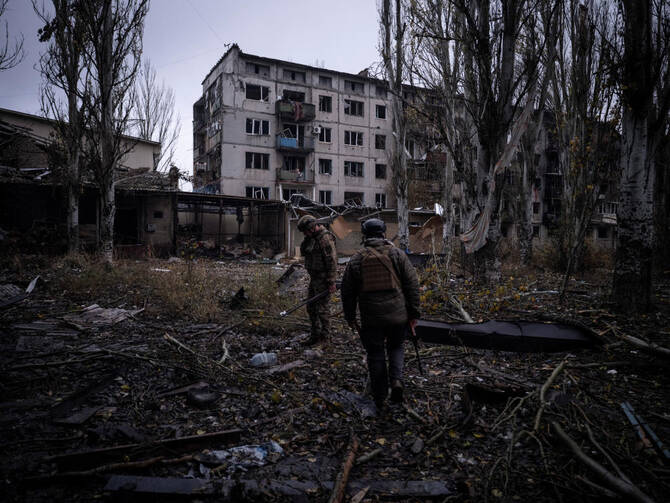
Above, Ukrainian servicemen inspect an area next to apartment buildings damaged by Russian military strikes in the frontline town of Kostiantynivka, Donetsk region on Nov. 12, 2025. (93rd Kholodnyi Yar Separate Mechanized Brigade of the Ukrainian Armed Forces/Reuters)
Short Url
Updated 16 November 2025
Follow

Ukraine seeking exchange of 1,200 prisoners with Russia

  • Ukrainian security chief holds consultations in Turkiye and the UAE, with the support of Kyiv’s partners, on resuming the process of exchanges

Ukraine is working to resume the exchange of prisoners with Russia, hoping for the release of 1,200 Ukrainians, President Volodymyr Zelensky and his Security Council chief said.
“We are … counting on the resumption of exchanges,” Zelensky said in a video posted on the Telegram messaging app on Sunday. “Many meetings, negotiations and calls are now devoted to this.”
His security chief, Rustem Umerov, said on Saturday that he had held consultations in Turkiye and the UAE, with the support of Kyiv’s partners, on resuming the process of exchanges.
“As a result of these negotiations, the parties agreed to return to the Istanbul agreements,” he said. “This concerns the release of 1,200 Ukrainians,” Umerov said in a statement on Telegram.
There was no immediate comment from Moscow to Ukraine’s statements.
The Istanbul agreements are prisoner-exchange understandings brokered with Turkish mediation in 2022, setting out rules for large, coordinated swaps between Russia and Ukraine.
Since then, the two have traded thousands of prisoners, though exchanges have been sporadic and often disrupted by frontline escalation in the war Russia launched against Ukraine in February 2022.
Umerov said that consultations would take place in the near future to decide the procedural and organizational details of the process.
“We are working without pause so that Ukrainians who are to return from captivity can celebrate New Year and Christmas at home – at the family table and with their loved ones,” Umerov said.


Australia hits Afghan Taliban officials with sanctions, travel bans

Updated 6 sec ago
Follow

Australia hits Afghan Taliban officials with sanctions, travel bans

  • The Taliban has said it respects women’s rights, in line with its interpretation of Islamic law and local custom
  • The measures were part of a new Australian government framework that enabled it to “directly impose its own sanctions and travel bans to increase pressure on the Taliban, targeting the oppression of the Afghan people,” Wong said

SYDNEY: Australia on Saturday imposed financial sanctions and travel bans on four officials in Afghanistan’s Taliban government over what it said was a deteriorating human rights situation in the country, especially for women and girls.
Australia’s Foreign Minister Penny Wong said the officials were involved “in the oppression of women and girls and in undermining good governance or the rule of law” in the Taliban-run country.
Australia was one of several nations which in August 2021 pulled troops out of Afghanistan, after being part of a NATO-led international force that trained Afghan security forces and fought the Taliban for two decades after Western-backed forces ousted the Islamist militants from power.
The Taliban, since regaining power in Afghanistan, has been criticized for deeply restricting the rights and freedoms of women and girls through bans on education and work.
The Taliban has said it respects women’s rights, in line with its interpretation of Islamic law and local custom.
Wong said in a statement the sanctions targeted three Taliban ministers and the group’s chief justice, accusing them of restricting access for girls and women “to education, employment, freedom of movement and the ability to participate in public life.”
The measures were part of a new Australian government framework that enabled it to “directly impose its own sanctions and travel bans to increase pressure on the Taliban, targeting the oppression of the Afghan people,” Wong said.
Australia took in thousands of evacuees, mostly women and children, from Afghanistan after the Taliban retook power in the war-shattered South Asian country, where much of the population now relies on humanitarian aid to survive.