Pakistan keeps petrol price unchanged, hikes diesel by Rs6 per liter

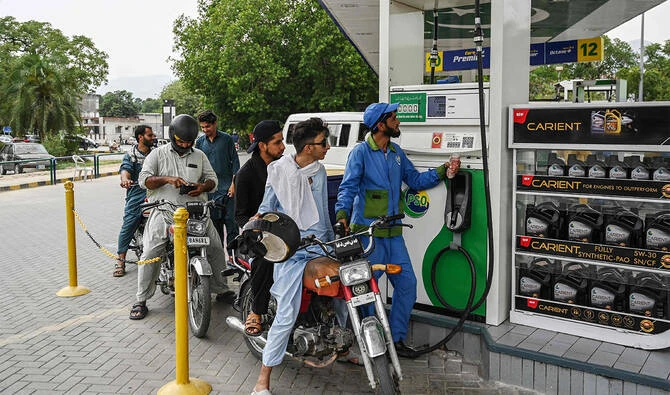
An employee fills the tank of a motorbike at a fuel station in Islamabad, Pakistan, on June 16, 2025. (AFP/File)
Short Url
Updated 16 November 2025
Follow

Pakistan keeps petrol price unchanged, hikes diesel by Rs6 per liter

  • Price of petrol remains unchanged at Rs265.45 per liter, diesel increased to Rs284.44 per liter
  • Pakistan’s government announces new prices of petroleum products after every two weeks

KARACHI: Pakistan’s government announced on Sunday that it has kept the price of petrol unchanged and hiked that of diesel by Rs6 per liter for the next fortnight, a notification from the Finance Division said.

As per the latest notification, the new price of high speed diesel has been fixed at Rs284.44 per liter from Rs278.44 per liter.

Meanwhile, the price of petrol remains the same at Rs265.45 per liter, the notification said. The government also did not announce any change in the prices of kerosene oil or motor spirit as well.

“The government has revised the prices of the petroleum products following input from the Oil & Gas Regulatory Authority (OGRA) and the relevant ministries,” the finance division said in its notification late Sunday night.

The government announces new prices of petroleum products every two weeks in Pakistan. These prices are influenced by global oil market trends, currency fluctuations and changes in domestic taxation.

The mechanism ensures that the net impact of changes in import costs is passed on to consumers, helping sustain the country’s fuel supply chain.

Petrol is mostly used for private transport, small vehicles, rickshaws and two-wheelers, while diesel powers heavy vehicles used for transportation of good across the South Asian country.

Any increases have a direct impact on inflation, raising production and transportation costs and driving up the prices of essential goods and services, particularly food. The effect is further amplified by Pakistan’s reliance on imported fuel.
Pakistan sees retail payments surge to $592 billion in first quarter of FY26— report

Updated 6 sec ago
Follow

Pakistan sees retail payments surge to $592 billion in first quarter of FY26— report

  • Retail payment volumes rose to 2.8 billion transactions during the quarter, marking 10% increase
  • Expansion primarily driven by continued rise in mobile app-based banking, says Pakistan’s central bank

KARACHI: Pakistan saw retail payments surge to Rs166 trillion [$592 billion] during the first quarter of the current fiscal year, a report by the central bank said on Tuesday, registering an increase of six percent compared to the last quarter. 

In its quarterly report on payment systems, the State Bank of Pakistan (SBP) said retail payment volumes rose to 2.8 billion transactions to mark a 10% quarterly growth. It said the value of the payments surged to $592 billion during the same period. 

“This expansion was primarily driven by the continued rise in mobile app-based banking,” the SBP report said. 

The report further said digital payment channels accounted for 2.5 billion transactions, representing 90% of total retail payments compared to 87% in the same quarter last year. 

The central bank said mobile app-based payments dominated the digital landscape, with 2 billion transactions carried out through apps offered by banks, branchless banking (BB) providers and EMIs [electronic money institutions]. 

“These transactions constituted 81% of all digital payments and amounted to PKR 33.7 trillion [$120.3 billion] in value,” the SBP report said.

Internet banking also saw a “steady expansion,” with the report stating that an increasing number of users conducted transactions through digital channels. Payment cards in circulation increased to 61.3 million, the SBP said, of which 90% are debit cards and four percent are credit cards.

The report also said that a network of 20,527 ATMs facilitated 267 million transactions across the country during the quarter that amounted to Rs4.5 trillion [$16.1 billion]. 

“These developments collectively reflect continued progress toward a more inclusive, efficient, and digitally enabled payments ecosystem in Pakistan,” the SBP said.