Saudi Arabia’s cultural sector enters new era of growth

The inaugural Cultural Investment Conference opens in Riyadh. (AN file photo)
Short Url
Updated 15 November 2025
Follow

Saudi Arabia’s cultural sector enters new era of growth

  • Surge in the sector is highlighted by public and private investments which have exceeded SR81 billion

RIYADH: Saudi Arabia’s cultural economy is entering a new phase of expansion, continuing to not only develop but also thrive as a key part of the Kingdom’s broader transformation under Vision 2030.

This was emphasized by the Cultural Investment Conference, held under the patronage of Crown Prince Mohammed bin Salman.

In an op-ed published by Asharq Al-Awsat, Saudi Minister of Culture Prince Badr bin Abdullah bin Farhan highlighted the conference as reflective of the Kingdom’s momentum. He referenced the 89 agreements worth SR5 billion (around $1.33 billion) signed at the conference as indicative of its success, as well as the Kingdom’s achievements in developing and diversifying its cultural economy.

Prince Badr described how the sector has evolved over the last several years: “Before 2018, the cultural sector contributed no more than SR30 billion to the national economy”.

Since the launch of Vision 2030, the creation of 11 specialized cultural commissions, the sector has expanded tremendously. In 2023, culture contributed about SR60 billion to the Kingdom’s economy.

The powerful surge in the sector is highlighted by public and private investments which have exceeded SR81 billion dedicated to museums, venues and large-scale events, making the investment in cultural infrastructure in the Kingdom the largest in Saudi history.

Basil Al-Ghalayini, chairman and CEO of BMG Financial Group, spoke to Arab News about the evolving investment landscape within the Kingdom’s cultural sector and the elements driving the growth. 
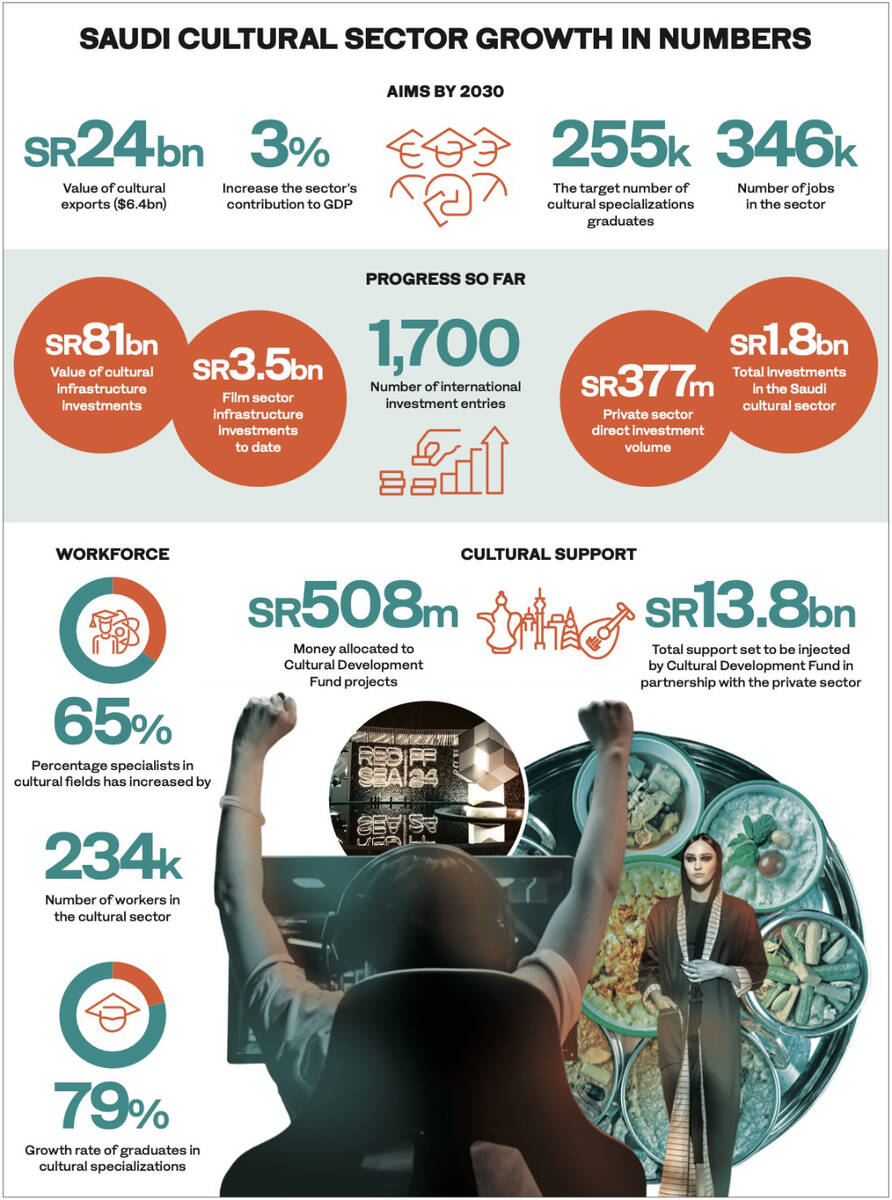
On the SR81 billion investment, he said: “It says that investing in culturally related projects is one of the pillars of the vision, with at least 3 percent contribution to the GDP.”

He added investor confidence would play a vital role in sustaining this progress, describing it as “a key success factor for any investment, especially with about SR60 billion in contribution to GDP during 2023.”

On a global scale, annual cultural investment is valued at around $2.3 trillion, accounting for 3.1 percent of global economic output. As a result, the Kingdom’s development of its ongoing cultural sector is becoming a core part of economic diversification.

The goal under Vision 2030 targets an increase in graduates in cultural disciplines to 255,000 and the creation of over 346,000 jobs.

Discussing the current investment climate, Al-Ghalayini pointed to the strong performance of small and medium-sized enterprises, saying the workforce has reached around 234,000 and the number of companies operating in cultural activities exceeded 51,000 in 2023, an increase of more than 23.6 percent since 2021.

The number of graduates in cultural fields has risen by more than 79 percent in the past year, with sector’s job market increasing by 65 percent.

Such figures, alongside roughly 1,700 foreign investors, reflect how quickly the sector is becoming a contributor to employment and private-sector growth. Between 2021 and 2024, for example, more than 23.5 million people attended cultural events, already surpassing Vision 2030’s target of 22 million attendees.

Prince Badr’s op-ed also referenced the Cultural Development Fund’s commitment to empowering entrepreneurs: “The Fund has also empowered 1,517 entrepreneurs (both men and women) in all fields through its development programs. It aims to bridge 45 percent of the existing financing gap, inject SR13.8 billion into the sector in financial support in partnership with the private sector, and create 30,000 jobs.”

The op-ed also emphasized the variety of areas funded by cultural investment funds, such as the fashion, film and culinary industries, which are expected to increase in value by between SR31.9 billion and SR34.8 billion by 2030.

Al-Ghalayini said the film industry would likely offer the most attractive returns for investors; the film and cinema sector has attracted more than SR3.5 billion riyals so far, currently generating around SR900 million in ticket revenue annually. The Red Sea International Film Festival stands as an example.

Prince Badr also highlighted an asset he claimed was “the greatest and most valuable of cultural investment” — Saudi artists. He praised their ability to create cultural communication with global audiences in creative and innovative ways and backed the transformation on an international scale.

The op-ed underlined the Kingdom’s commitment to supporting Saudi artists’ careers through cultural and artistic academies, teasing the Riyadh University of the Arts as an upcoming initiative.

As the Kingdom continues to support artists through its dedication to cultural economic expansion, a variety of other sectors thrive. From fashion and film to growing job and investment opportunities, Saudi Arabia has cemented its identity as an influential and transformative asset.

Regional Voluntary Carbon Market Co. reaches new partnerships in Asia

Updated 04 December 2025
Follow

Regional Voluntary Carbon Market Co. reaches new partnerships in Asia

RIYADH: Saudi Arabia’s Regional Voluntary Carbon Market Co. has announced the signing of a memorandum of understanding with Marubeni Saudi Investment Co. to cooperate in the field of carbon credit trading. 

The company, founded by the Public Investment Fund and the Saudi Tadawul Group, said that the move represents a significant expansion of its global presence and strengthens its relationships in Asian markets, according to the Saudi Press Agency.

It has also signed a partnership with Singapore-based Climate Bridge International to serve as a consulting partner. The two parties will collaborate to enhance and expand carbon projects in the Kingdom and Global South countries. 

Climate Bridge International specializes in designing and implementing strategies aligned with climate efforts, including carbon project development, sustainability innovation, policy development support, and fostering multilateral cooperation.

The partnerships with both Marubeni and Climate Bridge International reinforce RVCMC’s role as a leading global platform characterized by high transparency and integrity, connecting carbon credit buyers and suppliers across regions while expanding access to reliable, high-quality climate solutions.

These partnerships reflect growing international confidence in the Kingdom’s efforts to build an institutional-standard carbon market, increasing interest from Asian companies in the Saudi economy, and enhanced cooperation in the fields of sustainability, green investment, and climate action.

The agreements were signed on the sidelines of the Priority Summit of the Future Investment Initiative in Tokyo, in the presence of the Ambassador of the Custodian of the Two Holy Mosques to Japan, Ghazi bin Faisal bin Zagr, and the Chairperson of the Board of Directors of RVCMC, Rania Nashar, underscoring the strategic importance of these partnerships.

Fadi Saadeh, acting CEO and head of technology at RVCMC, explained that this partnership with Marubeni enhances the company’s presence in Asian markets, supports the platform’s evolution toward a globally interconnected market, and contributes to diversifying the membership base and strengthening its international standing. 

It represents a new chapter in cooperation with leading Asian economies and reflects the confidence global partners place in the Kingdom’s efforts to build a transparent, world-class carbon market that creates real and tangible impact across various regions. 

He welcomed Climate Bridge International as a consulting partner, enabling entities in the Kingdom and the region to benefit from the expertise of this leading Singaporean company.

For his part, Naoki Tamaki, chairman of the Board of Directors of Marubeni Saudi Investment Co., affirmed that the MoU with RVCMC aligns with Saudi Vision 2030, combining RVCMC’s expertise in developing a high-integrity carbon market with Marubeni’s global experience in trading carbon credits and renewable energy.

He noted that through this MoU, the aim is to contribute to the Kingdom’s transition toward a low-carbon economy and support the establishment of a transparent and reliable carbon market ecosystem, promoting sustainable economic growth in Saudi Arabia and the Middle East region.

Alvin Lim, CEO of Climate Bridge International, stated that cooperation with RVCMC is based on uniting the strengths of both parties. The company contributes its expertise in market building and project development. 

This integration enables the formation of a new generation of technically efficient, investment-ready carbon projects inside and outside the Kingdom that align with the highest integrity standards.

RVCMC launched the first voluntary carbon credit trading platform in the Kingdom of Saudi Arabia on Nov. 12, 2024. The platform was designed to meet market requirements for transparency, scalability, and increased liquidity by providing institutional infrastructure. 

This facilitates transparent and secure transactions and provides access to price and data information for carbon credit projects, a fundamental factor for global market growth and providing a price indicator for projects in the Middle East and North Africa region.

Additionally, the platform is open to markets, integrates with leading global registries, and has the potential to develop specialized infrastructure for trading carbon credits to enable Islamic finance. It offers a market for auctions, requests for quotes, reported trading functions, alongside other services to be launched in the future.

The voluntary carbon offset market is expected to grow in terms of traded capital volume, rising from $2 billion in 2020 to approximately $250 billion by 2050.

To enhance the growth of the voluntary carbon market in the Kingdom and the region, RVCMC’s trading platform is designed to provide institutional infrastructure for both sellers and buyers, adding further speed and security to transactions..