

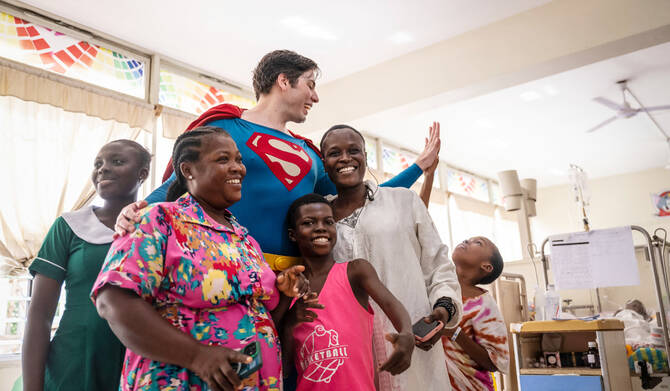

ACCRA: The three-story Child Health Department of the Korle Bu Teaching Hospital in Ghana’s capital, Accra, is a place with hushed corridors, labored breathing, and parents clutching on to hope.
But on Friday, the gloom gave way to shrieks of joy as children with drips taped to their arms sat upright for the first time in days.
Others, too weak to stand, managed faint but determined smiles. Nurses paused mid-rounds, phones raised in the cancer ward. Even exhausted mothers lit up.
The reason was nearly 2.03-meter tall, dressed in the iconic blue-and-red Superman suit and cape.
In real life, Leonardo Muylaert is a lawyer specializing in civil rights who needs reading glasses to work.
BACKGROUND
Leonardo Muylaert visits hospitals, schools, and charities, poses for pictures with commuters on random street corners, and generally tries to be what he calls a symbol of kindness and hope — all free of charge.
Muylaert — known worldwide as the “Brazilian Superman” — was rounding up his one-week maiden visit to Ghana, his first trip to Africa, and the cancer ward erupted into life.
Everywhere he walked, children reached for his hands. Parents scrambled for selfies. Medical staff crowded the hallways.
“He moved from bed to bed, giving each child attention,” a nurse whispered. “For some of them, this is the first time we’ve seen them smile in weeks.”
For 35-year-old Regina Awuku, whose five-year-old son is battling leukaemia, the moment was miraculous.
“My son was so happy to see Superman. This means a lot to us,” she said.
“You saw my son lying quietly on the bed, but he had the energy to wake up as soon as he saw him.”
“I chose Ghana to visit for my birthday,” Muylaert, who studied in the US on a basketball scholarship, said.
“I feel I identify with the culture, with the heritage, with the happiness.”
His sudden fame began in 2022 at the Comic-Con convention in Sao Paulo when a stranger surreptitiously shot a cell phone video of him, amazed at his resemblance to Superman film star Christopher Reeve.
“Am I seeing Clark Kent?” asked the star-struck comic book fan, in a clip that soon racked up thousands of views on TikTok — unbeknownst to Muylaert, who did not even have a social media account at the time.
Weeks later, Muylaert learned through friends that he had become an online sensation.
“It was funny and crazy to read that so many people think I look like Superman,” he told AFP then.
That’s when an idea took root in the back of his mind, he said to get a Superman suit and try the alter ego on for size. He ordered an old-fashioned costume online and started traveling around Brazil as Superman.
Muylaert visits hospitals, schools, and charities, poses for pictures with commuters on random street corners, and generally tries to be what he calls a symbol of kindness and hope — all free of charge.
He now visits vulnerable people worldwide.
In Accra, after leaving the hospital, he went to a prosthetics workshop on the city’s outskirts, where amputee children screamed “Superman! Superman!” as he joined their football match.
For Akua Sarpong, founder of Lifeline for Childhood Cancer Ghana, the impact was immediate.
“It has been a fun-filled day,” she said.
“I have seen so many children smiling and happy, even children undergoing treatment sitting up that I haven’t seen in a long time. He has brought such positive change.”
Muylaert said the visit reinforced his belief in the power of small acts of kindness.
“Everybody can be a hero ... you don’t need a cape,” he said.
“The smile on their faces changes the world.”
As he prepared to fly back to Brazil, he said “the idea is to spread happiness all over.”
“Maybe we won’t change the whole world, but as long as we inspire one person, that person inspires the other.”


