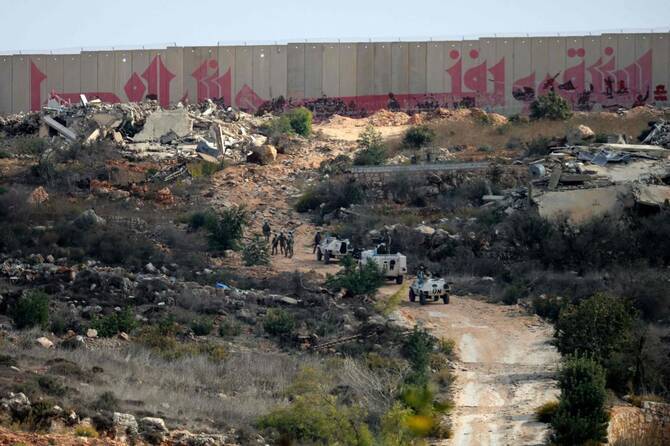
BEIRUT: Lebanon will file a complaint to the United Nations Security Council alleging that Israel is building walls in south Lebanon, an accusation Israel has denied, the Lebanese presidency said Saturday.
The United Nations Interim Force in Lebanon (UNIFIL) said on Friday that the Israeli army had built walls in south Lebanon near the UN-demarcated Blue Line, the de facto border.
When asked by AFP about the accusation, the Israeli military said “the wall does not cross the Blue Line.”
President Joseph Aoun’s office said he had instructed officials “to file an urgent complaint to the United Nations Security Council against Israel for constructing a concrete wall on Lebanon’s southern border exceeding the Blue Line.”
He requested that the complaint “be accompanied by reports issued by the United Nations refuting the Israeli denial of the wall’s construction.”
According to UNIFIL, last month peacekeepers surveyed a concrete T-wall erected by the Israeli army southwest of Yaroun and found that it “crossed the Blue Line, rendering more than 4,000 square meters of Lebanese territory inaccessible to the Lebanese people.”
A survey this month of additional construction showed “a section of wall southeast of Yaroun also crossed the Blue Line,” the UNIFIL statement added, calling it a violation of Lebanon’s sovereignty.
The force said it had informed the Israeli army of the October findings and requested it move the wall.
A ceasefire in November last year sought to end more than a year of hostilities including two months of all-out war between Israel and Lebanese militant group Hezbollah.
The Israeli military said the wall was part of a broader Israeli military plan “whose construction began in 2022.”
“Since the start of the war, and as part of lessons learnt from it, the (Israeli military) has been advancing a series of measures, including reinforcing the physical barrier along the northern border,” it added.
Under the truce, Israel was to withdraw its forces from south Lebanon, but it has kept them at five areas it deems strategic.
It has also kept up regular strikes on Lebanon, mainly saying it is targeting Hezbollah sites and operatives.


Lebanon to complain to UN over wall construction denied by Israel
https://arab.news/cjwff
Lebanon to complain to UN over wall construction denied by Israel

- Aoun’s office said he had instructed officials “to file an urgent complaint to the UN Security Council against Israel”
- He requested that the complaint “be accompanied by reports issued by the United Nations refuting the Israeli denial of the wall’s construction“


Iraq welcomes the appointment of Iran’s new supreme leader
- Armed faction Kataeb Hezbollah said it reflects a profound understanding “of the existential challenges confronting the nation”
BAGHDAD: Iraq’s Prime Minister Mohammed Shia Al-Sudani welcomed on Monday the appointment of Mojtaba Khamenei as Iran’s new supreme leader after his predecessor and father was killed in US and Israeli strikes.
“We express our confidence in the ability of the new leadership in the Islamic Republic of Iran to manage this critical stage,” and to further strengthen “the unity of the Iranian people” amid the current challenges, Sudani said in a statement.
He stressed that Iraq stands in solidarity with Iran and supports “all steps aimed at ending the conflict.”
Iran wields significant influence in Iraqi politics, and also backs armed groups whose power has grown both politically and financially.
Iraq has for decades been a proxy battleground between the US and Iran.
Pro-Tehran Iraqi groups were among the first to welcome the new supreme leader.
The powerful Badr organization said the new leadership represents a “blessed continuity of the path of the Islamic revolution.”
The Asaib Ahl Al-Haq faction said choosing Mojtaba Khamenei shows continuity and “reinforcement of the Islamic republic’s role as a central pillar in the axis of resistance.”
Armed faction Kataeb Hezbollah said it reflects a profound understanding “of the existential challenges confronting the nation.”
“The best successor to the best predecessor,” said Kataeb Hezbollah, which is part of the Islamic Resistance of Iraq — a pro-Iran alliance that has been claiming attacks on US bases since the start of the war in the Middle East.
Senior Iraqi politician and moderate cleric Ammar Al-Hakim wished the new supreme leader “success in following the path of his martyred father... in upholding the word of truth.”


