WEST PALM BEACH: US President Donald Trump said Friday he has “sort of” made up his mind about Venezuela, as his escalating military deployment in Latin America has ignited concerns about a wider regional conflict.
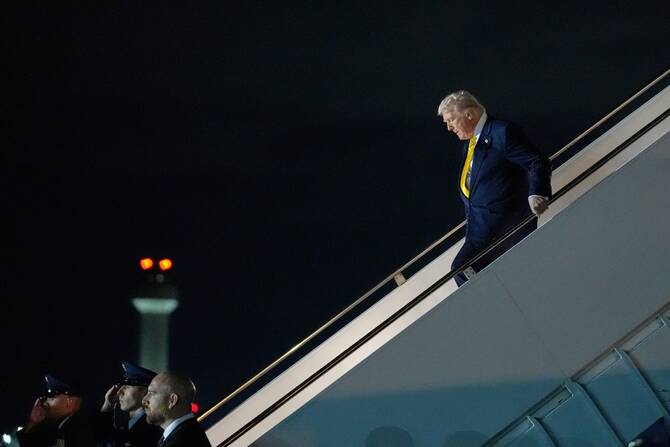
“I sort of made up my mind,” Trump told reporters on Air Force One as he traveled to his estate in Florida.
“I can’t tell you what it is, but we made a lot of progress with Venezuela in terms of stopping drugs from pouring in,” Trump added.
In recent weeks, Washington has deployed warships, fighter jets and thousands of soldiers to Latin America and launched strikes on 21 alleged drug-smuggling boats, killing at least 80 people.
The USS Gerald R. Ford, the world’s largest aircraft carrier, arrived in Latin America on Tuesday with the stated goal of helping to counter drug trafficking in the region.
But Caracas fears the US military deployment, which also includes F-35 stealth warplanes sent to Puerto Rico and US Navy ships in the Caribbean, is a regime change plot in disguise.
CBS News on Wednesday cited multiple sources as saying senior military officials had presented Trump with updated options for potential operations in Venezuela, including strikes on land.
On November 2, Trump downplayed the prospect of going to war with Venezuela but said the days of Nicolas Maduro — whom he accuses of being a drug lord — were numbered.
Colombia’s first leftist president, Gustavo Petro, has also alleged that the ultimate goal of the US deployment is to seize Venezuela’s oil wealth and destabilize Latin America.
Venezuela has announced its own nationwide military deployment to counter the growing US naval presence off its coast.

Trump says he ‘sort of’ decided on what to do with Venezuela
Short Url
https://arab.news/gjudn
Trump says he ‘sort of’ decided on what to do with Venezuela
- In recent weeks, Washington has deployed warships, fighter jets and thousands of soldiers to Latin America and launched strikes on 21 alleged drug-smuggling boats, killing at least 80 people
Japan ruling party approves plans to beef up intelligence
TOKYO: Japanese Prime Minister Sanae Takaichi’s ruling party has approved plans to beef up the country’s intelligence capability, a party official said Friday, as the premier pushes ahead with a defense overhaul.
Newly empowered after a landslide victory in snap elections this month, Takaichi has vowed to make Japan “strong and prosperous” through key policy changes including in defense and intelligence.
The plans come as a months-long diplomatic row between Japan and China over comments Takaichi made on Taiwan rumbles on.
The proposal, agreed by the intelligence strategy headquarters of the Liberal Democratic Party (LDP), includes establishing an upgraded intelligence bureau and strengthening “foreign intelligence collection capabilities,” an LDP official told AFP.
It calls for a mandatory registration system for foreign agents — such as individuals and corporations lobbying within Japan on behalf of other governments — as part of counterintelligence measures.
The plan, which also includes a ban on the use of mobile phones in key government buildings, is expected to be submitted to Takaichi next week, the Asahi Shimbun and other local media reported.
“One of the central pillars of the major policy shift (under Takaichi) is a fundamental strengthening of intelligence,” the LDP’s policy chief Takayuki Kobayashi said at the meeting Thursday where plans were approved.
“Simply creating an organization on paper is utterly meaningless; the question is how we can turn it into a truly living, functioning body,” he said.
Separately, the LDP on Wednesday proposed changes to Japan’s stringent rules on exporting military equipment so as to enable exports of lethal weapons, local reports said.
The LDP official could not immediately confirm the proposal.
Takaichi has also said that she plans to revise three key national security policy documents this year to reflect the changing security environment.
The premier, seen as a China hawk before becoming premier in October, suggested in November that Japan could intervene militarily if Beijing sought to take Taiwan by force.
China, which regards the democratic island as part of its territory and has not ruled out force to annex it, was furious.
It summoned Tokyo’s ambassador, warned Chinese citizens against visiting Japan and in December J-15 jets from China’s Liaoning aircraft carrier twice locked radar on Japanese aircraft in international waters near Okinawa, according to Japan.
Takaichi has vowed that Japan will steadfastly protect its territory, territorial waters and airspace.
Beijing’s top diplomat Wang Yi told the Munich Security Conference earlier this month that forces in Japan were seeking to “revive militarism.”
While she has said in parliament she will not change the rules, local media have reported that Takaichi is considering allowing US nuclear weapons into Japanese territory, a revision to the country’s non-nuclear principles of not producing, possessing or permitting the introduction of the weapons into the country.
Newly empowered after a landslide victory in snap elections this month, Takaichi has vowed to make Japan “strong and prosperous” through key policy changes including in defense and intelligence.
The plans come as a months-long diplomatic row between Japan and China over comments Takaichi made on Taiwan rumbles on.
The proposal, agreed by the intelligence strategy headquarters of the Liberal Democratic Party (LDP), includes establishing an upgraded intelligence bureau and strengthening “foreign intelligence collection capabilities,” an LDP official told AFP.
It calls for a mandatory registration system for foreign agents — such as individuals and corporations lobbying within Japan on behalf of other governments — as part of counterintelligence measures.
The plan, which also includes a ban on the use of mobile phones in key government buildings, is expected to be submitted to Takaichi next week, the Asahi Shimbun and other local media reported.
“One of the central pillars of the major policy shift (under Takaichi) is a fundamental strengthening of intelligence,” the LDP’s policy chief Takayuki Kobayashi said at the meeting Thursday where plans were approved.
“Simply creating an organization on paper is utterly meaningless; the question is how we can turn it into a truly living, functioning body,” he said.
Separately, the LDP on Wednesday proposed changes to Japan’s stringent rules on exporting military equipment so as to enable exports of lethal weapons, local reports said.
The LDP official could not immediately confirm the proposal.
Takaichi has also said that she plans to revise three key national security policy documents this year to reflect the changing security environment.
The premier, seen as a China hawk before becoming premier in October, suggested in November that Japan could intervene militarily if Beijing sought to take Taiwan by force.
China, which regards the democratic island as part of its territory and has not ruled out force to annex it, was furious.
It summoned Tokyo’s ambassador, warned Chinese citizens against visiting Japan and in December J-15 jets from China’s Liaoning aircraft carrier twice locked radar on Japanese aircraft in international waters near Okinawa, according to Japan.
Takaichi has vowed that Japan will steadfastly protect its territory, territorial waters and airspace.
Beijing’s top diplomat Wang Yi told the Munich Security Conference earlier this month that forces in Japan were seeking to “revive militarism.”
While she has said in parliament she will not change the rules, local media have reported that Takaichi is considering allowing US nuclear weapons into Japanese territory, a revision to the country’s non-nuclear principles of not producing, possessing or permitting the introduction of the weapons into the country.
© 2026 SAUDI RESEARCH & PUBLISHING COMPANY, All Rights Reserved And subject to Terms of Use Agreement.


