

Islamabad, US discuss boosting economic ties as American firms eye Pakistan investments

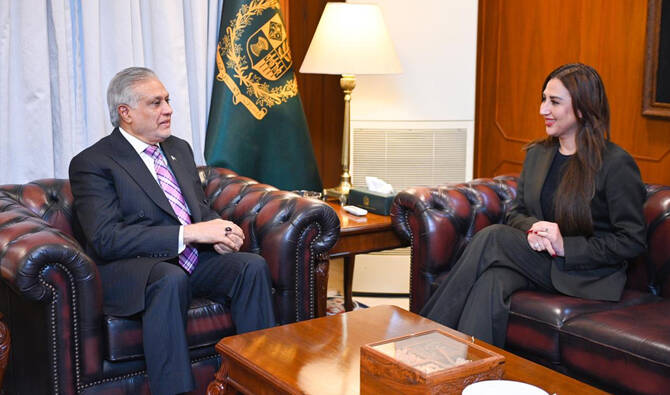
Deputy Prime Minister and Foreign Minister, Ishaq Dar, meets US Chargé d’Affaires Natalie Baker (left), in Islamabad, Pakistan, on November 14, 2025. (MOFA)
Short Url
Updated 15 November 2025
Follow

Islamabad, US discuss boosting economic ties as American firms eye Pakistan investments

  • Both sides this year signed a $500 million deal to create a framework for joint development of the entire mineral value chain
  • This month, Pakistan launched its first Google Chromebook assembly line as result of partnership involving government, Google

ISLAMABAD: Pakistan and the United States (US) on Friday discussed ways to deepen economic and investment cooperation, the Pakistani foreign office said, with Deputy Prime Minister Ishaq Dar welcoming growing interest from American firms.

The statement came after Dar’s meeting with the US Chargé d’Affaires Natalie Baker in Islamabad, a day after another US-based mining, exploration and development company, Nova Minerals, expressed interest in long-term investment in Pakistan’s mining and mineral sectors.

Pakistan has a vast and largely untapped potential in the mineral and mining sector, and the country offers promising investment opportunities across multiple areas, particularly in exploration and processing of high-value minerals.

Earlier this month, Pakistan launched its first Google Chromebook assembly line as a result of a public-private partnership involving the Pakistani government, Google and Tech Valley, along with the National Radio & Tele­com­munications Corpora­tion’s (NRTC) and Allied Corporation.

“Highlighting the importance of enhancing bilateral economic and investment cooperation, particularly in IT & critical minerals, the DPM/FM welcomed growing interest of US companies to invest in Pakistan, including establishment of the Google Chrome assembly line in Haripur,” the Pakistani foreign ministry said.

“Both sides also exchanged views on regional & international developments.”

The development comes more than a month after Pakistan dispatched its first ever shipment of rare earth and critical minerals to the US, a Chicago-based public relations (PR) firm said, following a landmark $500 million deal between the two countries.

The agreement, signed between American firm US Strategic Metals (USSM) and Pakistan’s Frontier Works Organization (FWO), aimed to create a framework for joint development of the entire mineral value chain, including exploration, beneficiation, concentrate production and eventual establishment of refineries in Pakistan.

Pakistan indigenously sourced and prepared antimony, copper concentrate, and rare earth elements with neodymium and praseodymium for shipment, according to US firm PR Newswire. With this first delivery and a multi-phase investment framework underway, Pakistan is now positioned as a rising force in the global critical mineral economy.

“Such initiatives would help create an ecosystem conducive to further foreign investment in Pakistan’s mining sector,” the Pakistani government said earlier, citing Board of Investment (BOI) Minister Qaiser Ahmed Sheikh.


Pakistan offers Kyrgyzstan Arabian Sea access as two states sign 15 cooperation accords

Updated 05 December 2025
Follow

Pakistan offers Kyrgyzstan Arabian Sea access as two states sign 15 cooperation accords

  • Pakistan and Kyrgyzstan sign MOUs spanning trade, energy, agriculture, ports, education, security cooperation
  • Kyrgyz president is on first visit to Pakistan in 20 years as both sides push connectivity and CASA-1000 power links

ISLAMABAD: Pakistan on Thursday offered Kyrgyzstan the shortest and most economical route to the Arabian Sea as the two countries signed 15 agreements and memoranda of understanding aimed at boosting cooperation across trade, energy, agriculture, education, customs data-sharing and port logistics.

The accords were signed during a visit to Islamabad by President Sadyr Zhaparov, the first by a Kyrgyz head of state to Pakistan in two decades, and part of Islamabad’s renewed push to link South Asia with landlocked Central Asian economies through ports, power corridors and transport routes.

For Pakistan, Kyrgyzstan offers access to hydropower through CASA-1000, a $1.2 billion regional electricity transmission project designed to carry surplus summer electricity from Kyrgyzstan and Tajikistan through Afghanistan into Pakistan. For Bishkek, Pakistan provides overland access to warm-water ports on the Arabian Sea, creating a shorter commercial route to global markets.

“President Asif Ali Zardari has reiterated Pakistan’s readiness to offer Kyrgyzstan the shortest and most economical route to the Arabian Sea,” Radio Pakistan reported after Zhaparov met the Pakistani president. 

The two leaders also discussed expanding direct flights to deepen business, tourism and people-to-people ties.

Zardari welcomed Kyrgyzstan’s completion of its segment of the CASA-1000 project and “reaffirmed Pakistan’s commitment to completing its part of the project, which is now at an advanced stage,” the state broadcaster said. 

Zhaparov thanked Islamabad for supporting Bishkek’s candidacy for a non-permanent UN Security Council seat and invited Zardari to visit Kyrgyzstan at a time of his convenience. Both sides expressed satisfaction with progress under the Quadrilateral Traffic in Transit Agreement, designed to facilitate road movement between Pakistan, Kyrgyzstan, Kazakhstan and China.

Earlier, both governments exchanged 15 sectoral cooperation documents covering commerce, mining, geosciences, power, agriculture, youth programs, the exchange of convicted persons, customs electronic data systems and a sister-city linkage between Islamabad and Bishkek.

According to APP, the MOUs were signed by ministers representing foreign affairs, commerce, economy, energy, power, railways, interior, culture, health and tourism. Agreements also covered cooperation between Pakistan’s Foreign Service Academy and the Diplomatic Academy of Kyrgyzstan, as well as collaboration between universities, youth ministries and cultural institutions.

“Our present mutual trade, comprising of about $15–16 million will be enhanced to $200 million in the next two years,” Prime Minister Shehbaz Sharif said after the agreements were signed, calling them “a framework for structured, result-oriented engagement and closer institutional linkages.”

Sharif said Pakistan was ready to serve as a maritime outlet for the landlocked Central Asian republic, offering access to Karachi, Port Qasim and Gwadar to help Kyrgyz goods reach regional and global markets.