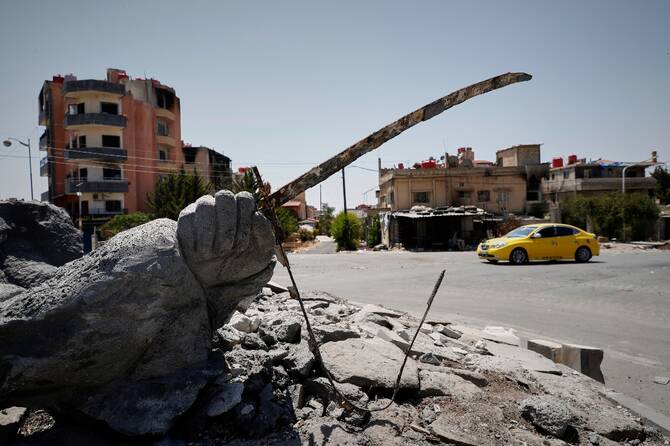
DAMASCUS: A new round of clashes between Druze armed groups and government forces in the province of Sweida in southern Syrian had subsided Friday but left fears of another escalation.
Clashes on Thursday led to both sides blaming each other for violating a ceasefire that ended several days of violent fighting in July. There were reports of people wounded on both sides, but no deaths reported.
The National Guard, the de facto military in Sweida, accused government forces of launching an attack on the town of Al-Majdal Thursday, “employing heavy and medium weapons and attack drones, in an aggressive attempt to breach our defense lines and target vital locations.”
“Our forces bravely and with high combat efficiency repelled this attack, inflicting heavy losses on the attacking forces in terms of equipment and personnel,” it said in a statement.
The government in Damascus accused the Sweida factions of violating the ceasefire first.
Mustafa Al-Bakour, the Damascus-appointed governor of Sweida province, said “some factions and the so-called National Guard” launched “attacks on de-escalation points.” The attacks, he added, “constitute a clear violation of international agreements and obstruct efforts to rebuild and prepare for the return of residents to their villages.”
Saber Abou Ras, a political analyst who lives in Sweida city, said Thursday’s clashes “were very intense and violent” and included attacks with drones, anti-aircraft machine guns and mortar shells. He said Israeli warplanes could be heard over the city of Sweida, but it was not clear if they launched any strikes.
Abou Ras said he believes the government forces had launched “a retaliatory attack” after the police chief of the local governmental body in Sweida, along with a “large group of officers” took over a checkpoint formerly controlled by Syrian government security forces in the northern countryside of the province.
On Thursday, Syrian Foreign Minister Asaad Al-Shibani, speaking at an event held by the Chatham House international affairs think tank during a visit to London said there had been “mistakes made by all sides” in Sweida.
“There are many problems, but we are not dealing with them as if we are the other party,” he said. “We are dealing with this as a Syrian wound, and that there is an internal problem within the same house.”
Sweida was the site of violent clashes in July that began as fighting between Druze groups and local Bedouin tribes after a series of tit-for-tat kidnappings.
The violence escalated after government security forces intervened, ostensibly to break up the fighting but ended up siding with the Bedouins. Hundreds of civilians, mostly Druze, were killed, many by government fighters.
Israel intervened on the side of the Druze, who also represent a significant minority in Israel, launching strikes on government forces and on the defense ministry building in central Damascus. A US-brokered ceasefire led to government forces withdrawing from Sweida.
Since then, Druze groups have set up a de facto military and governmental body in Sweida, similar to the Kurdish-led authorities in the country’s northeast, and have largely refused to deal with the government in Damascus.
Tens of thousands of people remain displaced after the July fighting, including Druze internally displaced within Sweida province and Bedouins who were evacuated from the province to other areas.

Druze groups and Syrian forces exchange ceasefire violation claims as clashes in Sweida resume
https://arab.news/pn9fs
Druze groups and Syrian forces exchange ceasefire violation claims as clashes in Sweida resume
- The National Guard, the de facto military in Sweida, accused government forces of launching an attack on the town of Al-Majdal
- The government in Damascus accused the Sweida factions of violating the ceasefire first
UN nuclear watchdog says it’s unable to verify whether Iran has suspended all uranium enrichment
VIENNA: Iran has not allowed the United Nations nuclear watchdog to access nuclear facilities affected by the 12-day war in June, according to a confidential report by the watchdog circulated to member states and seen Friday by The Associated Press.
The report from the International Atomic Energy Agency stressed that therefore it “cannot verify whether Iran has suspended all enrichment-related activities,” or the “size of Iran’s uranium stockpile at the affected nuclear facilities.”
The IAEA report on Friday warned that due to the continued lack of access to any of Iran’s four declared enrichment facilities, the agency “cannot provide any information on the current size, composition or whereabouts of the stockpile of enriched uranium in Iran.”
The report stressed that the “loss of continuity of knowledge over all previously declared nuclear material at affected facilities in Iran needs to be addressed with the utmost urgency.”
Iran long has insisted its program is peaceful, but the IAEA and Western nations say Tehran had an organized nuclear weapons program up until 2003.
Highly enriched material should be verified regularly
According to the IAEA, Iran maintains a stockpile of 440.9 kilograms (972 pounds) of uranium enriched up to 60 percent purity — a short, technical step away from weapons-grade levels of 90 percent.
That stockpile could allow Iran to build as many as 10 nuclear bombs, should it decide to weaponize its program, IAEA director general Rafael Grossi warned in a recent interview with the AP. He added that it doesn’t mean that Iran has such a weapon.
Such highly enriched nuclear material should normally be verified every month, according to the IAEA’s guidelines.
The IAEA also reported that it had observed, through the analysis of commercially available satellite imagery, “regular vehicular activity around the entrance to the tunnel complex at Isfahan.”
The facility in Isfahan, some 350 kilometers (215 miles) southeast of Tehran, was mainly known for producing the uranium gas that is fed into centrifuges to be spun and purified.
Israel has struck buildings at the Isfahan nuclear site, among them a uranium conversion facility. The US also struck Isfahan with missiles during the war last June.
The IAEA also reported that through the analysis of commercially available satellite imagery, it has observed “activities being conducted at some of the affected nuclear facilities, including the enrichment facilities at Natanz and Fordow,” but it added that “without access to these facilities it is not possible for the Agency to confirm the nature and the purpose of the activities.”
The confidential IAEA report also said Friday that Iran did provide access to IAEA inspectors “to each of the unaffected nuclear facilities at least once since the military attacks of June 2025, with the exception of Karun Nuclear Power Plan, which is in the early stages of construction and does not contain nuclear material.”
IAEA joined Geneva talks between Iran and US
The IAEA reported on Friday that Grossi attended negotiations between the US and Iran on Feb. 17 and Feb. 26 in Geneva at which he “provided advice on issues relevant to the verification of Iran’s nuclear program.” The report said that those negotiations are “ongoing.”
The Trump administration has held three rounds of nuclear talks this year with Iran under Omani mediation. Thursday’s round of talks in Geneva ended without a deal, leaving the danger of another Mideast war on the table as the US has gathered a massive fleet of aircraft and warships in the region.
Oman’s Foreign Minister Badr Al-Busaidi said technical talks involving lower-level representatives would continue next week in Vienna, the home of the IAEA. The agency is likely to be critical in any deal.
The US is seeking a deal to limit Iran’s nuclear program and ensure it does not develop nuclear weapons.
Iran says it is not pursuing weapons and has so far resisted demands that it halt uranium enrichment on its soil or hand over its stockpile of highly enriched uranium.
Similar talks last year between the US and Iran about Iran’s nuclear program broke down after Israel launched what became a 12-day war on Iran, that included the US bombing Iranian nuclear sites.
Before the June war, Iran had been enriching uranium up to 60 percent purity.


