

Spring all year round: Storing seeds to improve vegetation cover in the Kingdom

1 / 4
Growing Common poppy in Hail, Saudi Arabia. (SPA)
2 / 4
Among the flowers that grow in Saudi Arabia are the Common poppy, Poppy anemone, and Lavender. (SPA)
3 / 4
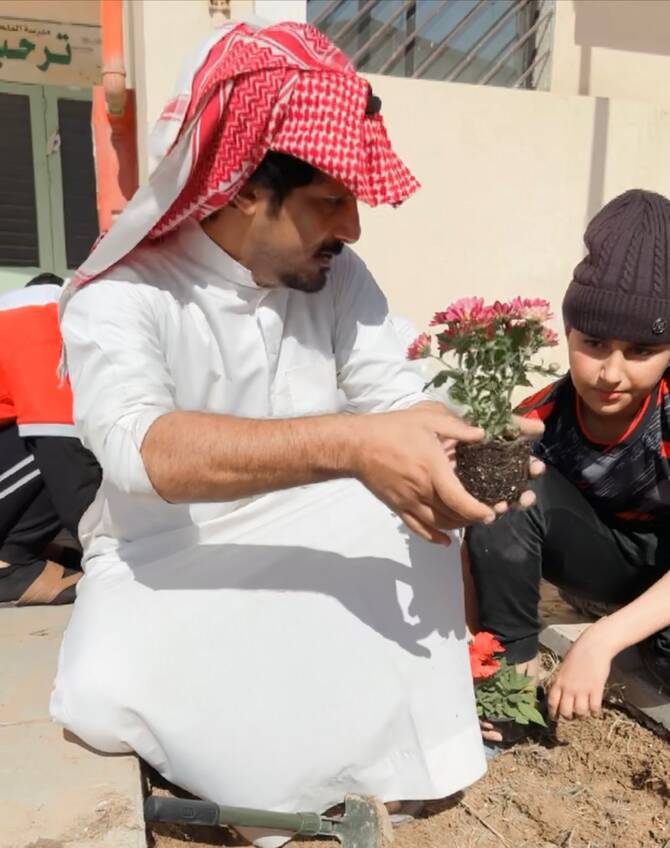
Obaid Alouni participating with volunteers to plant native flowers. (SUPPLIED)
4 / 4
NCVC launched an initiative in the past few weeks to plant one million seedlings from mother seed sources. This initiative has led to a significant qualitative improvement in the production of local seeds, enhancing the efficiency of collection, preservation, and propagation processes. (SUPPLIED)
Short Url
Updated 14 November 2025
Follow

Spring all year round: Storing seeds to improve vegetation cover in the Kingdom

RIYADH: The concept of having 'all year round spring' seems like a dreamy thought and an ambitious goal to achieve in a desert climate such as that in Saudi Arabia. Yet, environmental consultant Oubaid Alouni argues to differ.

Through the preservation of seeds and planting flowers suitable for each season, Alouni believes the vegetation cover will have the opportunity to flourish and paint the Saudi desert all year long.

"There are flowers that bloom in the summer, there are flowers in the spring, and there are flowers in the autumn... This is what we call 'all year round spring' because these flowers help in the cycle of life," Said Alouni.

He provides an example of one of the significant species, the honeybee, which relies on flowers for its survival. Therefore, it is critical to preserve flowers, along with pollinators, to have not only a balanced ecosystem but also economic stability for beekeepers, he said.

In his perspective, "The greater the number of flowers, the stronger the pollinators, indicating flower maturity."

He further explained the concept of 'environmental sustainability,' which he believes extends beyond flowers and pollinators.

Alouni highlighted that ensuring the health of flowers influences the health of other species, referring back to the honeybees and pollinators.

He said that bird species also consider pollinators and other bugs as food; thus, if there is a lack of pollinators, we will have an imbalance in the number of birds.

"If an element is missing, the other elements will be affected... resulting in an imbalance in the ecological pyramid," He commented.

Opinion

This section contains relevant reference points, placed in (Opinion field)

To help restore the environmental conditions in the Kingdom, Alouni discussed the importance of raising awareness about the need to protect and improve the vegetation cover.

In the past, people lacked adequate knowledge and awareness, and there were very few environmental activists advocating for this cause.

"Despite the efforts being made, there was a lack of support. The volunteers were few, and people were surprised by our work. There was no environmental awareness. Unfortunately, our efforts went unheard," Said Alouni.

However, thanks to the continuous changes that have been taking place in the country in recent years, environmental sustainability has been elevated to among the top priorities of overall development in Saudi Arabia.

One of the major centers dedicated to environmental protection is the National Center for Vegetation Cover Development and Combating Desertification (NCVC).

NCVC launched an initiative in the past few weeks to plant one million seedlings from mother seed sources. This initiative has led to a significant qualitative improvement in the production of local seeds, enhancing the efficiency of collection, preservation, and propagation processes.

Seed production has increased from 30 tons last year to more than 80 tons this year, a rise of about 167%. It reflects the direct impact of the initiative in strengthening national seed resources and boosting the Center's production capacity.

This increase enables the rehabilitation of more than 30,000 hectares of natural rangelands annually. The seeds are used after being scattered across degraded rangelands and targeted rehabilitation areas to restore natural vegetation cover and reestablish ecological balance in those locations, thereby contributing to environmental sustainability and combating desertification in Saudi Arabia.

As a result of this commitment, the Kingdom achieved a Guinness World Record for the world's most extensive seasonal seed storage collection. This international achievement showcases Saudi Arabia's leadership in protecting plant biodiversity and preserving the genetic resources of wild plants.

DID YOU KNOW?

• Approximately 60-80% of plants and trees worldwide require pollinators, according to Saudi environmentalist Oubaid Alouni.

• Seed production has increased from 30 to more than 80 tonnes over the past year, a rise of around 167%, which NCVS says enables the rehabilitation of over 30,000 hectares of natural rangelands annually.

• Among the flowers that grow in Saudi Arabia are the common poppy, poppy anemone, and lavender.

In addition, during the conversation with Alouni, he mentioned the invitation he received to participate in a volunteer activity to plant native seeds in the wild, which represents the dedication and care of the officials.

"The efforts have increased. We also aspire for more, and we don't stop at this level." Alouni said.

He concluded: "Some say we should stop here, no, no, no, the environment is thirsty, and our environment is beautiful… It's wonderful."

"People who believed that the Common poppy or Poppy anemone couldn't grow in Najd (the center region) and could only grow in the northern region, are now growing in Najd and are one of its most beautiful and picturesque landscapes."


Saudi Reef has played key role in empowering rural communities, says spokesperson

Updated 55 min 1 sec ago
Follow

Saudi Reef has played key role in empowering rural communities, says spokesperson

  • Program has benefited more than 90,000 rural families, enabled productive projects
  • Majed Al-Buraikan: The eight sectors supported by the Saudi Reef program help diversify agricultural production, support sustainable use of resources and improve supply chains

JEDDAH: The Saudi Reef program has played a key role in strengthening food security and empowering farmers and rural families across the Kingdom since its launch in 2019.

The program forms part of Saudi Arabia’s broader efforts under Vision 2030 to support sustainable agricultural development, diversify the economy, and enhance the contribution of rural communities to national growth.

Majed Al-Buraikan, the official spokesperson for Saudi Reef and its director of corporate communications and media, told Arab News that the program had made a positive impact in rural communities.

He said: “It has empowered small farmers and rural families to develop their agricultural projects and increase productivity.

“This support has helped strengthen food security, improve the use of resources, and support the long-term sustainability of the agricultural sector, in line with Vision 2030 goals to diversify the economy and develop rural areas.”

Through targeted support across eight priority agricultural sectors — including Saudi coffee, value-added development, livestock, rainfed crops, beekeeping and honey production, aromatic plants, fisheries, and fruit — the program focuses on enhancing the sustainability of these sectors to achieve empowerment and stability for rural families.

Al-Buraikan added: “The eight sectors supported by the Saudi Reef program help diversify agricultural production, support sustainable use of resources and improve supply chains.

“This diversity supports economic stability in rural areas, encourages balanced growth, and helps build a flexible rural production system that can expand over time.”

By benefiting more than 90,000 rural families and enabling productive projects rooted in local communities, the program has also opened up new economic opportunities for women and youngsters, supported entrepreneurship, and improved productivity across the rural sector.

Al-Buraikan said: “This shows the wide developmental impact of the Saudi Reef program and its strong geographic and social reach.

“It demonstrates the ability of rural areas to become productive economic spaces.

“This expansion has improved income levels, strengthened social stability in rural areas, and increased the contribution of agriculture to the national economy.”

The program has helped make rural work a competitive economic option by improving agricultural productivity, supporting a wide range of sectors, and enabling beneficiaries to access local and global markets.

The program announced in 2025 that the market value of production across its sectors had exceeded SR5.6 billion ($1.49 billion) since its launch.

Al-Buraikan said: “This reflects the strong economic potential of rural investment and its role in supporting the national economy, food security, and sustainability goals under Vision 2030.”

The Sustainable Reef initiative was launched in September 2025 to highlight the significant impact the program had made in supporting rural communities and enhancing agricultural and economic sustainability across various regions of the Kingdom.

Al-Buraikan said the initiative was a development-focused media extension of the Saudi Reef program.

“It highlights the real impact of government support through inspiring success stories that show how rural projects have become sustainable, productive businesses,” he said.

“What makes it different is that it goes beyond traditional support by building public awareness of the value of rural areas as promising economic and investment contributors.”

Saudi Reef has helped position rural work as a competitive and sustainable economic option, reinforcing its role in driving long-term development across the Kingdom.

The program has also empowered women in rural areas by opening new opportunities in agricultural activities while providing sustainable sources of income.

Al-Buraikan said: “It has also supported young people through an integrated entrepreneurship system that includes incubators, accelerators, and training programs, helping to turn rural ideas into productive projects led by and benefiting rural communities.”

In addition, the program supports Vision 2030 by empowering farmers, increasing local production, and building a sustainable agricultural sector that contributes to food security and economic development.

Demonstration farms serve as practical platforms where farmers can observe modern agricultural practices, learn improved production methods, and adopt modern technologies, thereby increasing efficiency and improving crop quality.

Al-Buraikan said: “The program balances agricultural production with environmental protection by promoting smart agriculture, improving resource use, and linking production to modern technologies. The program ensures agricultural growth while protecting the environment.”