

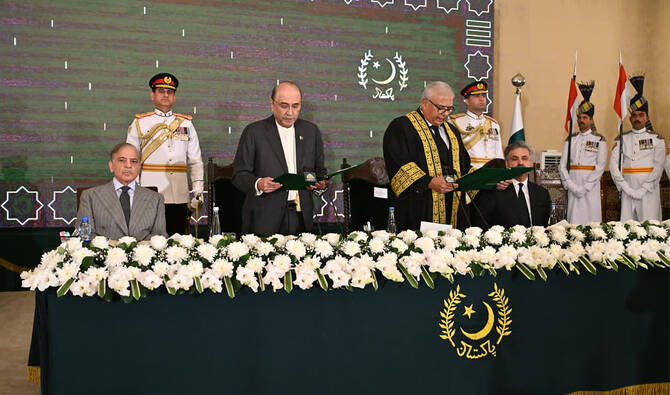

ISLAMABAD: Justice Amin-Ud-Din Khan on Friday took oath as the first chief justice of the Federal Constitutional Court (FCC), following sweeping changes in the country’s military and judicial command structure.
The FCC was formed after the government made changes to the military and judicial command structure via the 27th constitutional amendment. The amendment shifts constitutional cases from the Supreme Court to the FCC while it grants expanded powers to Pakistan’s army chief.
President Asif Ali Zardari administered oath to the FCC Chief Justice Khan at a ceremony in Islamabad, which was attended by Prime Minister Shehbaz Sharif, cabinet members, Supreme Court Chief Justice Yahya Afridi, parliamentarians and top military officials.
“I, Justice Amin-Ud-Din Khan, do solemnly swear that I will bear true faith and allegiance to Pakistan, that as chief justice of the Federal Constitutional Court of Pakistan, I will discharge my duties and perform my functions honestly, to the best of my ability and faithfully in accordance with the Constitution of the Islamic Republic of Pakistan and the law,” Khan said as he took oath as the Constitutional Court chief justice.
“I will not allow my personal interest to influence my official conduct or my official decisions.”
FCC Chief Justice Khan was born on Dec. 1, 1960 in the eastern city of Multan where he received his education from Kindergarten Muslim School. He completed his secondary education from the Government Muslim High School in 1977, according to the Supreme Court’s website.
He secured his bachelor’s degree in Philosophy in 1981 and completed his L.L.B degree from the University Law College in Multan in 1984 and also secured a diploma in Taxation Law. Khan obtained the license to practice in Pakistan’s lower courts in 1985 before enrolling as an advocate of the Lahore High Court in 1987.
He was later enrolled as an advocate of the Supreme Court of Pakistan in 2001. The FCC chief justice was involved there in mostly civil cases relating to property, preemption and matters of inheritance. He was elevated to the bench in 2011 and during his stint as judge, he decided thousands of civil cases in the Bahawalpur and Multan benches of the Lahore High Court.
In 2019, Khan was elevated as a judge of the Supreme Court in 2019.
His appointment to the post of FCC chief justice on Thursday took place hours after two Supreme Court judges, Justice Athar Minallah and Justice Mansoor Ali Shah, resigned in protest against the 27th constitutional amendment, with Justice Shah describing it as a “grave assault” on the constitution.
The FCC was set up after years of clashes between the executive and the judiciary. Verdicts issued by the top court over the years ousted prime ministers from office and put the judiciary on a confrontational path with the governments at the time.


