

Indian police carry out sweeping raids in disputed Kashmir

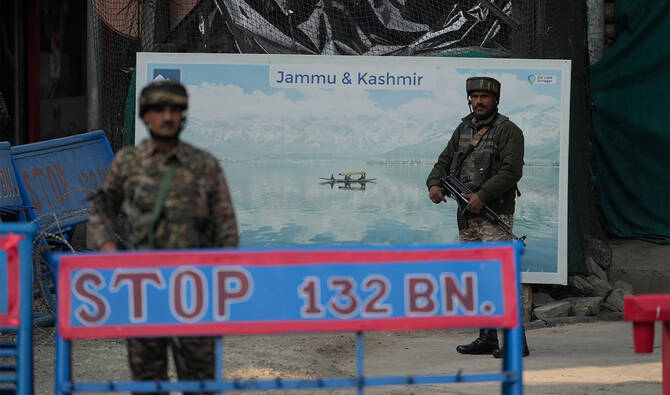
Indian soldiers stand guard in Srinagar, Indian controlled Kashmir, on Nov. 12, 2025. (AP)
Short Url
Updated 14 November 2025
Follow

Indian police carry out sweeping raids in disputed Kashmir

  • There has been no confirmation that the searches this week are connected to Monday’s explosion which killed at least 12 people in New Delhi
  • The blast was the most significant security incident since April 22 attack in Pahalgam which killed 26 people, triggered clashes with Pakistan

New Delhi: Indian police have carried out sweeping raids targeting a banned political party in Indian-administered Kashmir, days after the deadliest blast in the Indian capital for more than a decade.

There has been no confirmation that the searches this week are connected to Monday’s explosion — which killed at least 12 people near the historic Red Fort in the capital’s Old Delhi quarter.

But the raids represent a renewed effort by police to tighten security after the explosion, which the government called “a heinous terror incident” and blamed on “anti-national forces.”

Many of the raids have taken place since Wednesday, according to district police statements from across the Indian-administered part of the Himalayan territory.

Kashmir has been divided between India and Pakistan since their independence from British rule in 1947, and both claim the Himalayan territory in full. Tensions remain high between New Delhi and Islamabad.

Police, including in Kashmir’s Awantipora, Bandipora, Ganderbal, Shopian and Sopore districts, issued statements about the raids, which they said targeted the Jamaat-e-Islami (JeI) party.

Indian Prime Minister Narendra Modi’s Hindu-nationalist government banned the Kashmir branch of Jamaat-e-Islami in 2019 as an “unlawful association.”

'Large-scale operations'

Officers carried out “extensive raids at multiple locations” to “dismantle the terror ecosystem and its support structures,” the police in Awantipora said in a statement.

The department in Bandipora said they had seized “incriminating material,” while the Sopore police said it had carried out “large-scale operations against Jamaat-e-Islami-linked networks,” adding that more than 30 locations were searched.

Officers also raided Al-Falah University in Faridabad, on the southern outskirts of the capital, while security forces on Friday demolished a house in Kashmir’s Pulwama district.

Police have not commented on the demolition, although law enforcement agencies have carried out such destruction against those accused of launching attacks in the past.

India’s anti-terrorism National Investigation Agency is leading the probe into Monday’s blast, and the government has vowed to bring the “perpetrators, their collaborators, and their sponsors” to justice.

But officials, so far, have given little further information on who that might be — and whether it was a homegrown group or had links from abroad.

Indian media have widely connected the November 10 blast with a string of arrests just hours before, when they seized explosive materials and assault rifles.

Police said those arrested were linked with Jaish-e-Mohammed (JeM), an Al-Qaeda linked group, and Ansar Ghazwat-ul-Hind, a Kashmir offshoot linked to JeM.

Concerning those arrests, India’s Jammu and Kashmir police said on Monday — shortly before the explosion — that their investigations had “revealed a white collar terror ecosystem, involving radicalized professionals and students in contact with

foreign handlers, operating from Pakistan and other countries.”

The blast in Delhi was the most significant security incident since April 22, when 26 mainly Hindu civilians were killed at the tourist site of Pahalgam in Indian-administered Kashmir, triggering clashes with Pakistan.


Judge bars federal prosecutors from seeking the death penalty against Luigi Mangione

Updated 3 sec ago
Follow

Judge bars federal prosecutors from seeking the death penalty against Luigi Mangione

  • Judge Margaret Garnett’s Friday ruling foiled the Trump administration’s bid to see Mangione executed
  • Garnett dismissed a federal murder charge against Mangione, finding it technically flawed. She left in place stalking charges that could carry a life sentence
NEW YORK: Federal prosecutors can’t seek the death penalty against Luigi Mangione in the killing of UnitedHealthcare CEO Brian Thompson, a federal judge ruled Friday, foiling the Trump administration’s bid to see him executed for what it called a “premeditated, cold-blooded assassination that shocked America.”
Judge Margaret Garnett dismissed a federal murder charge that had enabled prosecutors to seek capital punishment, finding it technically flawed. She wrote that she did so to “foreclose the death penalty as an available punishment to be considered by the jury” as it weighs whether to convict Mangione.
Garnett also dismissed a gun charge but left in place stalking charges that carry a maximum punishment of life in prison. To seek the death penalty, prosecutors needed to show that Mangione killed Thompson while committing another “crime of violence.” Stalking doesn’t fit that definition, Garnett wrote in her opinion, citing case law and legal precedents.
In a win for prosecutors, Garnett ruled they can use evidence collected from his backpack during his arrest, including a 9mm handgun and a notebook in which authorities say Mangione described his intent to “wack” an insurance executive. Mangione’s lawyers had sought to exclude those items, arguing the search was illegal because police hadn’t yet obtained a warrant.
During a hearing Friday, Garnett gave prosecutors 30 days to update her on whether they’ll appeal her death penalty decision. A spokesperson for the US attorney’s office in Manhattan, which is prosecuting the federal case, declined to comment.
Garnett acknowledged that the decision “may strike the average person — and indeed many lawyers and judges — as tortured and strange, and the result may seem contrary to our intuitions about the criminal law.” But, she said, it reflected her “committed effort to faithfully apply the dictates of the Supreme Court to the charges in this case. The law must be the Court’s only concern.”
Mangione, 27, appeared relaxed as he sat with his lawyers during the scheduled hearing, which took place about an hour after Garnett issued her written ruling. Prosecutors retained their right to appeal but said they were ready to proceed to trial.
Outside court afterward, Mangione attorney Karen Friedman Agnifilo said her client and his defense team were relieved by the “incredible decision.”
Jury selection in the federal case is set for Sept. 8, followed by opening statements and testimony on Oct. 13. The state trial’s date hasn’t been set. On Wednesday, the Manhattan district attorney’s office urged the judge in that case to schedule a July 1 trial date.
“That case is none of my concern,” Garnett said, adding that she would proceed as if the federal case is the only case unless she hears formally from parties involved in the state case. She also said the federal case will be paused if the government appeals her death penalty ruling.
Thompson, 50, was killed on Dec. 4, 2024, as he walked to a midtown Manhattan hotel for UnitedHealth Group’s annual investor conference. Surveillance video showed a masked gunman shooting him from behind. Police say “delay,” “deny” and “depose” were written on the ammunition, mimicking a phrase used by critics to describe how insurers avoid paying claims.
Mangione, an Ivy League graduate from a wealthy Maryland family, was arrested five days later at a McDonald’s in Altoona, Pennsylvania, about 230 miles (about 370 kilometers) west of Manhattan.
Following through on Trump’s campaign promise to vigorously pursue capital punishment, Attorney General Pam Bondi ordered Manhattan federal prosecutors last April to seek the death penalty against Mangione.
It was the first time the Justice Department sought the death penalty in President Donald Trump’s second term. He returned to office a year ago with a vow to resume federal executions after they were halted under his predecessor, President Joe Biden.
Garnett, a Biden appointee and former Manhattan federal prosecutor, ruled after hearing oral arguments earlier this month.
Besides seeking to have the death penalty rejected on the grounds Garnett cited, Mangione’s lawyers argued that Bondi’s announcement flouted long-established Justice Department protocols and was “based on politics, not merit.”
They said her remarks, followed by posts to her Instagram account and a TV appearance, “indelibly prejudiced” the grand jury process resulting in his indictment weeks later.
Prosecutors urged Garnett to keep the death penalty on the table, arguing that the charges were legally sound and Bondi’s remarks weren’t prejudicial, as “pretrial publicity, even when intense, is not itself a constitutional defect.”
Prosecutors argued that careful questioning of prospective jurors would alleviate the defense’s concerns about their knowledge of the case and ensure Mangione’s rights are respected at trial.
“What the defendant recasts as a constitutional crisis is merely a repackaging of arguments” rejected in previous cases, prosecutors said. “None warrants dismissal of the indictment or categorical preclusion of a congressionally authorized punishment.”