

Pakistan’s cabinet approves Gwadar-Oman ferry service to boost trade, tourism

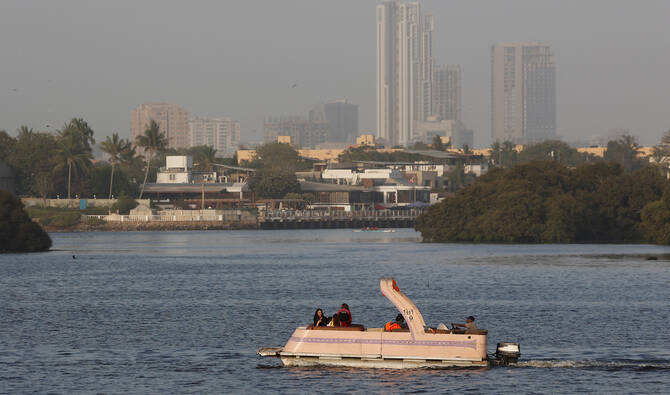
Locals ride on a boat during a hot summer day in Karachi, Pakistan on May 29, 2024. (REUTERS/File)
Short Url
Updated 14 November 2025
Follow

Pakistan’s cabinet approves Gwadar-Oman ferry service to boost trade, tourism

  • In Aug., Pakistan granted its first-ever ferry service license to an international operator, Sea Keepers, for routes connecting with Gulf countries
  • Maritime Affairs Minister Junaid Anwar Chaudhry says an Omani delegation will visit Pakistan to finalize arrangements regarding the ferry service

KARACHI: Pakistan’s federal cabinet has approved a ferry service to Oman from the southwestern Pakistani port of Gwadar, the country’s maritime affairs minister said on Friday, saying the move is aimed at boosting trade and tourism.

The development comes months after Pakistan granted its first-ever ferry service license to an international operator, Sea Keepers, for routes connecting Pakistan with Gulf Cooperation Council (GCC) countries Iran.

Officials had hailed the move as a “historic step,” aligned with Pakistan’s National Maritime Policy, and emphasized the opportunity this license creates for boosting regional connectivity, tourism and economic activity via sea.

Pakistan’s Maritime Affairs Minister Junaid Anwar Chaudhry said Islamabad and Oman will sign a memorandum of understanding (MoU) regarding the ferry link and the service will begin soon.

“An Omani delegation will visit Pakistan to finalize arrangements,” he said in a statement shared by his ministry. “New ferry route is expected to increase trade volume and investment. Travel will be easier for Pakistani expatriates.”

Besides trade, the ferry service will promote tourism and cultural ties, according to the maritime affairs minister. It will also reduce travel costs as compared to air transport.

“New maritime corridors will make Gwadar a new hub of economic activities,” he said. “Regional countries will get access to Central Asian markets [through the ferry link].”

Pakistan is currently making efforts to capitalize on its geostrategic location to boost trade and investment alongside tourism as it slowly recovers from a macroeconomic crisis under a $7 billion International Monetary Fund (IMF) program.

The South Asian country also plans to cut container dwell time at its seaports by up to 70 percent to improve trade competitiveness and ease congestion. Pakistan and Sri Lanka are also considering linking their coastal destinations in a bid to boost marine tourism.


Pakistan plans $3,500 locally made electric car to lure motorcycle users

Updated 5 sec ago
Follow

Pakistan plans $3,500 locally made electric car to lure motorcycle users

  • Government-backed program aims to speed shift to electric transport
  • Lithium battery plants and possible tax cuts seen lowering EV costs

ISLAMABAD: Pakistan is set to launch a locally manufactured low-cost electric vehicle (EV) priced at Rs1 million ($3,556), aimed at helping motorcycle users transition more easily to cars, an official from the Engineering Development Board (EDB) told Arab News on Monday.

The country has seen a gradual rise in the adoption of EVs in a market traditionally dominated by Japanese automakers. The development comes as major cities across Pakistan face some of the world’s highest levels of air pollution, leading to dense smog in winter, with road transport being a major contributor.

In June last year, Pakistan introduced its Electric Vehicle Policy 2025–30, announcing more than Rs100 billion ($353 million) in subsidies over five years to support electric bikes and rickshaws and accelerate the shift toward cleaner transport.

“The car will be fully made in Pakistan and a local company is working on it,” Zeeshan Ashraf, a spokesman for the Engineering Development Board, a government body, told Arab News. “Its full price will be Rs1 million while the government is planning to give extra subsidy on this.”

Chinese and Korean electric vehicle brands have increasingly entered Pakistan’s market in recent years, making EVs a more common sight in cities such as Islamabad, Lahore and Karachi.

Ashraf said the vehicle will be launched under the Pakistan Accelerated Vehicle Electrification (PAVE) Program, a public-sector initiative designed to promote an eco-friendly and economical transportation system in the country.

The locally manufactured low-cost EV is expected to become available across the country within the next few months, he added.

Earlier, Engineering Development Board Chief Executive Hammad Mansoor was quoted by local media as saying that Pakistan could see its first fully electric, locally manufactured car enter the market by June 2026, with an estimated price of around Rs1 million.

Speaking to journalists during an iftar dinner in Karachi this month, Mansoor also signaled that the government may lower vehicle taxes in the upcoming federal budget to make hybrid, electric and conventional fuel vehicles more affordable.

He said Pakistan’s first lithium battery manufacturing facility is expected to begin production by May, while a second plant could start operations in September.

According to him, about 74 percent of battery components will be produced locally, which could significantly reduce the cost of EVs by relying on domestically manufactured parts.