

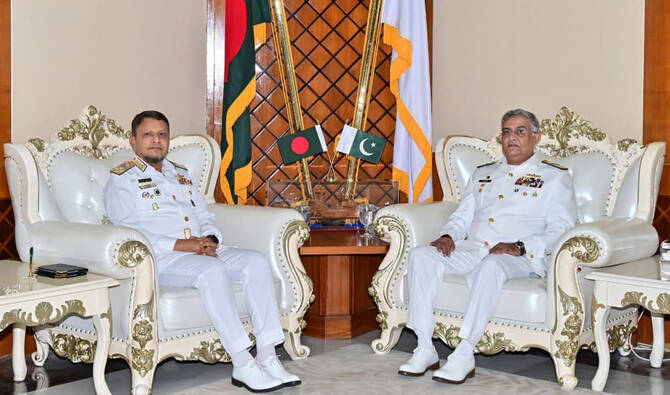
Pakistan, Bangladesh boost defense ties as Islamabad navy chief concludes visit to Chattogram

The handout photograph released on November 13, 2025, shows Pakistan’s Chief of Naval Staff, Admiral Naveed Ashraf, meeting Chief of Naval Staff Bangladesh, Admiral M Nazmul Hassan, in Bangladesh. (Facebook/@DgprNavy)
Short Url
Updated 13 November 2025
Follow

Pakistan, Bangladesh boost defense ties as Islamabad navy chief concludes visit to Chattogram

  • Visit comes as Pakistan and Bangladesh cautiously rebuild relations after years of strain following the 1971 war
  • Naval engagement reflects shifting regional alignments as Dhaka recalibrates ties with India after political transition

KARACHI: Pakistan and Bangladesh have stepped up defense engagement with a high-level naval visit to Chattogram, the Pakistan military said on Thursday, marking one of the most visible signs of warming ties between the two South Asian neighbors after years of diplomatic distance.

For decades, relations between Islamabad and Dhaka remained tense following the 1971 civil war that split the two countries, with Bangladesh aligning closely with India and maintaining only limited defense cooperation with Pakistan. But that dynamic has shifted since the fall of Sheikh Hasina’s government earlier this year — a period that saw Dhaka’s ties with New Delhi cool and opened space for renewed political and military outreach with Pakistan.

In this context, Pakistan’s Chief of Naval Staff Admiral Naveed Ashraf’s visit to Bangladesh — and the simultaneous port call of PNS Saif — signals an attempt by both sides to restore working-level coordination and rebuild a relationship long overshadowed by history.

“The next century belongs to the oceans,” Admiral Naveed Ashraf remarked during the visit. “Pakistan must plan today for the ports, trade routes, and maritime industries of tomorrow.”

During the multi-day trip, the naval chief met Bangladesh’s army, navy and air force heads, discussed regional maritime security and professional cooperation, and attended a reception onboard the Pakistani frigate Saif. He also visited the National Defense College and the Bangladesh Naval Academy, appreciating their professional standards and emphasizing the importance of advanced naval education.

While the visit does not represent a formal defense pact, the engagements point to broader strategic recalibration in the Bay of Bengal and Indian Ocean Region. Bangladesh’s armed forces continue longstanding cooperation with India, but the political transition in Dhaka — and the fallout from Sheikh Hasina’s departure to India — have introduced new diplomatic dynamics. Pakistan, meanwhile, has sought to expand military-to-military contacts across the region, particularly in the maritime domain.

The Bay of Bengal and the northern Indian Ocean have gained strategic significance in recent years amid rising competition for sea lanes, energy routes and naval influence. Both Pakistan and Bangladesh have expanded coastal infrastructure and maritime surveillance capacity, making naval diplomacy an increasingly important tool for signalling intent and managing regional relationships.

The Pakistan Navy said the visit aimed to “strengthen bilateral naval ties, foster mutual respect, and advance maritime security cooperation,” projecting the engagement as part of Islamabad’s wider effort to enhance regional connectivity and stability.


Pakistan, Indonesia sign MoUs to expand cooperation as Islamabad seeks to ease trade imbalance

Updated 4 sec ago
Follow

Pakistan, Indonesia sign MoUs to expand cooperation as Islamabad seeks to ease trade imbalance

  • Pakistan offers to send doctors and medical experts to support Indonesia’s expanding health needs
  • Indonesian president highlights close foreign policy coordination with Pakistan, including on Gaza

ISLAMABAD: Pakistan and Indonesia signed seven memoranda of understanding on Tuesday to deepen cooperation in trade, education and health, with Prime Minister Shehbaz Sharif saying Islamabad aimed to narrow a $4.5 billion bilateral trade imbalance heavily tilted in Jakarta’s favor.

The agreements were concluded during Indonesian President Prabowo Subianto’s two-day visit to Pakistan, his first trip to the country since taking office and the first by an Indonesian head of state in seven years.

Subianto, who arrived on Monday, held detailed talks with Sharif before the signing ceremony.

“Our discussion has been extremely productive,” Sharif said at a joint media appearance. “More than 90 percent of our current imports from Indonesia are palm oil. We have discussed how to take corrective measures to balance this through Pakistan’s agri-exports, IT-led initiatives and other areas.”

Sharif earlier noted Pakistan’s bilateral trade with Indonesia stood at around $4.5 billion, with the imbalance overwhelmingly in Jakarta’s favor.

Subianto thanked Pakistan for what he called an exceptionally warm welcome, noting his aircraft had been escorted by Pakistan Air Force JF-17 fighter jets.

He said the meeting had produced agreements across several fields, including trade, agriculture, education and science and technology.

The Indonesian president also welcomed Pakistan’s offer to help his country address critical shortages of medical professionals.

“Indonesia has vast needs for doctors, dentists and medical experts, and Pakistan’s support in this regard is strategic and critical,” he said.

Sharif noted Pakistan would be ready to send doctors, dentists and medical professors to assist Indonesia’s plans to expand its medical colleges and universities.

He added that Islamabad would “work closely and diligently” with Jakarta to achieve the targets set during the visit.

Subianto said both countries were also coordinating closely on foreign policy, particularly on developments in Gaza, and reaffirmed Indonesia’s support for a two-state solution.

He invited Sharif to visit Jakarta to deepen cooperation under the new agreements.

Pakistan and Indonesia marked the 75th anniversary of diplomatic ties this year, with both leaders saying the visit would help lift relations to what Sharif called “a much higher level” in trade, development and people-to-people links.