
KYIV, Ukraine: European Union officials warned Ukraine on Thursday that it must keep cracking down on graft in the wake of a major corruption scandal that could hurt the country’s ability to attract financial help. But they also offered assurances that aid will continue to flow as Kyiv strains to hold back Russia’s invasion.
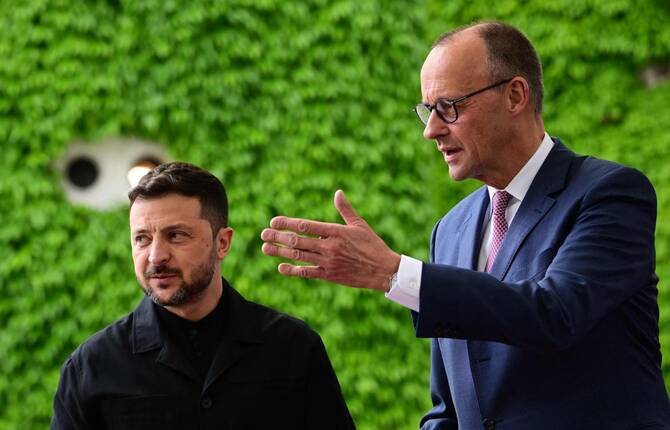
German Chancellor Friedrich Merz stressed European concerns about corruption when he spoke by phone with Ukrainian President Volodymyr Zelensky, whose administration has been engulfed by the scandal involving embezzlement and kickbacks at the state-owned nuclear power company. It’s fast becoming one of the most significant government crises since the full-scale invasion, with media reports implicating a close associate of Zelensky.
Merz “underlined the German government’s expectation that Ukraine press ahead energetically with fighting corruption and further reforms, particularly in the area of the rule of law,” his office said in a statement.
Zelensky, the statement said, promised “full transparency, long-term support for the independent anti-corruption authorities and quick further measures in order to win back the confidence of the Ukrainian population, European partners and international donors.”
At the same time, a European Commission spokesperson said that uncovering the alleged kickback scheme demonstrated that Ukraine’s efforts to fight corruption are working as the country strives to meet the standards for EU membership.
“This investigation shows that anti-corruption bodies are in place and functioning in Ukraine,” Guillaume Mercier said in Brussels.
“Let me stress that the fight against corruption is key for a country to join the EU. It requires continuous efforts to guarantee a strong capacity to combat corruption and a respect for the rule of law.”
Graft probe raises questions about senior officials
After Zelensky’s justice and energy ministers quit Wednesday amid the investigation into energy sector graft, the government fired the vice president of Energoatom, the state-owned nuclear power company believed by investigators to be at the center of the kickback scheme.

File photo of German Galushchenko, who was fired as Ukraine's energy minister for allegedly receiving "personal benefits" from a $100 million kickback scheme in the energy sector, which he oversaw as minister until July 2025. (AFP)
The EU and other foreign partners have poured money into Ukraine’s energy sector. Russia has relentlessly bombarded the power grid, which requires repeated repairs.
The heads of Energoatom’s finance, legal and procurement departments and a consultant to Energoatom’s president were also dismissed, Prime Minister Yuliia Svyrydenko said late Wednesday.
“During the full-scale war, when the enemy is destroying our energy infrastructure every day and the country is living under power outage schedules, any form of corruption is unacceptable,” Svyrydenko said Thursday in a video statement.
“In the most difficult times, our strength lies in unity. Eradicating corruption is a matter of honor and dignity,” she said.
Tymur Mindich, a co-owner of Zelensky’s Kvartal 95 media production company, is the conspiracy’s suspected mastermind. His whereabouts are unknown.
The investigation has prompted questions about what the country’s highest officials knew of the scheme. It has also awakened memories of Zelensky’s attempt last summer to curtail Ukraine’s anti-corruption watchdogs. He backtracked after widespread street protests in Ukraine and pressure from the European Union to address entrenched corruption.
A Kyiv court has begun hearing evidence from anti-corruption watchdogs. Those watchdogs — the same agencies Zelensky sought to weaken earlier this year — conducted a 15-month investigation, including 1,000 hours of wiretaps, that resulted in the detention of five people and implicated another seven in the scheme that allegedly earned about $100 million.
EU promises more money for Ukraine
European Commission President Ursula von der Leyen said the EU would disburse Thursday a 6 billion euros ($7 billion) loan to Ukraine and promised more money for Kyiv.
“We will cover the financial needs of Ukraine for the next two years,” she said in a speech to the European Parliament.
The EU is looking into how it can come up with more money for Ukraine, either by seizing frozen Russian assets, raising funds on capital markets or having some of the 27 EU nations raise the money themselves.
Russian President Vladimir Putin “thinks he can outlast us” in the battle over Ukraine’s future, von der Leyen said.
“And this is a clear miscalculation,” she said. “Now is therefore the moment to come, with a new impetus, to unlock Putin’s cynical attempt to buy time and bring him to the negotiation table.”
Ukraine fires its Flamingo cruise missile
Meanwhile, Gen. Oleksandr Syrskyi, Ukraine’s top military commander, visited units fighting to hold Pokrovsk in the eastern Donetsk region and coordinate operations in person, he said on the messaging app Telegram.
Ukrainian troops are locked in street battles with Russian forces in the city and fighting to prevent becoming surrounded as the Kremlin’s war of attrition slowly grinds across the countryside.
Syrskyi said the key goals are to regain control of certain areas of the city, as well as protect logistical routes and create new ones so that troops can be supplied and the wounded can be evacuated.
“There is no question of Russian control over the city of Pokrovsk or of the operational encirclement of Ukraine’s defense forces in the area,” Syrskyi said.
In other developments Thursday, Ukraine used a new domestically produced cruise missile as well as other weapons to strike “several dozen objects” in Russian-occupied territories and inside Russia itself, according to the general staff.
The FP-5 missile, which Ukrainian officials say can fly 3,000 kilometers (1,864 miles) and land within 14 meters (45 feet) of its target, is one of the largest such missiles in the world, delivering a payload of 1,150 kilograms (2,535 pounds), according to experts. It is commonly known as a Flamingo missile because initial versions came out pink after a manufacturing error.
In Crimea, which Russia has illegally annexed, Ukraine’s general staff said its forces struck an oil terminal, a helicopter base, a drone storage site and an air defense radar system. In occupied parts of the southern Zaporizhzhia region, an oil storage depot and two Russian command centers were hit.
The general staff gave no details about what was targeted on Russian soil.