

Pakistan says Afghan citizens involved in two suicide bombings this week

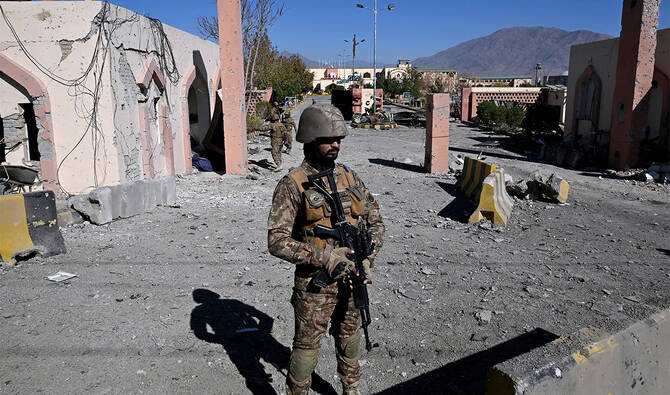
Pakistani military stands guard after militants attacked the Cadet College in Wana, Waziristan district near the Pakistan-Afghanistan border, on November 13, 2025. (AFP)
Short Url
Updated 13 November 2025
Follow

Pakistan says Afghan citizens involved in two suicide bombings this week

  • Interior minister says Afghan nationals carried out attacks in Islamabad, cadet college in northwestern Pakistan
  • Pakistan has long accused Afghanistan of harboring militants on its soil, a charge Kabul vehemently denies

ISLAMABAD: Afghan citizens were involved in two suicide bombings that took place in Pakistan this week, Interior Minister Mohsin Naqvi confirmed on Thursday, saying the government would decide how to respond to the attacks.

Naqvi was referring to a suicide bomb blast that took place in Pakistan’s capital on Tuesday, killing 12 and injuring 36. No group claimed responsibility for the attack while the Pakistani Taliban or the Tehreek-e-Taliban Pakistan (TTP) denied it was involved.

The second attack took place on Monday targeting a cadet college in the northwestern Wana town. Militants rammed an explosive-laden vehicle into the main gate before gunmen entered the premises. A firefight between the militants and security forces lasted for hours, during which all the attackers were killed and cadets, staff and civilians inside the building were safely rescued.

“Afghan citizens had conducted these suicide attacks,” Naqvi told reporters in Islamabad. “We have received confirmation of both. Both these people came from Afghanistan and they did it. We are taking this up.”

When asked how Islamabad would respond to the attacks, Naqvi said:

“What we will do will be decided at the government level.”

Earlier, a security official with direct knowledge of the attack on the Wana cadet college said the assault was planned and managed from Afghanistan. 

The official, speaking on condition of anonymity, said all assailants were also Afghan citizens. 

“The attack was planned in Afghanistan by Kharji Zahid and the final approval was given by Kharji Noorwali Mehsud,” the official, privy to the investigations, said in a statement. 

“All the Khwarij who attacked Cadet College Wana were Afghan citizens. The equipment for this attack was provided from Afghanistan, which included American-made weapons.”

Pakistani officials use the term “khwarij” to refer to the TTP, an umbrella network of armed factions. The term rooted in early Islamic history and used to describe an extremist sect that rebelled against legitimate authority and declared other Muslims to be apostates.

The official also named top TTP figures, including Mehsud, the network’s chief, as directing the operation.

He said a group called “Jaish-ul-Hind” claimed responsibility on the orders of the TTP leadership as a diversionary tactic.

Pakistan has long accused the Afghan Taliban administration of harboring TTP militants and facilitating their cross-border attacks, an allegation Kabul denies.

The official added that Afghan leaders had pressured TTP commanders not to publicly accept responsibility for the assault.

“The attack on Cadet College Wana was aimed at increasing security concerns in Pakistan, on demand of the Indian agency RAW,” he said.

 “The identities of the Afghan terrorists killed in the attack firmly establishes the links of terrorists in their bases in Afghanistan.”

Apart from Afghanistan, Pakistan has consistently accused India of backing anti-Pakistan militant groups, though New Delhi denies the claim.


Pakistan military says ex-PM Khan’s narrative has become ‘threat to national security’

Updated 7 sec ago
Follow

Pakistan military says ex-PM Khan’s narrative has become ‘threat to national security’

  • Military spokesperson responds to Khan’s fresh criticism of Pakistan’s powerful army chief, whom he accuses of denying him basic rights
  • Lt. Gen. Ahmed Sharif Chaudhry warns army will “come bare knuckle” if Khan and his party do not desist from attacking military leadership

ISLAMABAD: Pakistan military spokesperson Lt. Gen. Ahmed Sharif Chaudhry said on Friday that former prime minister Imran Khan’s narrative against the armed forces has become a “national security threat,” warning him and his party to keep the army out of political statements. 

Chaudhry’s criticism comes in response to Khan’s latest statement, released by his account on social media platform X on Thursday, in which he blamed Chief of Defense Forces Field Marshal Asim Munir for “the complete collapse of the constitution and rule of law in Pakistan.”

Khan, who was ousted via a parliamentary vote in April 2022, blames the country’s powerful army for colluding with his political rivals to keep him away from power. He blames the military and the incumbent government for keeping him in solitary confinement in a central prison in Rawalpindi. Pakistan’s military and the government have strongly rejected his claims. 

“It may seem to you a bit strange coming from me this because that person [Khan] and the narrative he is pushing, it has become a national security threat,” Chaudhry told reporters at a news conference. 

“And that is why it is very important that we come clear, without any ambiguity, without any doubt. We need to come clear and we need to say what needs to be said,” he added. 

Throughout the press conference, Chaudhry kept referring to the former prime minister as a “mentally ill” person. He played video clips of Indian news channels and Afghanistan’s social media accounts promoting Khan’s statements against the military. 

“Why would they not do it? Because sitting in your country, a mindset, a mentally ill person sitting here is saying these things against the military and its leadership,” he said. 

The military spokesperson warned Khan and his party against criticizing the military. He added that while the military welcomes constructive criticism, it should be kept away from political statements. 

“If someone for the sake of his own self, his delusional mindset and narcissistic thinking attacks this armed forces and its leadership, then we will also come bare knuckle,” he warned. 

“There should be no doubt on that.”

Khan, who remains in prison on a slew of charges that he says are politically motivated, continues to be popular among the masses. 

His Pakistan Tehreek-e-Insaf (PTI) party has frequently led rallies to demand his release from jail, including one in May 2023 and another in November 2024 that saw clashes with law enforcement personnel. 

While the former prime minister continues to remain behind bars, rallies organized by the PTI still draw thousands of people across the country and his party still enjoys a sizable following on social media platforms.