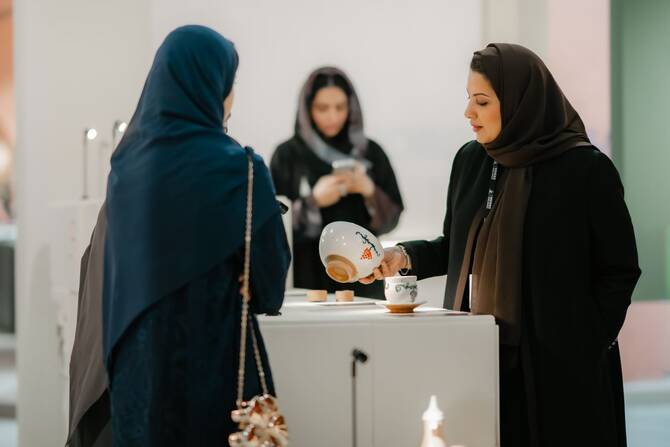

DUBAI: Saudi Arabia’s creative heritage took center stage at Dubai Design Week through FAW, a Saudi brand founded by Amal Al-Bednah.
FAW participated in Dubai Design Week’s Designed in Saudi exhibition, presenting handcrafted pottery inspired by the Saudi archaeological site Al-Faw village.
Haya Al-Aqeel, designer and craftswoman at FAW, told Arab News that the project was established to highlight the story of Al-Faw through design. “Our designs are inspired by discoveries from the site. We reimagine them in a modern artistic way while staying true to their origins,” she said.

One of FAW’s creations for Dubai Design Week. (Supplied)
Al-Faw was once the capital of the Kingdom of Kinda. It is located about 100 km south of Wadi ad-Dawasir and roughly 700 km southwest of Riyadh. The archaeological site contains the remains of residential houses, markets, roads, cemeteries, temples, and water wells that provide insight into the region’s early urban and cultural life.
At Dubai Design Week, FAW showcased two pottery pieces — a bowl and a cup with a matching plate. The items were finished in soft, natural tones of beige and terracotta, with subtle engraved patterns inspired by the carvings and inscriptions found at Al-Faw.
FAW’s wider collection features a variety of handcrafted items, including ceramic cups, plates and bowls adorned with motifs such as gazelles, grape clusters and ancient jar designs painted in earthy tones. The brand also produces vintage-style leather notebooks embossed with symbols inspired by historical carvings.
Each FAW piece is made from high-quality clay, shaped and fired by hand, Al-Bednah told Arab News.
“Saudi Arabia has a rich history that we must benefit from,” she said. “We merge art, beauty, and modern design with our historical roots and identity. Every piece we create tells a story from Al-Faw, each carrying its own meaning and message.”
The design process begins with research into the site’s architectural details and inscriptions, which are reinterpreted into geometric patterns and subtle textures across the pottery surfaces. “When you believe in the idea you are presenting, you find endless inspiration,” Al-Bednah said.

Visitors to Dubai Design Week examine FAW’s work. (Supplied)
Al-Aqeel described FAW’s creative approach as “historical heritage presented through a modern artistic challenge.” She added: “Our aim is to build a deep connection between the collector and each piece. We want people to feel that link between the past and the present.”
FAW also aims to preserve craftsmanship and support new generations of designers. The brand’s mission is “to revive the spirit of Al-Faw and keep heritage alive across generations through training and knowledge-sharing.” Al-Bednah said FAW seeks to maintain continuity between the Kingdom’s history and its evolving creative practices.
FAW’s products are made entirely in Saudi Arabia, and the brand has begun receiving orders from clients abroad.
Al-Bednah noted that participation in the Designed in Saudi initiative, launched by the Saudi Architecture and Design Commission, provided valuable exposure. “(Being selected) gave us great confidence,” she said. “It allows Saudi designers and creatives to present their work internationally.”
She also praised the growth of Saudi Arabia’s design sector in recent years, highlighting the opportunities created under Vision 2030. “Our history is rich,” Al-Bednah said. “Saudi designers are thinking in new ways while continuing to reflect their identity and traditions. The creative sector is expanding, and that progress is encouraging.”
She added that public initiatives have played an important role in supporting local talent. “I always encourage young Saudis to take advantage of the support available for artists and designers. Vision 2030 has created continuous opportunities for creativity in different areas,” she concluded.