

Pakistan’s lower house passes 27th constitutional amendment seeking revisions to judicial, military command 

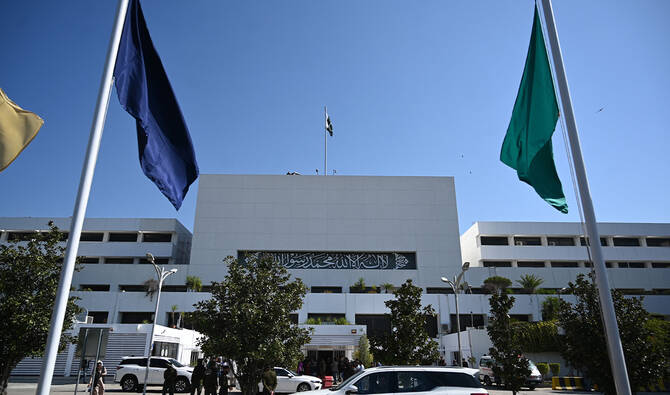
A general view of the Pakistan's Parliament House during the presidential election in Islamabad on March 9, 2024. (AFP/ file)
Short Url
Updated 12 November 2025
Follow

Pakistan’s lower house passes 27th constitutional amendment seeking revisions to judicial, military command 

  • Constitutional amendment sails through National Assembly with 234 votes in favor, four against amid opposition walkout
  • Bill empowers army chief to become constitutionally recognized head of armed services, reduces top court’s powers

ISLAMABAD: Pakistan’s lower house of parliament on Wednesday passed the contentious 27th constitutional amendment seeking major changes in the country’s judicial and military command structure by a two-thirds majority required for constitutional changes, as opposition lawmakers staged a walkout in protest. 

The development takes place after Pakistan’s upper house of parliament, the Senate, passed the 27th constitutional amendment by a two-thirds majority on Monday. Law Minister Azam Nazeer Tarar had tabled it in the lower house a day earlier. 

The amendment introduces changes to Article 243 of the constitution, creating a new post of the Chief of Defense Forces. It also abolishes the role of the Chairman of the Joint Chiefs of Staff Committee (CJCSC). This empowers the army chief to become the constitutionally recognized head of Pakistan’s armed services. 

It also calls for establishing a Constitutional Court, reducing the powers of the top court and introducing new procedures for the transfer of judges. Pakistan’s government argues the amendment will help reduce the backlog of cases and improve governance. The opposition argues it clips the powers of the judiciary. 

“Two hundred and thirty-four members cast their votes for Is, four members were nos. Consequently the bill is passed by the assembly by not less than the two-third of the membership of the assembly,” Speaker Ayaz Sadiq announced to loud applause. 

Former three-time prime minister Nawaz Sharif, Prime Minister Shehbaz Sharif and Pakistan Peoples Party (PPP) Chairman Bilawal Bhutto Zardari attended the National Assembly session. 

Before voting took place, Tarar announced the government had introduced a set of new amendments to the bill. One of these amendments clarified that the post of the chief justice was not being abolished, adding that Justice Yahya Afridi will remain as the country’s top judge. 

Shortly after Tarar started speaking, opposition members started shouting slogans before staging a walkout in protest. Voting on the bill followed. 

Another amendment was made to Article 6 of the constitution, which relates to “high treason.” Tarar said previously, neither the Supreme Court nor a high court could ratify the abrogation of the constitution. He said the constitutional court was also added to this list.

The bill will now be sent back to the upper house or Senate for the new amendments to be debated upon again. If it sails through the Senate, the bill will then require the president’s assent to become law. 

The 27th amendment follows the 26th amendment of October 2024, which gave parliament a role in appointing the chief justice and created a senior judges’ panel to hear constitutional cases, measures that were also widely criticized as weakening judicial independence.


Pakistan says defense pact with Saudi Arabia elevated brotherly ties to ‘new heights’

Updated 25 February 2026
Follow

Pakistan says defense pact with Saudi Arabia elevated brotherly ties to ‘new heights’

  • Pakistan, Saudi Arabia signed strategic defense pact last year pledging aggression against one will be treated as attack on both
  • Deputy PM Ishaq Dar says enduring bonds with Islamic and Arab nations form vital pillar of Pakistan’s foreign policy 

ISLAMABAD: Deputy Prime Minister Ishaq Dar said on Wednesday that Pakistan’s defense pact with Saudi Arabia elevated its brotherly ties with the Kingdom to “new heights,” stressing that close ties with Arab and Islamic nations form a key pillar of Islamabad’s foreign policy. 

Pakistan and Saudi Arabia signed a Strategic Mutual Defense Agreement on Sept. 17 last year, pledging that aggression against one country would be treated as an attack on both, enhancing joint deterrence and formalizing decades of military and security cooperation.

Both nations agreed in October 2025 to launch an economic cooperation framework to strengthen trade and investment ties. 

“In the Middle East, our landmark Strategic Mutual Defense Agreement with Saudi Arabia has elevated our brotherly ties to new heights,” Dar said while speaking at the Pakistan Governance Forum 2026 event in Islamabad. 

The Pakistani deputy prime minister was speaking on the topic “Navigating International Relations Amidst Changing Geo-Politics.”

Dar noted that Pakistan has reinforced partnerships with other Middle Eastern nations such as the UAE, Qatar, Jordan, Oman, Egypt and Bahrain. He said these partnerships have yielded “concrete agreements” in investment, agriculture, infrastructure, and energy sectors. 

“Our enduring bonds with Islamic and Arab nations form a vital pillar of our foreign policy, and we will continue to expand our partnerships across Asia, Latin America, and Africa,” he said. 

Dar pointed out that the presidents of Kazakhstan, Uzbekistan and Kyrgyzstan have undertaken visits to Pakistan in recent months, reflecting Central Asian nations’ desire to boost cooperation with Islamabad.

On South Asia, the Pakistani deputy PM said Pakistan has successfully transformed its fraternal ties with Bangladesh into “a substantive partnership.”

“Similarly, the trilateral mechanism involving China, Pakistan, and Bangladesh has been launched with a view to expanding and deepening regional cooperation and synergy,” the Pakistani minister said. 

He said Islamabad has strengthened its “all-weather” partnership with China via the second phase of the multi-billion-dollar China-Pakistan Economic Corridor agreement and “unwavering support” from both sides for each other’s core interests. 

Dar said Pakistan had also reinvigorated its partnership with the US, advancing cooperation in trade, technology, investment, and regional stability. 

“This calibrated approach has enhanced our ability to navigate complexity with skill and confidence, ensuring that our national interests are served without compromising our core foreign policy principles,” he said.