

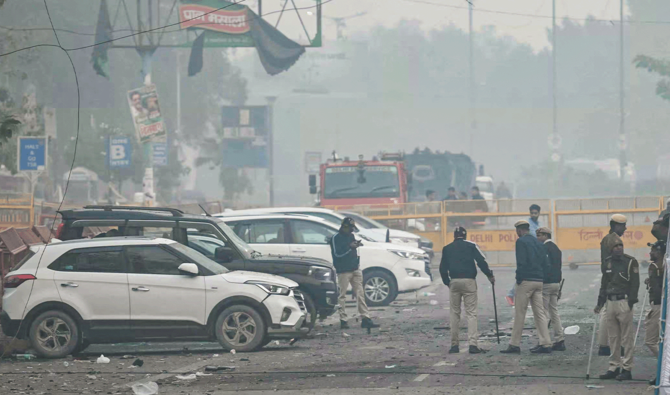

SRINAGAR, India: Indian security agencies have detained several suspects in the disputed Kashmir region as part of their investigation into this week’s deadly car explosion in New Delhi, officials said Wednesday.
The blast occurred Monday near the historic Red Fort monument of New Delhi, killing eight people and injuring several other people. Authorities on Tuesday announced that they are investigating it as possible terrorism — a step that gives investigating authorities broader powers to arrest or detain people.
Red Fort, a major tourist attraction, is a 17th-century monument and the place where Indian prime ministers deliver Independence Day speeches on Aug. 15 each year.
If confirmed as a deliberate attack, it would be the deadliest blast in India’s capital since 2011.
At least five people were detained for questioning in a series of raids overnight in the Kashmir’s southern Pulwama district, police officials said Wednesday.
A suspected militant cell dismantled, and then the blast
Monday’s blast came hours after police in Indian-controlled Kashmir said they had dismantled a suspected militant cell operating from the disputed region to the outskirts of New Delhi. At least seven people, including two doctors, were arrested, and police seized weapons and a large quantity of bomb-making material in Faridabad, a city in Haryana state, which is near New Delhi.
Indian news outlets report the explosion could be linked to the same cell. Police have not commented, citing their ongoing investigation.
Four police officers in Kashmir familiar with the case said the investigation that led them to the cell began with a routine probe into anti-India posters that appeared in a neighborhood in the Kashmir city of Srinagar on Oct. 19. The posters threatened attacks on Indian troops stationed in Kashmir.
The officers, who spoke on condition of anonymity because of the sensitivity of the case, said CCTV footage helped identify suspects, initially leading to the arrest of at least three people.
Over the following three weeks, interrogations led to the detention of two Kashmiri doctors working in two Indian cities, as well as two other suspects from Kashmir, the officers said.
Local media reports suggest car’s driver was from Kashmir
Indian news outlets have reported that police are investigating whether another suspected member of the same cell, also a Kashmiri doctor teaching at a medical college in Faridabad, was driving the car that exploded. Police have not confirmed those reports, but Indian news outlets said the doctor may have either deliberately triggered the blast to avoid arrest or was transporting explosives that detonated accidentally.
Delhi police spokesman Sanjay Tyagi said investigators were probing “all possible angles, including a terror attack, an accidental blast or any kind of failure in the car.”
Shagufta Jan, the doctor’s sister-in-law in Kashmir’s Pulwama district, said the family had not heard from him since last Friday, when she told him police were looking for him.
“He called us on Friday, and I told him to come home. He said he would come after three days,” she said.
“That was the last time we spoke with him,” Jan said, adding that police came to their home Monday night and took in the doctor’s mother and two brothers for questioning.
The blast could raise tensions between India and Pakistan
The possible terrorism link in the blast has raised fears of renewed tensions between nuclear-armed rivals India and Pakistan. India often accuses Pakistan of backing attacks on its soil, saying they are carried out by groups based across the border.
In April, suspected militants killed 26 people, mostly Hindu tourists, in Indian-controlled Kashmir. New Delhi blamed Pakistan for the massacre, which Islamabad denied. It was followed by tit-for-tat military strikes by India and Pakistan, bringing the nuclear-armed rivals to the brink of their third war over the region.
India and Pakistan each administer a part of Kashmir but both claim the territory in its entirety.
Militants in the Indian-controlled portion of Kashmir have been fighting New Delhi’s rule since 1989. India insists the Kashmir militancy is Pakistan-sponsored terrorism. Pakistan denies the charge, and many Kashmiris consider it a legitimate freedom struggle.
New Delhi witnessed several major bombings in the 1990s and 2000s.
In 1996, a car bomb tore through the crowded Lajpat Nagar market, killing 13 people. In 2008, coordinated blasts hit busy shopping areas, leaving about 20 dead.
|Those attacks were blamed on Kashmiri militant groups and an Indian Islamist student organization.


