Coalition led by Iraqi PM Sudani comes first in Iraq’s election, commission says

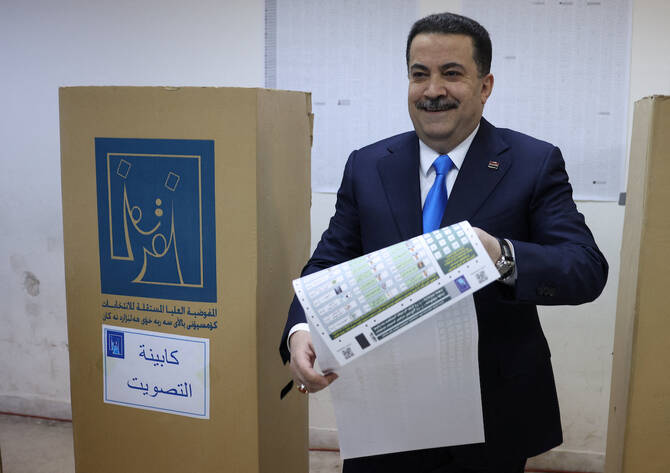
Iraqi PM Mohammed Shia Al-Sudani votes at a polling station in the Green Zone during the parliamentary election, in Baghdad, Iraq, November 11, 2025. (Reuters)
Short Url
Updated 13 November 2025
Follow

Coalition led by Iraqi PM Sudani comes first in Iraq’s election, commission says

  • His coalition received 1.317 million votes in Tuesday’s election, the commission said
  • No party can form a government on its own in Iraq’s 329-member legislature, so parties build alliances with other groups to become an administration

BAGHDAD: A coalition led by Iraqi Prime Minister Mohammed Shia Al-Sudani came first in Iraq’s parliamentary election, the Independent High Electoral Commission said on Wednesday.
His coalition received 1.317 million votes in Tuesday’s election, the commission said.
Reuters reported earlier that Sudani placed first, citing two electoral commission officials with knowledge of the results.
Sudani was seeking a second term in Tuesday’s election, but many disillusioned young voters saw the vote simply as a vehicle for established parties to divide Iraq’s oil wealth.
However, Sudani tried to cast himself as the leader who could make Iraq a success after years of instability, arguing he had moved against established parties that brought him to power.
No party can form a government on its own in Iraq’s 329-member legislature, so parties build alliances with other groups to become an administration, a fraught process that often takes many months.
The final total turnout in Iraq’s parliamentary election reached 56.11 percent, the electoral commission said earlier on Wednesday.
“The voter turnout is clear evidence of another success, reflected in the restoration of confidence in the political system,” Sudani said in a televised speech following the announcement of the initial results.


Syria’s growth accelerates as sanctions ease, refugees return

Updated 06 December 2025
Follow

Syria’s growth accelerates as sanctions ease, refugees return

  • Economy grows much faster than World Bank’s 1% estimate, fueling plans for currency’s relaunch

NEW YORK: Syria’s economy is growing much faster than the World Bank’s 1 percent estimate for 2025 as refugees flow back after the end of a 14-year civil war, fueling plans for the relaunch of the country’s currency and efforts to build a new Middle East financial hub, central bank Governor AbdulKader Husrieh has said.

Speaking via video link at a conference in New York, Husrieh also said he welcomed a deal with Visa to establish digital payment systems and added that the country is working with the International Monetary Fund to develop methods to accurately measure economic data to reflect the resurgence. 

The Syrian central bank chief, who is helping guide the war-torn country’s reintegration into the global economy after the fall of Bashar Assad’s regime about a year ago, described the repeal of many US sanctions against Syria as “a miracle.”

The US Treasury on Nov. 10 announced a 180-day extension of the suspension of the so-called Caesar sanctions against Syria; lifting them entirely requires approval by the US Congress. 

Husrieh said that based on discussions with US lawmakers, he expects the sanctions to be repealed by the end of 2025, ending “the last episode of the sanctions.”

“Once this happens, this will give comfort to our potential correspondent banks about dealing with Syria,” he said.

Husrieh also said that Syria was working to revamp regulations aimed at combating money laundering and the financing of terrorism, which he said would provide further assurances to international lenders. 

Syria’s central bank has recently organized workshops with banks from the US, Turkiye, Jordan and Australia to discuss due diligence in reviewing transactions, he added.

Husrieh said that Syria is preparing to launch a new currency in eight note denominations and confirmed plans to remove two zeroes from them in a bid to restore confidence in the battered pound.

“The new currency will be a signal and symbol for this financial liberation,” Husrieh said. “We are glad that we are working with Visa and Mastercard,” Husrieh said.