UK health minister denies plotting against PM Starmer

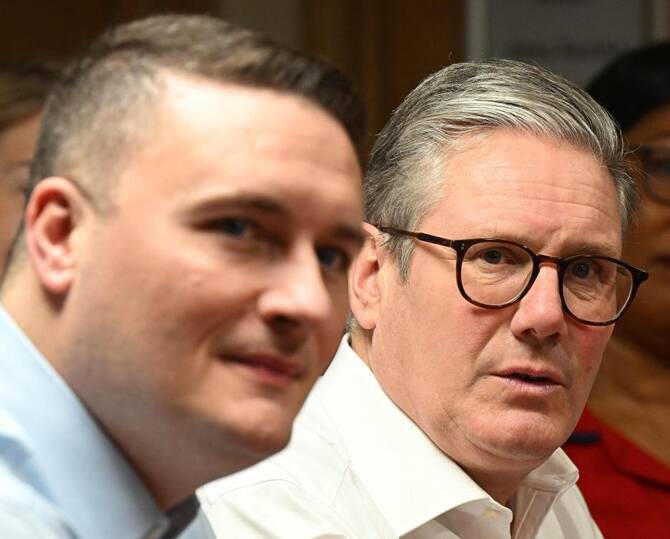
UK health minister Wes Streeting, left, was forced to repeatedly deny he planned to oust Prime Minister Keir Starmer. (AFP)
Short Url
Updated 12 November 2025
Follow

UK health minister denies plotting against PM Starmer

  • Health chief Wes Streeting has long been seen as a potential replacement for Keir Starmer
  • The government’s poll ratings have nosedived since Starmer won power in July last year

LONDON: The UK health minister was on Wednesday forced to repeatedly deny he planned to oust Prime Minister Keir Starmer, hours after sources said the premier would fight off any leadership challenge, despite plummeting poll ratings.
“I’m not going in to demand the prime minister’s resignation,” Wes Streeting told Sky News. “I support the prime minister. I have done since he was elected leader of the Labour Party.”
The 42-year-old has long been seen as a potential replacement for Starmer.
His denial, repeated to other broadcasters, follow anonymous briefings by Starmer allies who on Sunday told journalists he would fight any attempt to replace him.
“Keir knows he is already fighting a leadership contest. When it comes, he won’t resign. He will fight it,” one supporter was quoted as saying by The Times daily.
The government’s poll ratings have nosedived since Starmer won power in July last year.
Despite securing a landslide election victory, his government has struggled on issues such as economic growth and immigration.
Brexit figurehead Nigel Farage’s Reform UK party has been leading by double-digit margins in many national polls for much of this year.
The next general election is not expected until 2029 but the government faces an important test at local elections in May 2026.
A challenge for the leadership of the Labour Party would require the support of 20 percent of the party’s MPs, which currently means 80 nominations would be needed.


WHO warns of increase in malaria cases and deaths

Updated 5 sec ago
Follow

WHO warns of increase in malaria cases and deaths

  • 282 million cases of malaria, including 610,000 deaths, were recorded worldwide in 2024 
  • Africa remains by far the most-affected region, with 94 percent of cases and 95 percent of malaria deaths

GENEVA, Switzerland: Deaths linked to malaria last year rose last year, the World Health Organization said on Thursday, warning also of an increase in cases and resistance to current treatment.
There were some 282 million cases and 610,000 deaths recorded worldwide in 2024 — slightly up on the previous 12 months — underlining the mosquito-borne disease as a continuing serious global health issue.
WHO chief Tedros Adhanom Ghebreyesus said the increase in deaths and cases, combined with funding cuts “threaten to roll back the progress we have made over the past two decades.”
But he added: “None of these challenges is insurmountable. With the leadership of the most-affected countries and targeted investment, the vision of a malaria-free world remains achievable.”
Africa remains by far the most-affected region, with 94 percent of cases and 95 percent of malaria deaths, the majority (75 percent) involving children under five.
Five countries — the Democratic Republic of Congo, Ethiopia, Mozambique, Nigeria and Uganda — account for more than half of the number of cases, the WHO said in a new report.
But the global health agency said progress had still been made.
Since the WHO approved the first vaccines against malaria in 2021, 24 countries have introduced routine immunization programs.
Chemoprevention, which involves the use of medication to prevent infection during high-risk malaria seasons, is now being implemented in 20 countries, reaching 54 million children in 2024 — up from about 200,000 in 2021.
The WHO has now certified 47 countries and one territory as being exempt from malaria, including Cape Verde and Egypt in 2024, as well as Georgia, Suriname and East Timor in 2025.
Progress in the fight against malaria had already stalled in recent years, notably because of climate change, an increase in conflict and resistance to drugs and insecticides.
The WHO’s director of malaria and neglected tropical diseases, Daniel Ngamije, said underfunding of malaria response programs had exacerbated the challenges.
There was now an “obvious risk in massive uncontrolled resurgence of disease,” he added.
The WHO said its targets for cutting malaria deaths remained “far off track.”
The 610,000 deaths in 2024 correspond to 13.8 deaths per 100,000 people — more than three times the global target of 4.5 deaths per 100,000.