

Pakistan tightens security in Punjab after court blast, boosts protection for Sri Lanka cricket team

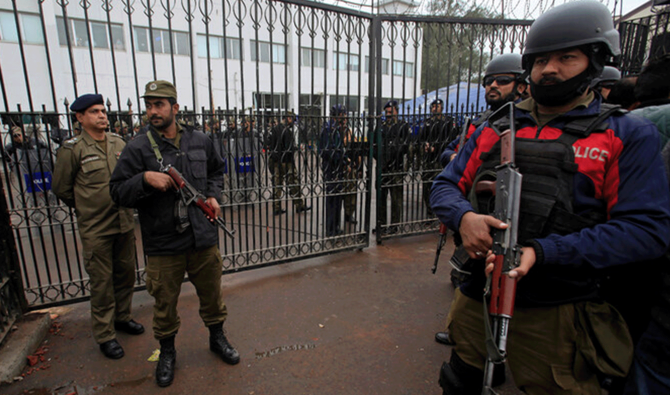
Police officers stand guard for security measures at the premises of the Punjab Institute of Cardiology building, in Lahore, Pakistan on December 12, 2019. (Reuters/File)
Short Url
Updated 12 November 2025
Follow

Pakistan tightens security in Punjab after court blast, boosts protection for Sri Lanka cricket team

  • Punjab steps up security across major cities after Islamabad suicide bombing kills 12
  • Punjab has remained relatively peaceful in recent years but has witnessed militant attacks in the past

ISLAMABAD: Pakistan’s Punjab province has ordered an immediate tightening of security after a deadly suicide bombing outside a court in the capital Islamabad this week killed at least 12 people and wounded more than 30, a government notification said.

The attack at the court, located on the edge of the city and next to a residential area, has raised alarms that despite multiple operations by security forces to crush the militants, they are still capable of mounting high-profile bombings in the Pakistani capital. Authorities have struggled with a surge in militant attacks across the country in recent years but until Tuesday’s bombing, Islamabad has largely been considered a safer place.

Hours after the blast on Tuesday, the Punjab provincial home department directed police and counterterrorism officials to enhance security at key sites and in major cities, including Lahore, Rawalpindi, and Multan. 

“This cowardly act of terrorism [in Islamabad], occurring so close to our provincial borders, underscores the persistent and evolving threat being posed by extremist elements and necessitates an immediate, proactive security response throughout the province,” said a notification circulated on Tuesday.

Meanwhile, Federal Interior Minister and Pakistan Cricket Board Chairman Mohsin Naqvi on Wednesday visited the Rawalpindi Cricket Stadium, where Pakistan is hosting Sri Lanka for a Test match, to review arrangements and assure that the visiting team was receiving full protection. 

Rawalpindi, which borders Islamabad and is one of Punjab province’s largest cities, serves as the administrative twin of the federal capital.

“The Sri Lankan team has been accorded the status of State Guests and their security will be ensured at all costs,” Naqvi was quoted as saying in a statement released by his office. “Maintaining peace and stability along with promoting sports and other activities is a collective goal.”

The two developments, the Punjab alert and the minister’s visit, reflect stepped-up vigilance following the Islamabad bombing, which authorities blamed on the Tehreek-e-Taliban Pakistan (TTP). Islamabad says the group is operating from bases in Afghanistan, a charge Kabul denies.

Sri Lanka’s cricket team, playing in Rawalpindi for the first time since 2019, is under tight protection due to security sensitivities. The country’s team was attacked in Lahore in 2009, an incident that kept international cricket away from Pakistan for nearly a decade.

Islamabad is also currently hosting an international speakers’ conference attended by parliamentary delegations from multiple countries, while the National Assembly is in session to debate the landmark 27th constitutional amendment. The timing has amplified government focus on maintaining order and reassuring foreign participants amid renewed militant threats.

While most militant attacks in recent years have occurred in the provinces of Khyber Pakhtunkhwa and Balochistan, both of which border Afghanistan, Punjab, Pakistan’s most populous and richest province, has witnessed major incidents in the past, prompting fresh precautionary measures after Tuesday’s blast.


Pakistan defense minister discusses regional, global developments with counterparts in Munich

Updated 5 sec ago
Follow

Pakistan defense minister discusses regional, global developments with counterparts in Munich

  • The high-powered meeting of government leaders, diplomats comes shortly before Russia’s war on Ukraine enters its fifth gruelling year
  • Bruised by President Donald Trump’s comments, European leaders at summit have pledged to shoulder more of the burden of shared defenses

ISLAMABAD: Pakistan’s Defense Minister Khawaja Asif on Friday met his Italian and Albanian counterparts to discuss bilateral cooperation and regional and global developments on the sidelines of the Munich Security Conference, the Pakistani embassy in Germany said.

The high-powered Munich meeting of government leaders, diplomats, defense and intelligence chiefs comes shortly before Russia’s full-scale war on Ukraine is set to enter its fifth gruelling year.

Bruised by President Donald Trump’s designs on Greenland and his often hostile comments about America’s traditional bedrock allies, European leaders at the conference have pledged to shoulder more of the burden of shared defenses.

Asif met his Italian counterpart Guido Crosetto during the conference, running from Feb. 13 till Feb. 15, with both sides agreeing to enhance bilateral ties, according to the Pakistani embassy.

“Asif met the Defense Minister of Republic of Albania, Mr. Pirro Vengu, on the sidelines of the 62nd Munich Security Conference,” the Pakistani embassy said on X.

“Discussed matters related to enhancing bilateral cooperation in the wake of recent regional and international developments.”

The development came as US Secretary of State Marco Rubio was set to address European leaders on Saturday as they try to step up their autonomy in defense while salvaging transatlantic ties badly strained under President Trump.

German Chancellor Friedrich Merz acknowledged a “rift” had opened up between Europe and the United States, fueled by culture wars, but issued an appeal to Washington: “Let’s repair and revive transatlantic trust together.”

“In the era of great power rivalry, even the United States will not be powerful enough to go it alone,” said the conservative leader, who has ramped up defense spending in the top EU economy.

Macron said a new framework was needed to deal with “an aggressive Russia” once the fighting in Ukraine ends.

Ukrainian President Volodymyr Zelensky, who has been in Munich since Friday and meeting multiple allies, was expected to address the meeting on Saturday. No Russian officials have been invited.

Kremlin critic Mikhail Khodorkovsky said he feared “a new cold war” between Europe and Russia in the coming decade, making reopening dialogue with Moscow essential.

“If it makes sense to talk, we are willing to talk,” said Merz, but he also charged that “Russia is not yet willing to talk seriously.”