BAILEYVILLE: Setting the thermostat at 60 degrees used to be no problem for Gerard Berry, even during harsh Maine winters. Then he got sick with stomach cancer and struggled to stay warm as he lost weight.
“I used to tell the kids, ‘Put a sweatshirt on.’ But when I got sick, I got really thin, and we had to push it up a lot more,” said Berry, 47. “We burned a lot more fuel last year than we ever did.”
Berry’s family of seven got help filling their oil tank last winter. But Maine officials and those in other states are scrambling to sort out their options in light of the federal government shutdown.
An emergency assistance program that typically starts Nov. 1 and helps 7,000 Maine families per year remains on hold. But MaineHousing is reallocating $2.2 million earmarked for weatherization to make initial payments for roughly 4,000 households that applied early to the broader Low-Income Home Energy Assistance Program.
Borrowing funds from one program to pay for another is not ideal, but “this will get the trucks rolling,” said Dan Brennan, director of the quasi-state agency. Over the next few weeks, households that applied in August and September will have money added to their accounts with fuel vendors.
“This will help prevent heating emergencies for our most vulnerable neighbors, family members, and friends,” Brennan said.
Commonly called LIHEAP, the $4.1 billion program helps 5.9 million households nationwide heat and cool their homes. While the uncertainty over its future is raising concerns across the country, New England officials are particularly concerned given the region’s reliance on oil for heat. Electric and natural gas companies generally are barred from pulling the plug, but more than half of Maine households rely on oil.
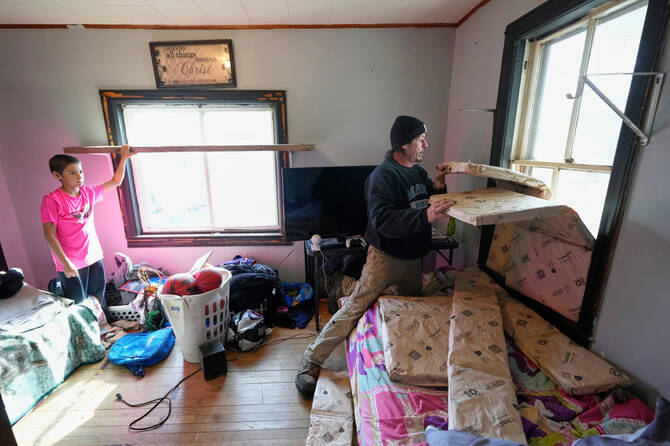
In Baileyville, a small town near the Canadian border, Berry puts plastic over his windows and blankets under the door to block the wind. In addition to the emergency assistance, he has benefited from a fuel donation program in Hancock and Washington counties known as “The Heating and Warmth Fund,” or THAW. His church community also supported him through his illness, which included a severe lung infection, sepsis and surgery to remove part of his stomach and colon.
“The thing about having faith is, you don’t have to worry. Like, God’s got me no matter what,” he said. “But I know that a lot of people are really freaking out. They’re really nervous, and it’s sad to me.”
Berry considers himself “very conservative” but said he thinks both Republicans and Democrats are being manipulative. His said his illness prompted him to focus less on Washington and more on his local community.
“Hopefully people are waking up, but hopefully they wake up in the right way,” he said. “Instead of waking up and being like, ‘Let’s start a revolution!’ Let’s wake up and let’s go shake hands with our neighbors.”

Federal shutdown creates uncertainty for Maine cancer patient struggling to stay warm
Short Url
https://arab.news/jbz4y
Federal shutdown creates uncertainty for Maine cancer patient struggling to stay warm
- New England officials are particularly concerned given the region’s reliance on oil for heat
- While electric and natural gas companies generally are barred from cutting customers off, more than half of Maine households rely on oil
Animal trafficking reaches record high in 2025: Interpol
LYON: Demand for exotic pets drove seizures of live animals to a record high in 2025, the Interpol police agency said Thursday as it announced a clampdown that led to the interception of nearly 30,000 animals.
Interpol said that wildlife crime is now an industry worth more than $20 billion a year, ranging from the movement of thousands of shark fins to banned ivory and primate meat.
In a month-long operation from September 15, law enforcement in 134 countries seized 6,160 birds, 2,040 tortoises, 1,150 reptiles, 208 primates, 46 pangolins, 10 “big cats” and 19,415 other wild animals, Interpol said in a statement. Some 1,100 suspects were detained.
It said that in Qatar, authorities detained a man seeking to sell a primate threatened with extinction for $14,000 on a social media platform. In Brazil, police identified 145 suspects as they rescued more than 200 animals, including in a crackdown on an international golden lion tamarin trafficking ring.
“A shipment from Asia intercepted at a North American mail center contained over 1,300 primate body parts including bones skulls and other derivatives,” the statement said.
Nearly 10,500 butterflies, spiders and insects were also caught in Operation Thunder 2025, highlighting the variety of species being targeted, according to Interpol.
“While live animal seizures reached a record high this year — driven largely by demand for exotic pets — most wildlife trafficking involved animal remains, parts and derivatives, often used in traditional medicine or specialty foods,” the Lyon-based agency said.
“Estimates put the annual value of wildlife crime at $20 billion, but the clandestine nature of the trade suggests that the real figure is likely much higher.”
Interpol said there was “an escalating illicit trade” in bushmeat, the term used for wild animal meat.
It said Belgian authorities intercepted “primate meat,” Kenyan officials seized over 400 kilogrammes (880 pounds) of giraffe meat and Tanzanian law enforcement recovered zebra and antelope meat and skins valued at $10,000.
“Globally, a record 5.8 tons of bushmeat was seized, with a notable increase in cases from Africa into Europe.”
The clampdown also resulted in the seizure of some 32,000 cubic meters of illegally cut wood. Interpol said that illegal forestry accounts for between 15 and 30 percent of global wood trade.
Interpol said that wildlife crime is now an industry worth more than $20 billion a year, ranging from the movement of thousands of shark fins to banned ivory and primate meat.
In a month-long operation from September 15, law enforcement in 134 countries seized 6,160 birds, 2,040 tortoises, 1,150 reptiles, 208 primates, 46 pangolins, 10 “big cats” and 19,415 other wild animals, Interpol said in a statement. Some 1,100 suspects were detained.
It said that in Qatar, authorities detained a man seeking to sell a primate threatened with extinction for $14,000 on a social media platform. In Brazil, police identified 145 suspects as they rescued more than 200 animals, including in a crackdown on an international golden lion tamarin trafficking ring.
“A shipment from Asia intercepted at a North American mail center contained over 1,300 primate body parts including bones skulls and other derivatives,” the statement said.
Nearly 10,500 butterflies, spiders and insects were also caught in Operation Thunder 2025, highlighting the variety of species being targeted, according to Interpol.
“While live animal seizures reached a record high this year — driven largely by demand for exotic pets — most wildlife trafficking involved animal remains, parts and derivatives, often used in traditional medicine or specialty foods,” the Lyon-based agency said.
“Estimates put the annual value of wildlife crime at $20 billion, but the clandestine nature of the trade suggests that the real figure is likely much higher.”
Interpol said there was “an escalating illicit trade” in bushmeat, the term used for wild animal meat.
It said Belgian authorities intercepted “primate meat,” Kenyan officials seized over 400 kilogrammes (880 pounds) of giraffe meat and Tanzanian law enforcement recovered zebra and antelope meat and skins valued at $10,000.
“Globally, a record 5.8 tons of bushmeat was seized, with a notable increase in cases from Africa into Europe.”
The clampdown also resulted in the seizure of some 32,000 cubic meters of illegally cut wood. Interpol said that illegal forestry accounts for between 15 and 30 percent of global wood trade.
© 2025 SAUDI RESEARCH & PUBLISHING COMPANY, All Rights Reserved And subject to Terms of Use Agreement.