Federal shutdown creates uncertainty for Maine cancer patient struggling to stay warm

While electric and natural gas companies generally are barred from cutting customers off, more than half of Maine households rely on oil. (AP)
Short Url
Updated 12 November 2025
Follow

Federal shutdown creates uncertainty for Maine cancer patient struggling to stay warm

  • New England officials are particularly concerned given the region’s reliance on oil for heat
  • While electric and natural gas companies generally are barred from cutting customers off, more than half of Maine households rely on oil

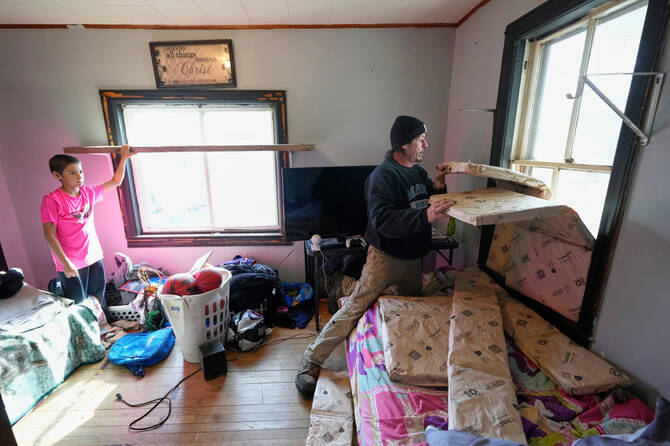
BAILEYVILLE: Setting the thermostat at 60 degrees used to be no problem for Gerard Berry, even during harsh Maine winters. Then he got sick with stomach cancer and struggled to stay warm as he lost weight.
“I used to tell the kids, ‘Put a sweatshirt on.’ But when I got sick, I got really thin, and we had to push it up a lot more,” said Berry, 47. “We burned a lot more fuel last year than we ever did.”
Berry’s family of seven got help filling their oil tank last winter. But Maine officials and those in other states are scrambling to sort out their options in light of the federal government shutdown.
An emergency assistance program that typically starts Nov. 1 and helps 7,000 Maine families per year remains on hold. But MaineHousing is reallocating $2.2 million earmarked for weatherization to make initial payments for roughly 4,000 households that applied early to the broader Low-Income Home Energy Assistance Program.
Borrowing funds from one program to pay for another is not ideal, but “this will get the trucks rolling,” said Dan Brennan, director of the quasi-state agency. Over the next few weeks, households that applied in August and September will have money added to their accounts with fuel vendors.
“This will help prevent heating emergencies for our most vulnerable neighbors, family members, and friends,” Brennan said.
Commonly called LIHEAP, the $4.1 billion program helps 5.9 million households nationwide heat and cool their homes. While the uncertainty over its future is raising concerns across the country, New England officials are particularly concerned given the region’s reliance on oil for heat. Electric and natural gas companies generally are barred from pulling the plug, but more than half of Maine households rely on oil.
In Baileyville, a small town near the Canadian border, Berry puts plastic over his windows and blankets under the door to block the wind. In addition to the emergency assistance, he has benefited from a fuel donation program in Hancock and Washington counties known as “The Heating and Warmth Fund,” or THAW. His church community also supported him through his illness, which included a severe lung infection, sepsis and surgery to remove part of his stomach and colon.
“The thing about having faith is, you don’t have to worry. Like, God’s got me no matter what,” he said. “But I know that a lot of people are really freaking out. They’re really nervous, and it’s sad to me.”
Berry considers himself “very conservative” but said he thinks both Republicans and Democrats are being manipulative. His said his illness prompted him to focus less on Washington and more on his local community.
“Hopefully people are waking up, but hopefully they wake up in the right way,” he said. “Instead of waking up and being like, ‘Let’s start a revolution!’ Let’s wake up and let’s go shake hands with our neighbors.”


First climate migrants arrive in Australia from sinking Tuvalu in South Pacific

Updated 3 sec ago
Follow

First climate migrants arrive in Australia from sinking Tuvalu in South Pacific

SYDNEY: The first climate migrants to leave the remote Pacific island nation of Tuvalu have arrived in Australia, hoping to preserve links to their sinking island home, foreign affairs officials said on Thursday.
More than one-third of Tuvalu’s 11,000 population applied for a climate visa to migrate to Australia, under a deal struck between the two countries two years ago.
The intake is capped at 280 visas annually to prevent a brain drain in the small island nation.
Among the islanders selected in the initial intake of climate migrants is Tuvalu’s first female forklift driver, a dentist, and a pastor focused on preserving their spiritual life thousands of kilometers (miles) from home, Australian government officials said.
Tuvalu, one of the countries at greatest risk from climate change because of rising sea levels, is a group of low-lying atolls scattered across the Pacific between Australia and Hawaii.
Manipua Puafolau, from Tuvalu’s main island of Funafuti, arrived in Australia a fortnight ago. A trainee pastor with the most prominent church in Tuvalu, he plans to live in the small town of Naracoorte in the state of South Australia, where several hundred Pacific Islanders work in seasonal agriculture and meat processing jobs.
“For the people moving to Australia, it is not only for their physical and economic well-being, but also calls for spiritual guidance,” he said in a video released by Australia’s foreign affairs department.
Tuvalu Prime Minister Feleti Teo visited the Tuvaluan community in Melton, Melbourne, last month to emphasize the importance of maintaining strong ties and cultural bonds across borders as citizens migrate, Tuvalu officials said.
On Tuvalu’s main atoll of Funafuti, the land is barely wider than the road in many stretches. Families live under thatched roofs, and children play football on the airport runway due to space constraints.
By 2050, NASA scientists project daily tides will submerge half of Funafuti atoll, home to 60 percent of Tuvalu’s residents, where villagers cling to a strip of land as narrow as 20 meters (65 feet). The forecast assumes a one-meter rise in sea levels, while the worst case, double that, would put 90 percent of the country’s main atoll under water.

CLIMATE VISAS OFFER ‘MOBILITY WITH DIGNITY’
Australia’s Foreign Minister Penny Wong said the climate migrants would contribute to Australian society.
The visa offered “mobility with dignity, by providing Tuvaluans the opportunity to live, study and work in Australia as climate impacts worsen,” Wong said in a statement to Reuters.
Support services are being established by Australia to help Tuvaluan families set up in the east coast city of Melbourne, Adelaide in South Australia and in the northern state of Queensland.
Kitai Haulapi, the first female forklift driver in Tuvalu, recently married and will relocate to Melbourne, population five million. In a video released by Australia’s foreign affairs department she says that she hopes to find a job in Australia and continue to contribute to Tuvalu by sending money back to her family.
Dentist Masina Matolu, who has three school-aged children and a seafarer husband, will move with her family to the northern Australian city of Darwin. She plans to work with indigenous communities.
“I can always bring whatever I learn new from Australia back to my home culture, just to help,” she said in a video statement.