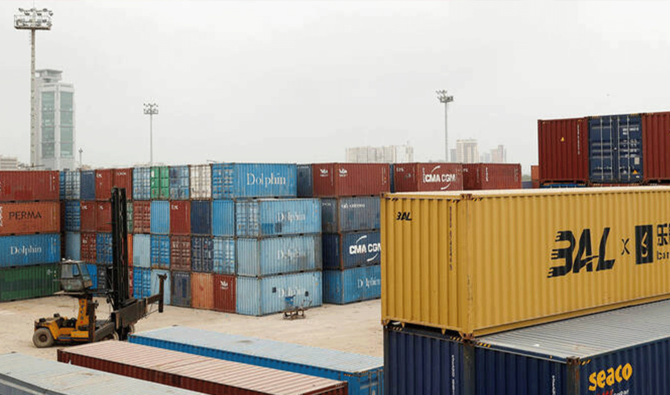

KARACHI: Pakistan recorded a $35 million trade deficit with neighboring India in the first quarter of the current fiscal year despite formal bilateral trade remaining suspended since August 2019, according to official central bank data reviewed by Arab News.
Trade between the two countries has been halted since Pakistan suspended imports and exports after India revoked the semi-autonomous status of Indian-administered Kashmir in 2019. However, limited imports continue under special permissions, primarily involving pharmaceutical raw materials described by officials as humanitarian exemptions. The continuation of such flows comes at a time of renewed border tension following cross-border strikes and a brief military conflict in May this year.
State Bank of Pakistan (SBP) data shows that during July–September of fiscal year 2025–26, Pakistan imported $36.6 million worth of goods from India while exporting goods worth $1.95 million. This resulted in a $34.7 million surplus in India’s favor.
“Pakistan imports largely pharma APIs [Active Pharmaceutical Ingredients] from India on humanitarian grounds,” said Shankar Talreja, head of research at Karachi-based Topline Securities. “The APIs market is quite well-established in India, and its trade is currently permitted [by Pakistan],” he told Arab News.
Pakistan’s commerce ministry spokesperson, Naveed-ul-Haq Kallu, did not respond to questions about whether any formal trade channels had been reopened or what measures were being considered to manage the deficit.
Pakistan and India, which both claim Kashmir in full but administer it in part, have fought several wars since independence in 1947. The most recent escalation followed an April 22 attack in Indian-administered Kashmir that killed 26 people, most of them tourists.
India blamed militants it said were backed from Pakistan, which Islamabad denied. India later carried out strikes it described as targeting militant infrastructure across the border on May 7. Pakistan said it retaliated and downed several Indian aircraft, while acknowledging its own air bases sustained damage. The confrontation ended with a US-brokered ceasefire.
Pakistan originally suspended bilateral trade with India in August 2019 after New Delhi revoked Article 370 of its constitution, ending the semi-autonomous status of Indian-administered Kashmir. Islamabad responded by downgrading diplomatic ties and halting imports and exports.
However, limited exceptions were later allowed for essential items such as pharmaceutical raw materials, which Pakistani officials have described as necessary to avoid domestic shortages. Despite the formal suspension, cross-border commercial flows have continued at a small scale, often through third countries or via documented “humanitarian” exemptions.
In August 2019, Pakistan’s exports to India were $2.47 million and imports $69.1 million.
While formal trade remains halted, SBP data shows bilateral trade still totaled $222 million in FY25 and $210 million in FY24, largely due to permitted pharmaceutical inputs and small-scale commercial flows.
Before the suspension, the two countries traded pharmaceuticals, cotton, organic chemicals, food products, edible fruits and nuts, mineral fuels, raw hides, plastics, and glassware, according to the Indian High Commission in Islamabad. According to data cited on its website, Indian exports to Pakista historically exceeded imports, reaching a surplus of $1.8 billion in 2013–14.
In the first quarter of FY26, Pakistan increased exports to India to $1.95 million from $275,000 in the same period last year while reducing imports to $36.6 million from $57.5 million. Pakistan’s overall trade deficit with India in FY25 widened by 99 percent to $219 million, SBP figures show.
Prime Minister Shehbaz Sharif is currently attempting to stabilize Pakistan’s economy under a $7 billion International Monetary Fund program, which calls for boosting exports and tax revenue as part of broader reforms.