Top ex-judges warn Pakistan Supreme Court faces ‘greatest threat’ from 27th amendment

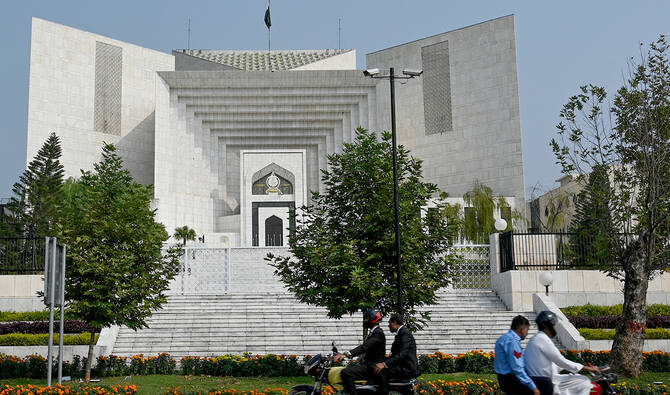
In this photograph taken on October 23, 2024, commuters ride past the Pakistan's Supreme Court building in Islamabad. (AFP)
Short Url
Updated 10 November 2025
Follow

Top ex-judges warn Pakistan Supreme Court faces ‘greatest threat’ from 27th amendment

  • Former judges say amendment would permanently subordinate Supreme Court to new court
  • Letter urges Chief Justice Afridi to call immediate full court meeting before vote

ISLAMABAD: Several former senior judges and prominent lawyers have written to Chief Justice Yahya Afridi warning that Pakistan’s proposed 27th constitutional amendment would “permanently denude” the Supreme Court of its constitutional authority, according to a letter seen by Arab News on Monday. 

The amendment, which is currently being debated in parliament, introduces sweeping institutional changes to establish a new Federal Constitutional Court, alter procedures for judicial appointments and transfers, and restructure the command hierarchy of Pakistan’s armed forces by creating the post of Chief of Defense Forces and abolishing the office of Chairman of the Joint Chiefs of Staff Committee (CJCSC). The bill also proposes revisions to how federal tax revenue is shared with provinces under the National Finance Commission (NFC) award, a core element of Pakistan’s federal system.

Because these measures affect the Supreme Court’s role as the country’s highest constitutional authority, the proposal has become one of the most politically sensitive constitutional debates in years. Opposition lawmakers have also warned that the 27th amendment would undermine civilian oversight and provincial rights. Ruling party members have rejected this, arguing the changes clarify institutional roles and strengthen the federation.

“With deep sadness and with the deepest regret, this letter is being written by us not in normal times but in times that present the greatest threat to the Supreme Court of Pakistan since its establishment in 1956,” the signatories wrote in a letter to the chief justice, adding that the proposed amendment would be “the biggest and the most radical restructuring of the Federal Appellate Court structure since the enactment of the Government of India Act, 1935.”

“We say this without any fear of contradiction that no civilian or military government in Pakistan’s history has even tried, let alone succeeded, in relegating the Supreme Court of Pakistan as a sub-ordinate court and permanently denude it of its constitutional jurisdiction, as is being done through the proposed Constitution (Twenty-Seventh Amendment) Act, 2025,” the letter said.

The signatories requested Chief Justice Afridi to “call a Full Court Meeting immediately and without any delay” to deliberate on the amendment before parliament votes on it.

In its most severe warning, the letter says that if the request is refused, “we would at least expect you to accept and admit in a written response to us that you are now reconciled to be the last Chief Justice of Pakistan and now reconciled to accept the demise of the Supreme Court of Pakistan as the highest court in Pakistan.”

The letter was signed by former Senior Puisne Judge of the Supreme Court Justice (R) Mushir Alam, former senior judges, and multiple former presidents of the Supreme Court Bar Association, including Muneer A. Malik, Muhammad Akram Sheikh, Anwar Mansoor Khan, Ali Ahmad Kurd and Abid S. Zuberi.

Earlier on Monday, Information Minister Attaullah Tarar said the government had the votes required to pass the 27th constitutional amendment.

“God willing, we have the complete votes [to have the amendment passed],” Tarar told reporters at the Parliament House. 

“There is no ambiguity in it. This is a positive constitutional amendment and has been made keeping in mind the best international practices in the world and our prevailing circumstances.”

Constitutional amendments in Pakistan require a two-thirds majority in both houses of parliament. Since its adoption in 1973, the constitution has been amended more than two dozen times, often reflecting shifts in authority between civilian governments, the judiciary and the military.

The current proposal follows the 26th constitutional amendment passed in October 2024, which gave parliament a formal role in appointing the chief justice and established a senior judges’ panel to hear constitutional cases, measures critics said weakened judicial independence.


IMF board to approve Pakistan reviews today ‘if all goes well,’ say officials

Updated 4 sec ago
Follow

IMF board to approve Pakistan reviews today ‘if all goes well,’ say officials

  • IMF’s executive board is scheduled to meet today to discuss the disbursement of $1.2 billion
  • Economists say the money will boost Pakistan’s forex reserves, send positive signals to investors

KARACHI: The International Monetary Fund’s (IMF) executive board is scheduled to meet today, Monday, to approve the release of about $1.2 billion for Pakistan under the lender’s two loan facilities, said IMF officials who requested not to be named.

The IMF officials confirmed the executive board was going to decide on the Fund’s second review under the $7 billion Extended Fund Facility (EFF) and first review under the $1.4 billion Resilience and Sustainability Facility (RSF), a financing tool that provides long-term, low-cost loans to help countries address climate risks.

“The board meeting will be taking place as planned,” an IMF official told Arab News.

“The board is on today yes as per the calendar,” said another.

A well-placed official at Pakistan’s finance ministry also confirmed the board meeting was scheduled today to discuss the next tranche for Pakistan.

The IMF executive board’s meeting comes nearly two months after a staff-level agreement (SLA) was signed between the two sides in October.

Procedurally, the SLAs are subject to approval by the executive board, though it is largely viewed as a formality.

“If all goes well, the reviews should pass,” said the second IMF official.

On approval, Pakistan will have access to about $1 billion under the EFF and about $200 million under the RSF, the IMF said in a statement in October after the SLA.

The fresh transfer will bring total disbursements under the two arrangements to about $3.3 billion, it added.

Experts see smooth sailing for Pakistan in terms of the passing of the two reviews, saying the IMF disbursements will help the cash-strapped nation to strengthen its balance of payments position.

Samiullah Tariq, group head of research at Pakistan Kuwait Investment Company Limited, said the IMF board’s approval will show that Pakistan’s economy is on the right path.

“It obviously will help strengthen [the country’s] external sector, the balance of payments,” he told Arab News.

Until recently, Pakistan grappled with a macroeconomic crisis that drained its financial resources and triggered a balance of payments crisis.

Pakistan has reported financial gains since 2022, recording current account surpluses and taming inflation that touched unprecedented levels in mid-2023.

Economists also viewed the IMF’s bailout packages as crucial for cash-strapped Pakistan, which has relied heavily on financing from bilateral partners such as Saudi Arabia, China and the United Arab Emirates, as well as multilateral lenders.

Saudi Arabia, through the Saudi Fund for Development, last week extended the term of its $3 billion deposit for another year to help Pakistan boost its foreign exchange reserves, which stood at $14.5 billion as of November 28, according to State Bank of Pakistan statements.

“In our view this [IMF tranche] will be approved,” said Shankar Talreja, head of research at Karachi-based brokerage Topline Securities Limited.

“This will help strengthen reserves and will eventually help a rating upgrade going forward,” he said.

The IMF board’s nod, Talreja said, would also send a signal to the international and local investors regarding the continuation of the reform agenda by Pakistan’s government.