

Pakistan government says it has the votes to pass sweeping 27th constitutional amendment

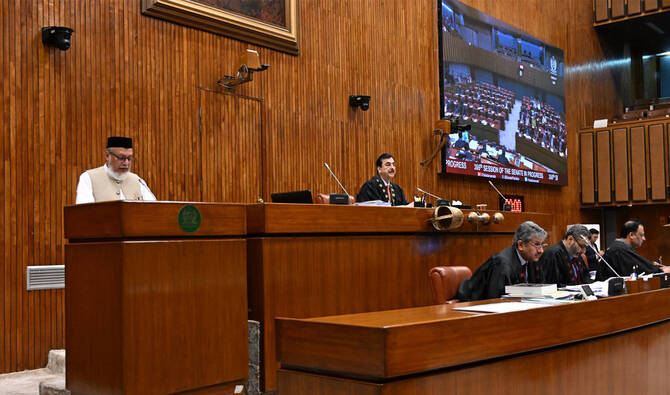
Senate Chairman Syed Yousaf Raza Gilani is chairing a session in the parliament on November 8, 2025. (Pakistan Senate)
Short Url
Updated 10 November 2025
Follow

Pakistan government says it has the votes to pass sweeping 27th constitutional amendment

  • Amendment would create Constitutional Court, elevate army chief as Chief of Defense Forces
  • Proposal also revises judicial transfer powers and could alter provincial revenue protections

ISLAMABAD: Information Minister Attaullah Tarar said on Monday the government had the votes required to pass the 27th constitutional amendment, as Pakistan’s Senate resumed debate on legislation that would overhaul key aspects of the judicial structure, military command arrangements and federal-provincial revenue balance.

The draft amendment tabled last week introduces several far-reaching changes. It rewrites Article 243 of the Constitution to create the new post of Chief of Defense Forces, abolishing the long-standing role of Chairman of the Joint Chiefs of Staff Committee (CJCSC). The army chief would be elevated to the constitutionally recognized top command of Pakistan’s armed services, while the president would formally appoint the army, navy and air chiefs on the prime minister’s advice. The amendment also proposes establishing a constitutional court, revising procedures on the transfer of judges and altering the framework that governs how federal revenue is shared with provinces.

The proposed changes to the National Finance Commission (NFC) award, which governs how federal tax revenues are divided among provinces, are particularly sensitive because they underpin Pakistan’s federal structure and provincial fiscal autonomy.

“God willing, we have the complete votes [to have the amendment passed],” Tarar told reporters at the Parliament House. “There is no ambiguity in it. This is a positive constitutional amendment and has been made keeping in mind the best international practices in the world and our prevailing circumstances.”

Constitutional amendments in Pakistan require a two-thirds majority in both houses of parliament. Since its adoption in 1973, the constitution has been amended more than two dozen times, often reflecting shifts in authority between civilian governments, the judiciary and the military.

The current proposal follows the 26th constitutional amendment passed in October 2024, which gave parliament a formal role in appointing the chief justice and established a senior judges’ panel to hear constitutional cases, measures critics said weakened judicial independence.

Opposition lawmakers have warned the 27th amendment would undermine civilian oversight and provincial rights. Ruling party members have rejected this, arguing the changes clarify institutional roles and strengthen the federation.

Both the Senate and the National Assembly are continuing debate this week as the government works to secure the required majority.


Islamabad dismisses claims about paying up to 8 percent interest on foreign loans as ‘misleading’

Updated 22 February 2026
Follow

Islamabad dismisses claims about paying up to 8 percent interest on foreign loans as ‘misleading’

  • Pakistan has long relied on external loans to help bridge persistent gaps in public finances and foreign exchange reserves
  • Pakistan’s total external debt, liabilities stand at $138 billion at an overall average cost of around 4 percent, ministry says

KARACHI: Pakistan’s finance ministry on Sunday dismissed as “misleading” claims that the country is paying up to 8 percent interest on external loans, saying the overall average cost of external public debt is approximately 4 percent.

Pakistan has long relied on external loans to help bridge persistent gaps in public finances and foreign exchange reserves, driven largely by a narrow tax base, chronic trade deficits, rising debt-servicing costs and repeated balance-of-payments pressures.

Over the decades, successive governments have turned to multilateral and bilateral lenders, including the International Monetary Fund, the World Bank and the Asian Development Bank, to support budgetary needs and shore up foreign exchange reserves.

The finance ministry on Sunday issued a clarification in response to a “recent press commentary” regarding the country’s external debt position and associated interest payments, and said the figures required contextual explanation to ensure accurate understanding of Pakistan’s external debt profile.

“Pakistan’s total external debt and liabilities currently stand at $138 billion. This figure, however, encompasses a broad range of obligations, including public and publicly guaranteed debt, debt of Public Sector Enterprises (both guaranteed and non-guaranteed), bank borrowings, private-sector external debt, and intercompany liabilities to direct investors. It is therefore important to distinguish this aggregate figure from External Public (Government) Debt, which amounts to approximately $92 billion,” it said.

“Of the total External Public Debt, nearly 75 percent comprises concessional and long-term financing obtained from multilateral institutions (excluding the IMF) and bilateral development partners. Only about 7 percent of this debt consists of commercial loans, while another 7 percent relates to long-term Eurobonds. In light of this composition, the claim that Pakistan is paying interest on external loans ‘up to 8 percent’ is misleading.

The overall average cost of External Public Debt is approximately 4 percent, reflecting the predominantly concessional nature of the borrowing portfolio.”

With respect to interest payments, public external debt interest outflows increased from $1.99 billion in Fiscal Year (FY) 2022 to $3.59 billion in FY2025, representing an increase of 80.4 percent, not 84 percent as reported. In absolute terms, interest payments rose by $1.60 billion over this period, not $1.67 billion, it said.

According to the State Bank of Pakistan’s records, Pakistan’s total debt servicing payments to specific creditors during the period under reference were as follows: the IMF received $1.50 billion, of which $580 million constituted interest; Naya Pakistan Certificates payments totaled $1.56 billion, including $94 million in interest; the Asian Development Bank received $1.54 billion, including $615 million in interest; the World Bank received $1.25 billion, including $419 million in interest; and external commercial loans amounted to nearly $3 billion, of which $327 million represented interest payments.

“While interest payments have increased in absolute terms, this rise cannot be attributed solely to an expansion in the debt stock,” the ministry said. “Although the overall debt stock has increased slightly since FY2022, the additional inflows have primarily originated from concessional multilateral sources and the IMF’s Extended Fund Facility (EFF) under the ongoing IMF-supported program.”

Pakistan secured a $7 billion IMF bailout in Sept. 2024 as part of Prime Minister Shehbaz Sharif’s efforts to stabilize the South Asian economy that narrowly averted a default in 2023. The government has since been making efforts to boost trade and bring in foreign investment to consolidate recovery.

“It is also important to note that the increase in interest payments reflects prevailing global interest rate dynamics. In response to the inflation surge of 2021–22, the US Federal Reserve raised the federal funds rate from 0.75-1.00 percent in May 2022 to 5.25–5.50 percent by July 2023. Although rates have since moderated to around 3.75 percent, they remain significantly higher than 2022 levels,” the finance ministry said.

“The government remains committed to prudent debt management, transparency, and the continued strengthening of Pakistan’s macroeconomic stability,” it added.