Britain’s BBC boss Tim Davie resigns following criticism over Trump documentary edit

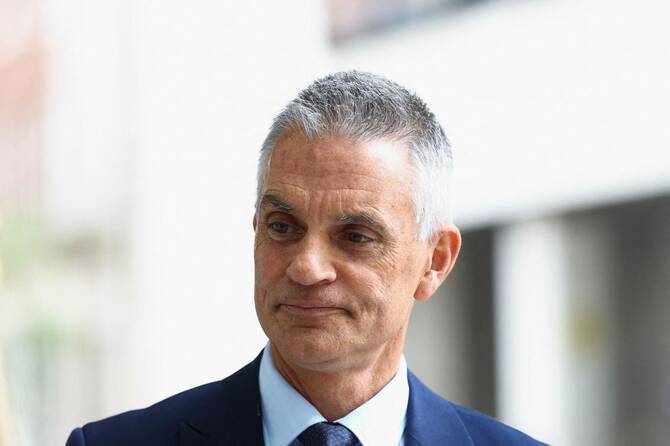
Tim Davie has announced he will step down as director-general of the BBC. It comes after concerns have been raised about impartiality at the corporation, including how a speech by US President Donald Trump was edited in an episode of Panorama. (AFP)
Short Url
Updated 09 November 2025
Follow

Britain’s BBC boss Tim Davie resigns following criticism over Trump documentary edit

  • BBC was accused of bias over Trump, Gaza
  • White House had accused the BBC of being a “propaganda machine“
  • BBC board stunned by Davie’s resignation — source

LONDON: The director general of Britain’s BBC, Tim Davie, and the chief executive of news, Deborah Turness, have resigned following criticism over bias at the corporation, including in the way it edited a speech by US President Donald Trump.

The BBC has been embroiled in a spate of allegations that it had failed to maintain political neutrality in its reporting, including in its coverage of Trump and the Israel-Hamas war.

In the most recent controversy, the Daily Telegraph had reported for days on an internal document produced by a former BBC adviser on standards who had listed a raft of errors, including in the way a speech by Trump on Jan. 6, 2021, was edited.

The document suggested the flagship Panorama program had edited two parts of Trump’s speech together so he appeared to encourage the Capitol Hill riots of January 2021.

“This is entirely my decision, and I remain very thankful to the Chair and Board for their unswerving and unanimous support throughout my entire tenure, including during recent days,” Davie said in a statement.

“I have been reflecting on the very intense personal and professional demands of managing this role over many years in these febrile times, combined with the fact that I want to give a successor time to help shape the Charter plans they will be delivering.”

Trump in the BBC documentary was shown telling his supporters that “we’re going to walk down to the Capitol” and that they would “fight like hell,” a comment he made in a different part of his speech.

Trump’s press secretary Karoline Leavitt described the BBC as “100 percent fake news” and a “propaganda machine” in an interview published on Friday.

Davie will stay on for the next few months while a replacement is found.

A person familiar with the situation said Davie’s decision had left the BBC board stunned by the move. 


BBC backs Israel’s participation in Eurovision Song Contest amid expanding boycott

Updated 06 December 2025
Follow

BBC backs Israel’s participation in Eurovision Song Contest amid expanding boycott

  • Ireland, Spain, the Netherlands and Slovenia withdraw, citing concerns about the war in Gaza, after organizers clear Israel to compete
  • Critics accuse organizers of double standards, given that Russia was banned from Eurovision in 2022 after invasion of Ukraine

LONDON: The BBC has backed the European Broadcasting Union’s decision to allow Israel to participate in the 2026 Eurovision Song Contest, despite mounting opposition and an expanding boycott by European countries and public broadcasters.

National broadcasters in Ireland, Spain, the Netherlands and Slovenia have formally withdrawn from next year’s event, citing what they described as Israel’s violations of international law during its ongoing war on Gaza, which has killed more than 70,000 people, left much of the territory in ruins and prompted accusations of war crimes.

The BBC, however, said it backed the decision to allow Israel to take part in the contest.

“We support the collective decision made by members of the EBU,” a BBC spokesperson said. “This is about enforcing the rules of the EBU and being inclusive.”

Israel’s participation in the 2026 event, set to take place in the Austrian capital Vienna in May, was confirmed during the EBU’s general assembly in Geneva on Thursday. 

However, pressure continued to build in opposition to the decision, with broadcasters from four countries pulling out and critics accusing organizers of double standards, given that Russia was banned from Eurovision in 2022 after the invasion of Ukraine.

Following the EBU decision, Irish public broadcaster RTE said it would neither participate in nor screen the contest. It said Ireland’s participation “remains unconscionable given the appalling loss of lives in Gaza and the humanitarian crisis there.” It also condemned the killing of journalists in Gaza and the denial of access to the international media. More than 200 Palestinian journalists have reportedly been killed since the start of the war.

Slovenian broadcaster RTV said it was withdrawing from the competition “on behalf of the 20,000 children who died in Gaza.” Chairperson Natalija Gorscak said the decision reflected growing public demand to uphold European values of peace and press freedoms, noting that the international media are still banned from Gaza.

She added that Israel’s 2025 Eurovision performance had been overtly political, and contrasted the decision about Israel with the ban on Russia’s participation following the invasion of Ukraine.

Dutch broadcaster AVROTROS also withdrew from the contest, describing the decision of the EBU as “incompatible with the public values that are essential to us.”

CEO Taco Zimmerman said: “Culture unites, but not at all costs. What happened last year touches our boundaries … Universal values like humanity and a free press have been seriously violated.”

The EBU did not hold a vote on Israel’s participation in the contest. Instead, member broadcasters voted in favor of new rules for contest voting to prevent governments or other groups from unfairly promoting songs to manipulate the result.

Austria, which is set to host the competition after Viennese singer JJ won this year with “Wasted Love,” supports Israel’s participation. Germany, too, was said to back Israel.