

US air travel could ‘slow to a trickle’ as shutdown bites: transport secretary

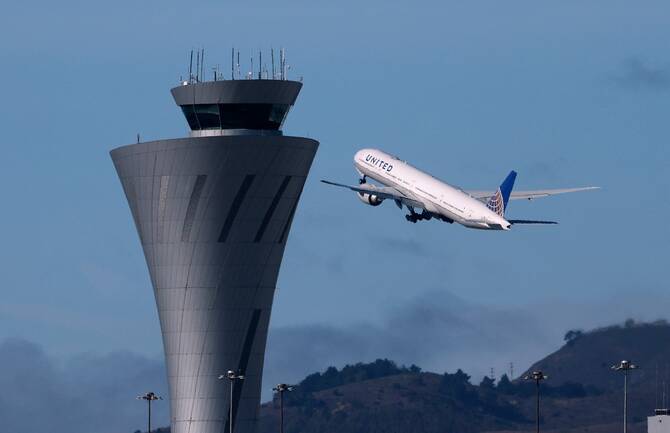
A United Airlines plane takes off from San Francisco International Airport (SFO) in San Francisco, California, Nov. 07, 2025. (AFP)
Short Url
Updated 10 November 2025
Follow

US air travel could ‘slow to a trickle’ as shutdown bites: transport secretary

  • “The two weeks before Thanksgiving, you’re going to see air travel be reduced to a trickle,” transport secretary said
  • On Sunday morning, more than 1,330 cancelations were recorded for flights within the US and to and from the US

WASHINGTON: Air travel in the United States could soon “slow to a trickle,” authorities warned Sunday as thousands more flights were canceled or delayed and passengers faced chaos triggered by the federal government shutdown.
Transportation Secretary Sean Duffy said the number of flights being snarled or cut would multiply if the funding impasse between Democrats and Republicans continues while Americans gear up to travel for the Thanksgiving holiday later this month.
“It’s only going to get worse,” Duffy said on CNN’s “State of the Union,” a Sunday news talk show.
“The two weeks before Thanksgiving, you’re going to see air travel be reduced to a trickle.”
On Sunday morning, more than 1,330 cancelations were recorded for flights within the United States and to and from the US, according to data from FlightAware, a flight tracking platform.
Airports that were particularly hard hit included the three New York City area airports, Chicago’s O’Hare International Airport, and Atlanta’s Hartsfield-Jackson Airport.
Duffy warned that many Americans planning to travel for the November 27 holiday “are not going to be able to get on an airplane, because there are not going to be that many flights that fly if this thing doesn’t open back up.”

‘Massive disruption’

Sunday marked the 40th day of the record shutdown and the third day of flights being reduced at airports nationwide, after the Trump administration ordered reductions to ease strain on air traffic controllers working without pay.
“We’re going to see air traffic controllers, very few of them coming to work, which means you’ll have a few flights taking off and landing,” Duffy told Fox News Sunday.
“You’re going to have massive disruption (and) a lot of angry Americans.”
Duffy sought to blame Democrats for the high-stakes political standoff, but Senator Adam Schiff said Republicans were rejecting a “reasonable” compromise deal to end the shutdown.
“And the result from the Senate Republicans was ‘no,’ from the House Republicans ‘we are staying on vacation,’ and from the president ‘I’m going out to play golf,’ and that’s where we are while people are hurting,” Schiff said.
When asked whether Democrats would turn around and vote with Republicans, Schiff, a California Democrat, indicated that the issue of health care subsidies remained a sticking point in negotiations.

“No, I certainly hope it isn’t going to happen if millions of people are going to retain their health coverage and not have to pay these exorbitant premium increases,” Schiff said on ABC’s “This Week with George Stephanopoulos.”
“We need to end this. We proposed something, I think very reasonable. It was a compromise. Certainly wasn’t everything I want, which is a permanent extension of the tax credits,” he said, urging Republicans to allow “more time to work on this and reopen the government.”


Air India crash still shrouded in mystery six months on

Updated 4 sec ago
Follow

Air India crash still shrouded in mystery six months on

AHMEDABAD: What caused an Air India Boeing 787-8 Dreamliner to crash, killing 260 people? Six months on, investigators have yet to provide clear answers, fueling disputes between pilots, the airline and the manufacturer.
As required by international law, India’s Aircraft Accident Investigation Bureau (AAIB) published a preliminary report one month after the June 12 disaster, when the plane exploded into flames shortly after takeoff from Ahmedabad in western India.
That report provided some technical information, but the investigation is still ongoing.

- What happened? -

Air India flight 171 took off at 1:38 p.m. from Ahmedabad airport with 230 passengers and 12 crew members on board, bound for London Gatwick Airport.
Less than a minute later, it crashed into the buildings of a medical university campus, located a few hundred meters (yards) from the runway.
Video footage shows it taking off but failing to gain altitude, before crashing in a fireball.
The crash killed 241 of the 242 people on board and 19 on the ground.
Only one passenger survived but was seriously injured.
Among the dead were 200 Indians, 52 British nationals, seven Portuguese and one Canadian.

- Initial findings -

The AAIB report published on July 12 said that the fuel supply switches for both engines were almost simultaneously placed in the “off” position just after takeoff.
“In the cockpit voice recording, one of the pilots is heard asking the other why did he cut off (the fuel supply). The other pilot responded that he did not do so,” the report states.
The aircraft then began to lose altitude.
The report also notes that an auxiliary power unit, intended to provide power to the aircraft in the event of engine failure, deployed automatically.
Less than 10 seconds later, both switches were returned to the “on” position.
Immediately afterwards, “one of the two pilots” managed to transmit “Mayday, Mayday, Mayday,” before the plane crashed.
The 15-page document does not mention whether the turning off of the fuel switches could have been caused by pilot maneuver, or by any kind of malfunction.

- Controversy -

As soon as it was published, the report met strong criticism.
Pilot associations argue that the dialogue between the captain and his co-pilot, which the report merely paraphrases, suggests the possibility of human error without providing evidence.
They also pointed out that the AAIB did not recommend at that stage any control measures on the aircraft or its engines — effectively ruling out the possibility of a technical failure, or a maintenance or servicing defect.
A war of words erupted between the families of the victims, lawyers and pilots on one side, and the airline and the manufacturer on the other.
The father of one of the pilots took the case to the Supreme Court.
Pushkaraj Sabharwal, 91, father of pilot Sumeet Sabharwal, said the preliminary investigation was “profoundly flawed.”
In his petition, seen by AFP, he argued that it appeared to “predominantly focus on the deceased pilots, who are no longer able to defend themselves, while failing to examine or eliminate other more plausible technical and procedural causes of the crash.”

- Hypotheses -

British lawyer Sarah Stewart, who represents around 50 families of victims, also favors a scenario not involving the pilots.
“The factual information raises a troubling spectre that this accident may have been caused by uncommanded fuel cut off, suggesting a possible failure in the Boeing systems,” she said in a statement.
Air India CEO Campbell Wilson, in a speech on September 10, said that the “preliminary report indicates nothing wrong with the aircraft, nothing wrong with the engines, nothing wrong with the airline’s operation.”
Some experts, however, seem to doubt this.
“There were electrical faults reported before the crash on this plane,” former commercial pilot Amit Singh, founder of Safety Matters Foundation, told AFP.
“The narrative of the report is built in such a way that the reader tends to believe that the pilots are responsible” even though “a lot of the data presented are not sourced,” he said.
The final report “could be manipulated,” he warned.
Aviation expert Mark Martin goes even further, calling it a “cleverly designed cover-up.”
“Boeing did exactly the same after the 737 MAX crashes — they blamed the pilots,” he said of the accidents in 2018 and 2019, noting that an investigation later found a design flaw.
“Boeing cannot afford to take the blame for the crash,” said Martin.
Contacted by AFP, the US aircraft manufacturer declined to comment.