

Maldives pioneers eco-driven tourism approach, says minister

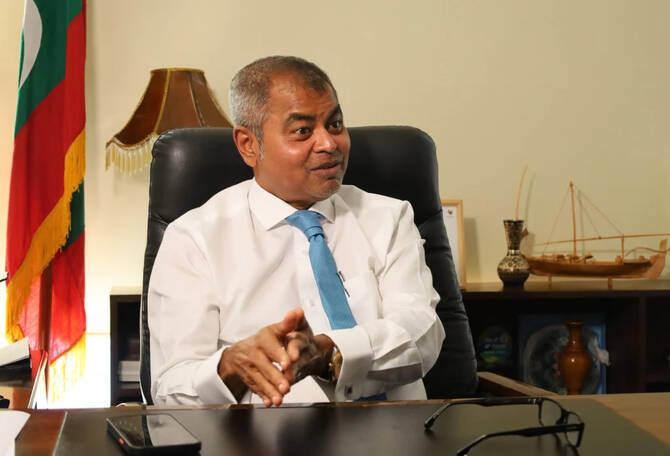
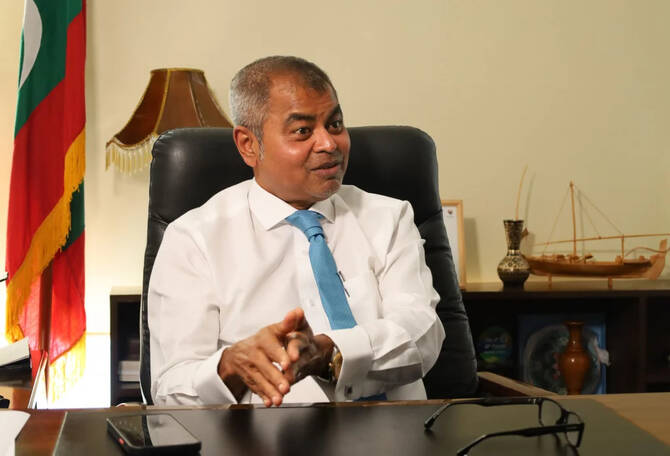
Maldives Minister of Tourism and Environment Thoriq Ibrahim. File
Short Url
Updated 10 November 2025
Follow

Maldives pioneers eco-driven tourism approach, says minister

RIYADH: The Maldives’ tourism model is built on a delicate balance between economic growth and environmental preservation, Minister of Tourism and Environment Thoriq Ibrahim said in an interview ahead of the UN’s Tourism 2025 event.

“In the Maldives, we have luxury resorts — one resort, one island — which means that tourists live on a separate island,” Ibrahim said. “Most of the tourism resorts are like deserted islands, so that’s where we stand out from other countries.”

Ibrahim explained that sustainability is a legal requirement at every stage of development. Before any resort construction begins, developers must carry out a comprehensive Environmental Impact Assessment to identify and mitigate potential damage to surrounding ecosystems.

“When one builds a resort, they first have to do an Environmental Impact Assessment to make sure that when they build the resort, there is minimal environmental impact,” he said.

Each resort, the minister noted, is designed to operate independently, with its own waste management, water production, and energy systems — an approach that promotes environmental self-sufficiency.

“They have to have their own solid waste management system, their own water production system, and they produce their own power,” he said.

This decentralized model also supports the government’s wider clean energy agenda. Under the current administration, the Maldives aims to generate 33 percent of its electricity from renewable sources by 2028, with solar energy leading the transition.

“Resorts are required to generate their own power. Under the current administration, one of the key pledges is that by 2028 the nation will produce 33 percent of its electricity from renewable energy,” Ibrahim said.

He added that many resorts are already moving in this direction, adopting large-scale solar installations and energy storage technologies. “Some resorts now have more than 50 or 60 percent renewable energy,” he said. “We are trying to have more and greener resorts that can have a lesser footprint.”

Beyond infrastructure, Ibrahim stressed the importance of educating visitors about environmental responsibility to preserve the islands’ fragile ecosystem.

“When tourists arrive at the resorts, we try to educate them and tell them what things they should not do that harm the environment, but at the same time, they should enjoy it and make sure they live within it,” he said.

He concluded that the Maldives’ success story hinges on maintaining this equilibrium — expanding tourism opportunities while safeguarding the pristine natural environment that defines the country’s global identity.

Saudi Maaden reports 156% profit surge to $2bn on strong commodity prices, record production

Updated 05 March 2026
Follow

Saudi Maaden reports 156% profit surge to $2bn on strong commodity prices, record production

RIYADH: Saudi mining and metals company Maaden has reported a 156 percent jump in its net profit attributable to shareholders for 2025, driven by higher commodity prices, record production volumes, and a one-off bargain purchase gain.

The state-backed giant posted a net profit of SR7.35 billion ($1.95 billion) for the full year 2025, an increase from SR2.87 billion in the previous year. The firm’s revenue surged by 19 percent to SR38.58 billion, up from SR32.55 billion in 2024.

This comes as Saudi Arabia steps up efforts to expand its mining sector as a pillar of economic diversification, encouraging international participation and private investment to unlock the Kingdom’s estimated $2.5 trillion in untapped mineral resources under Vision 2030.    

In a statement on Tadawul, the company said: “Performance was led by record phosphate production, near record aluminum production, an increase in all three of Maaden’s main output commodity prices.”

The performance was also fueled by a 60 percent increase in gross profit, which reached SR14.79 billion. In its annual results announcement, Maaden attributed the top-line growth to “higher commodity market prices for phosphate, aluminum and gold business units,” as well as increased sales volumes in its phosphate and aluminum segments. This was partially offset by slightly lower sales volume in the gold unit.

Maaden’s CEO, Bob Wilt, hailed 2025 as a transformative year for the company, marked by strategic growth and operational excellence. “This was a great year for Maaden’s strategic growth. We delivered strong financial results and sustained operational excellence across the business,” he said in a statement.

“This was driven by growth in production across all businesses, including record-breaking DAP (di-ammonium phosphatevolumes), disciplined cost control across and a clear commitment to our role as a cornerstone of the Saudi economy,” Wilt added.

Profitability was further bolstered by an increased share of net profit from joint ventures and an associate. This included a one-off bargain purchase gain of SR768 million related to Maaden’s investment in Aluminium Bahrain B.S.C. The company also benefited from lower finance costs.

The fourth quarter of 2025 was strong, with Maaden swinging to a net profit of SR1.67 billion, compared to a loss of SR106 million in the same period of the prior year. Quarterly revenue rose 7 percent to SR10.64 billion.

The firm achieved record production of di-ammonium phosphate, reaching 6.72 million tonnes for the year, a 9 percent increase. Aluminum production remained near-record levels, while the company added a net 7.8 million ounces to its reportable gold mineral resources through discovery and resource development.

The phosphate division saw sales jump 17 percent to SR20.77 billion, with the earnings before interest, taxes, depreciation, and amortization margin expanding to 47 percent. The aluminum business reported a 9 percent increase in sales to SR10.99 billion, with EBITDA more than doubling in the fourth quarter.

Looking ahead, Wilt emphasized that the pace of growth will accelerate as the company advances key initiatives, including the Phosphate 3 Phase 1 and Ar Rjum projects, which remain on budget and schedule. Maaden has also secured a gas supply for its future Phosphate 4 project.

“This pace of growth will only accelerate. Not only as we advance projects and increase the scale of our exploration program, but as we continue to grow production and implement technology that will further modernize, streamline and unlock value,” Wilt added.

Earnings per share for the year rose sharply to SR1.91, up from SR0.78 in 2024. Total shareholders’ equity increased by 18.7 percent to SR61.59 billion.