

Saudi Arabia, Pakistan sign Hajj 2026 agreement

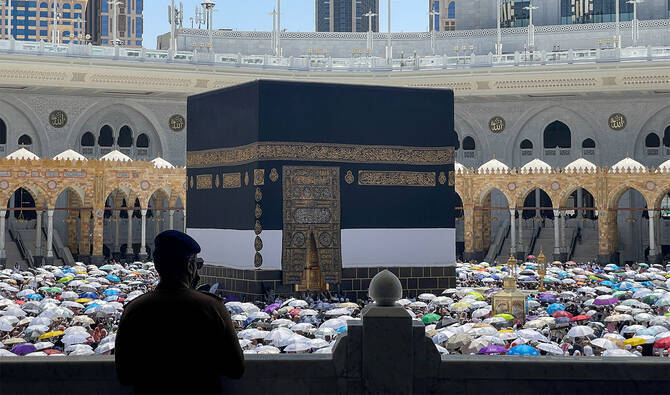
A policeman looks as Muslims perform the farewell Tawaf ritual around the Kaaba at the Grand Mosque in the holy city of Mecca, Saudi Arabia, on June 8, 2025. (REUTERS/File)
Short Url
Updated 09 November 2025
Follow

Saudi Arabia, Pakistan sign Hajj 2026 agreement

  • Pakistan has been allocated a quota of 179,210 pilgrims for Hajj 2026
  • Around 118,000 seats have been allocated to the government scheme

ISLAMABAD: Pakistan and the Kingdom of Saudi Arabia have formally reached an agreement regarding Hajj 2026 arrangements, the Pakistani religious affairs ministry said on Sunday.

The agreement was signed by Saudi Deputy Minister of Hajj and Umrah Dr. Abdul Fattah bin Sulaiman Al-Mashat and Pakistan's Secretary for Religious Affairs Dr. Syed Atta-ur-Rehman in Jeddah on Saturday night.

Rehman thanked the Saudi government for its excellent efforts in facilitating pilgrims and expressed his hopes about the provision of high-quality facilities to Pakistani pilgrims next year as well.

"The Ministry of Religious Affairs is committed to completing the arrangements for the government and private Hajj schemes in a timely and effective manner as per the instructions of the Saudi government," he was quoted as saying.

Pakistan has been allocated a quota of 179,210 pilgrims for Hajj 2026. Of these, around 118,000 seats have been allocated to the government scheme and the rest to private tour operators.

Under Pakistan’s Hajj scheme, the estimated cost of the government package ranges from Rs1,150,000 to Rs1,250,000 [$4,049.93 to $4,236], subject to final agreements with service providers.

Applicants paid an initial installment of Rs500,000 ($1,764) or Rs550,000 ($1,941), depending on the selected package, in August, while the remaining amount will be collected in November.


At OIC meeting, Pakistan calls on world to halt Israel’s annexation of West Bank

Updated 8 sec ago
Follow

At OIC meeting, Pakistan calls on world to halt Israel’s annexation of West Bank

  • Israel this month decided to approve land registration procedures in parts of the West Bank for the first time since 1967
  • FM Ishaq Dar demands end to Palestinian displacement, reconstruction of Gaza, pathway to independent Palestinian state

ISLAMABAD: Pakistan on Friday called on the international community to stop Israel from annexing the occupied West Bank, demanding a “political pathway” toward an independent Palestinian state.
Israel decided this month to approve land registration procedures in parts of the West Bank for the first time since 1967, drawing sharp criticism from Muslim nations along with several European countries, which described it as a move to ease the path for settlement expansion and annexation.

Speaking at an extraordinary ministerial session of the Organization of Islamic Cooperation (OIC), Pakistani Foreign Minister Ishaq Dar said the development carries profound implications not only for the Palestinian people but also for the credibility of international law, United Nations charter and the integrity of the multilateral system.

“Israel continues with impunity to expand illegal settlements and enforce de facto annexation in the Occupied West Bank. These actions, flagrantly violate international law including UN Charter, UN Security Council Resolution 2803 [endorsing President Donald Trump’s peace plan for Gaza], undermine all diplomatic efforts and threaten the very foundation of a just and lasting peace,” Dar said.

“These violations embolden further aggression, erode regional stability and trample on the rights and dignity of the Palestinian people. The international community must decisively act and act now to halt these violations, uphold international law and ensure delivery of the assurances made in good faith to the group of eight Arab-Islamic countries, including Pakistan.”

The West Bank is among the territories that the Palestinians seek for a future independent state. Much of it is under Israeli military control, with limited Palestinian self-rule in some areas run by the Western-backed Palestinian Authority (PA). More than 500,000 Israelis live in settlements and outposts in the West Bank, excluding Israeli-annexed East Jerusalem, alongside nearly three million Palestinians.

Dar recalled that leaders and the foreign ministers of the group of eight Arab-Islamic countries, including Pakistan, engaged with United States President Donald Trump on the sidelines of the UN General Assembly on Sept. 25 to help end the bloodshed in Gaza, ensure unimpeded humanitarian access, secure a permanent and sustainable ceasefire and advance a comprehensive peace process for the Palestinian brothers and sisters.

“During these consultations, we, the group of eight, ensured that the non-annexation of the Occupied West Bank remained firmly on the agenda and assurances were given to us in New York that the annexation of West Bank would not take place,” he said.
“In view of the serious gravity of the situation, we need to collectively ensure, first, an immediate reversal of all Israeli measures aimed at de-facto annexation of the Occupied Palestinian Territory, including West Bank, which constitutes a red line for any just resolution of the issue of Palestine.”

Pakistan is among the Group of Eight Arab Islamic countries, which also includes Saudi Arabia, Jordan, the United Arab Emirates, Qatar, Indonesia, Egypt and Türkiye. Islamabad does not have diplomatic relations with Israel and maintains a firm policy of non-recognition, rooted in its support for an independent Palestinian state in the Middle East with Al-Quds Al-Sharif as its capital.

Speaking at the meeting, Dar called for an immediate end to all “forms of displacement, democratic manipulation and collective punishment” of the Palestinians, a ceasefire in and reconstruction of Gaza as well as “a credible, irreversible and time-bound political horizon” leading to the establishment of a Palestinian state.