Syrian president arrives in US for landmark visit

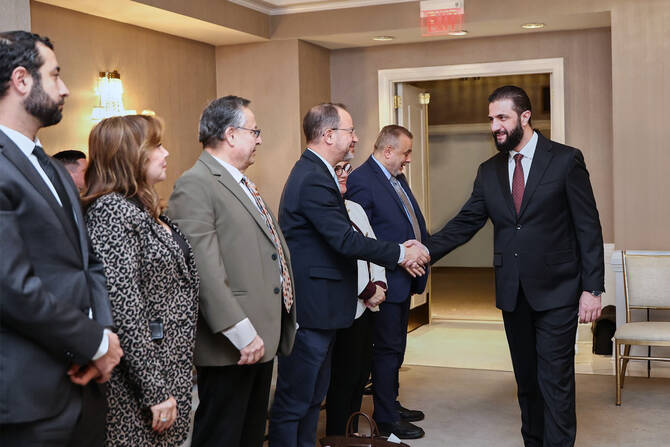
Syrian President Ahmad Al-Sharaa, right, meets with representatives of Syrian American organizations in Washington. (Syrian Presidency via AP)
Short Url
Updated 09 November 2025
Follow

Syrian president arrives in US for landmark visit

  • President Ahmed Al-Sharaa due to meet US President Donald Trump at the White House on Monday
  • Sharaa’s Washington trip comes after his visit to the UN in September, his first time on US soil

WASHINGTON: Syria’s President Ahmed Al-Sharaa arrived in the United States on Saturday for a landmark official visit, his country’s state news agency reported, a day after Washington removed him from a terrorism blacklist.

Sharaa, whose forces ousted longtime ruler Bashar Assad late last year, is due to meet US President Donald Trump at the White House on Monday.

It’s the first such visit by a Syrian president since the country’s independence in 1946, according to analysts.

The interim leader met Trump for the first time in Riyadh during the US president’s regional tour in May.

Washington’s envoy to Syria, Tom Barrack, said earlier this month that Sharaa would “hopefully” sign an agreement to join the international US-led alliance against the Daesh group.

The United States plans to establish a military base near Damascus “to coordinate humanitarian aid and observe developments between Syria and Israel,” a diplomatic source in Syria said.

The State Department’s decision Friday to remove Sharaa from the blacklist was widely expected.

State Department spokesman Tommy Pigott said Sharaa’s government had been meeting US demands including on working to find missing Americans and on eliminating any remaining chemical weapons.

“These actions are being taken in recognition of the progress demonstrated by the Syrian leadership after the departure of Bashar Assad and more than 50 years of repression under the Assad regime,” Pigott said.

The spokesman added that the US delisting would promote “regional security and stability as well as an inclusive, Syrian-led and Syrian-owned political process.”

The Syrian interior ministry announced on Saturday that it had carried out 61 raids and made 71 arrests in a “proactive campaign to neutralize the threat” of Daesh, according to the official SANA news agency.

It said the raids targeted locations where IS sleeper cells remain, including Aleppo, Idlib, Hama, Homs, Deir ez-Zor, Raqqa and Damascus.

After his arrival, Sharaa met with representatives from Syrian organizations in Washington, according to his country’s official media.

The Syrian foreign minister posted a social media video, filmed before Sharaa’s departure, of him playing basketball with CENTCOM commander Brad Cooper and Kevin Lambert, the head of the international anti-Daesh operation in Iraq, alongside the caption “work hard, play harder.”

Transformation

Sharaa’s Washington trip comes after his landmark visit to the United Nations in September – his first time on US soil – where the ex-militant became the first Syrian president in decades to address the UN General Assembly in New York.

On Thursday, Washington led a vote by the Security Council to remove UN sanctions against him.

Formerly affiliated with Al-Qaeda, Sharaa’s group, Hayat Tahrir Al-Sham (HTS), was delisted as a terrorist group by Washington as recently as July.

Since taking power, Syria’s new leaders have sought to break from their violent past and present a moderate image more tolerable to ordinary Syrians and foreign powers.

The White House visit “is further testament to the US commitment to the new Syria and a hugely symbolic moment for the country’s new leader, who thus marks another step in his astonishing transformation from militant leader to global statesman,” International Crisis Group US program director Michael Hanna said.

Sharaa is expected to seek funds for Syria, which faces significant challenges in rebuilding after 13 years of civil war.

In October, the World Bank put a “conservative best estimate” of the cost of rebuilding Syria at $216 billion.


Syria nears anniversary of Assad’s fall amid renewed ‘deeply troubling’ abuses, UN warns

Updated 05 December 2025
Follow

Syria nears anniversary of Assad’s fall amid renewed ‘deeply troubling’ abuses, UN warns

  • Early steps by interim leadership ‘encouraging but only the beginning’ of long process of accountability, human rights chief says
  • Concern that rising hate speech, both online and on the streets, has intensified violence against Alawite, Druze, Christian, Bedouin communities 

NEW YORK: Syria is days away from marking the first anniversary of the fall of President Bashar Assad’s regime, but the country’s interim authorities face mounting criticism over continuing abuses and a fragile security environment, the UN human rights chief said. 

In a statement on Friday, UN High Commissioner for Human Rights Volker Turk said early steps by the interim leadership, including the creation of national commissions for transitional justice and missing persons, and investigative bodies examining violence in coastal areas and in Suweida, were “encouraging but only the beginning” of a long process of accountability. 

Trials for suspects linked to last year’s coastal violence have begun, and a draft law on transitional justice has been announced. But Turk said the human rights situation remains deeply troubling. 

According to the UN, hundreds of people have been killed over the past year in summary executions, arbitrary killings, and abductions. Victims include members of minority communities and individuals accused of ties to the former government. Deaths were attributed to gunfire, stabbings, blunt-force attacks, shelling, hand grenades and explosive remnants of war. 

The UN said perpetrators include security forces under the interim authorities, armed groups aligned with them, remnants of the former government’s forces, local militias, and unidentified armed actors. 

Investigators also documented reports of sexual violence, arbitrary detention, looting, destruction of homes, forced evictions, and property confiscations, along with restrictions on free expression and peaceful assembly. 

Turk warned that rising hate speech, both online and on the streets, had intensified violence against Alawite, Druze, Christian, and Bedouin communities. 

The past year has also seen repeated Israeli military operations inside Syrian territory, including incursions and the occupation of additional areas. The UN said it had received reports of civilian casualties in a recent Israeli strike near Damascus, along with arrests and home searches carried out during military actions. 

Turk expressed concern that former armed groups have been integrated into new security forces without adequate human rights checks, raising the risk of repeat violations. 

“Proper vetting and comprehensive security sector reform are essential to prevent individuals responsible for serious abuses from entering the security forces,” he said. 

He urged Syria’s interim authorities to ensure independent and transparent investigations into all violations, past and present, and to hold those responsible to account. 

“Accountability, justice, peace, and the security of all Syrians are absolute prerequisites for a successful transition,” Turk said, adding that victims must have access to remedies and reparation. 

The UN Human Rights Office said its Damascus program is supporting efforts to advance inclusive transitional justice and strengthen the rule of law as Syria navigates a post-Assad transition.