‘Passion for bat and ball’: Baseball United and PTV Partner to bring professional baseball to Pakistan

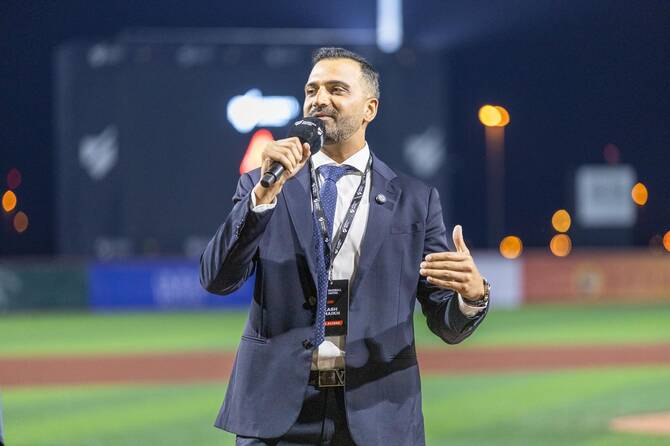
Baseball United, the first professional baseball league focused on the Middle East and South Asia, announced a partnership with the Pakistan Television Corporation on Saturday, Kash Shaikh, chairman, CEO and co-founder of Baseball United, announced. (Supplied)
Short Url
Updated 08 November 2025
Follow

‘Passion for bat and ball’: Baseball United and PTV Partner to bring professional baseball to Pakistan

  • Partnership will see all Baseball United Season One games screened live

DUBAI: Baseball United, the first professional baseball league focused on the Middle East and South Asia, announced a partnership with the Pakistan Television Corporation on Saturday.

The collaboration will include coverage on PTV Sports of all 21 of Baseball United’s games this November and December, including several primetime games featuring the Karachi Monarchs, Pakistan’s first professional baseball franchise.

Broadcasts will feature English commentary and graphics, catering to Pakistan’s massive youth population — nearly 60 percent of the country’s population is aged under 25.

Baseball United’s inaugural season will feature the league’s four founding franchises — the Arabia Wolves and the Mid East Falcons from the UAE, India’s Mumbai Cobras, and Pakistan’s Karachi Monarchs. The Monarchs roster includes four Pakistani players: Musharaf Khan, Faisal Hayat, Amar Mahmood, and Pierce Khan.

The season opens with a matchup between Karachi and Mumbai in the three-game Subcontinent Series on Nov. 14, 15, and 16. It will be the first meeting between professional baseball teams from Pakistan and India, “symbolizing a new chapter of sportsmanship, growth, and unity through sport,” according to a press release. In addition to the four Pakistani players, the Monarchs’ roster features players from 10 countries, including the US, the Netherlands, and South Korea.

The partnership with PTV builds on Baseball United’s history of strong viewership in Pakistan; the league drew 3 million viewers per game during February’s friendly series between its two UAE franchises. The series between Karachi and Mumbai is set to significantly top those figures, the organizers believe.

“We are very grateful to announce this partnership with the Pakistan Television Corporation,” Kash Shaikh, chairman, CEO, and co-founder of Baseball United, said in a statement. “This move continues to reinforce our growth across the subcontinent. PTV Sports has been the home of sports in Pakistan for decades, connecting generations of fans through cricket, football, and now, baseball. Millions of Pakistanis will now have the chance to experience a brand-new sport that builds upon their passion for bat and ball, led by their own professional franchise, the Karachi Monarchs. We’re honored to join forces with such a trusted and iconic broadcaster to grow the game and inspire the next generation of Pakistani athletes.”

PTV Sports will support the launch with on-air promotions, cross-channel marketing, and collaborative social media campaigns with Baseball United’s marketing team.

Pakistan represents one of Baseball United’s most promising markets, the press release states, adding: “The country’s deep sports culture, love for competition, and enthusiasm for international events make it a cornerstone of the league’s long-term strategy, marking a pivotal moment in bringing professional baseball to fans in the world’s fifth-most populous nation.”

“PTV Sports is delighted to partner with Baseball United to introduce this exciting global sport to Pakistani audiences,” said Aaliya Rasheed, executive director of PTV Sports. “This collaboration reflects our commitment to diversifying sports content and giving fans access to world-class international action.”

Baseball United’s first full season will feature 21 games played over 30 days at Baseball United Ballpark in Dubai. The season will culminate with the United Series Championship on Dec. 12, 13, and 14.

Supported by 20 Major League Baseball legends, including Mariano Rivera, Barry Larkin, Adrián Beltré, and Albert Pujols, Baseball United is “building the first professional baseball ecosystem in the Middle East and South Asia,” the press release stated. “Each franchise represents the first professional baseball team in its respective city, and the league has constructed significant grassroots infrastructure in Pakistan and surrounding countries to help develop top talent.”


From concrete walls to open skies: Meet Chile’s first rugby team created inside a prison

Updated 1 sec ago
Follow

From concrete walls to open skies: Meet Chile’s first rugby team created inside a prison

VALPARAISO: At first, the tackles, rucks and mauls were merely survival tactics within the harsh world of prison. But what began as a workshop behind barbed wire has transcended the walls of the Valparaíso Penitentiary Complex to become Chile’s first official rugby team formed behind bars.
The routine is intense. Three days of field training, two days in the gym, and matches every weekend. It mirrors the schedule of a professional league, but this is Rugby Unión Libertad — a sports club officially registered in mid-January with a mission that goes far beyond the pitch: preparing inmates for social reintegration after they serve their sentences.
“Rugby freed me; it healed my soul,” Alex Javier Silva, 48, who has been incarcerated since 1999, told The Associated Press. “Here you have no heart, no mind — you’re not at peace with anything. You’re like an animal.”
Rugby Unión Libertad began to take shape in 2016 as part of a workshop inside the prison walls. Led by the Addiction Treatment Center, the classes initially sparked the interest of around 50 inmates, who began to play with the “pill” — rugby’s oval ball — as a way to ease the weight of their time inside.
Over the years, the workshop evolved into Rugby Unión Libertad, a club that gained enough momentum to face the Chilean national team, Los Cóndores, in 2024.
Off the field, the team became the cornerstone of the Fundación Libertad, or Freedom Foundation. The nonprofit was established in November by a collective of former inmates, educators, psychologists and coaches, and it supports released prisoners through a mix of rugby, training, counseling and therapy.
Rugby as anger management
Three times a week, two coaches enter Valparaíso prison — about 120 kilometers (75 miles) from the capital Santiago — to lead training sessions for Unión Libertad. For two hours, the team’s 27 players practice the strategies, passes and kicks that characterize the sport.
This is precious time spent tasting freedom despite the barbed wire and watchful guards. It is here, on a tiny dirt field surrounded by guard towers, that the players release their anger and frustration that come with life behind bars.
“Violence is rampant here,” said Jorge Henríquez, 42. “There’s a lot of rage; sometimes you explode for no reason, and so (with rugby) you regulate that, you start to distance yourself from conflicts so that rage doesn’t resurface.”
Like many other correctional facilities in Chile, the one in Valparaíso is overcrowded. With 3,351 inmates crammed into a space built for 1,919, it operates at nearly double its capacity, leading to precarious hygiene and health conditions and ultimately fueling a surge in internal violence.
Coach Leopoldo Cerda, a teacher and volunteer who has spearheaded the project since its beginning, explained that playing rugby — a demanding sport by nature — is especially difficult in prison.
“People sleep poorly, eat poorly, and yet they have the physical and mental strength to overcome many obstacles that this sport presents,” he noted, adding that the changes in the players’ attitudes have been remarkable.
“The first thing is discipline, mastering self-control and anger management, since there’s a lot of physical contact in rugby,” said Cerda. “And they’ve managed to overcome that.”
The team has also become a role model for other inmates who hope to join Unión Libertad. “New guys keep arriving. They see from the cellblocks how they train and start preparing, even improving their behavior so they can train,” said Gonzalo Delgado, another coach.
In order to be part of the project, inmates need to have good behavior and cultivate teamwork.
“Many crimes are committed because people don’t know how to use their free time properly,” said the head of the Valparaíso Penitentiary Complex, Isaac Falcón Espinace. Thus, rugby gives inmates the opportunity to “not use it for actions that go against society once they’re free.”
Touching the sky
Guillermo Velásquez, 42, was one of the nearly 50 inmates who participated in the first rugby workshop a decade ago, quickly becoming a fan of this unfamiliar sport.
After a short period of freedom, poor choices landed him back in prison in 2019. To cope with drugs and constant fights, Velásquez began developing the idea of ​​founding a rugby team inside the prison.
The dream finally came true in 2022, when he and half a dozen fellow inmates obtained permission to use the prison’s gym after several unsuccessful attempts.
Rugby Unión Libertad was born.
The first practices were very basic, but the group gradually won the support of other inmates and the trust of the prison guards. Sessions moved outdoors, the players gained their own rugby field and volunteers embraced the project.
“Rugby saved my life,” said Velásquez, who left prison seven months ago. “If the Libertad team hadn’t existed inside the prison, society would have had one more criminal.”
The same year it was founded, Unión Libertad entered its first tournament, but in 2024, they truly touched the sky: The players left Valparaíso prison for the first time to face Los Cóndores, the very same Chilean national team that will compete in the 2027 Rugby World Cup in Australia.
“It was an epic battle,” recalled Silva. “Nobody has ever done that in Chile. And there we were, some mere prisoners, playing against them. Everyone was watching, we were on TV.”
The match — held at another prison in the north of Santiago — was a turning point. The project gained scope, visibility and more supporters.
Hope beyond the walls
Since its inception, Freedom Foundation has used rugby as the catalyst for social reintegration, providing support including therapy, professional training and partnering with potential employers to help with the process.
“They want to change,” said psychologist and former national rugby player Cynthia Canales, president of the foundation. “We also want to show that there is a lack of opportunities, that we have to address the stigma.”
Reintegration can be complex though, as it depends not only on personal will but on the availability of opportunities outside prison. Very often, the stigma of a criminal record undermines efforts to change.
“Often, many of these men have the desire to change, but all they find are closed doors,” said coach Cerda. “Society remains deeply prejudiced.”
Thanks to the work of the Freedom Foundation, former inmates can keep their intense training routine once out of prison. Now, instead of a tiny, dirt field under constant surveillance, the men train on the vast grass fields of Valparaíso. They no longer play behind bars but for “All Free” — the former inmates’ branch of Unión Libertad.