

After years in captivity, brown bear ‘Rano’ begins journey to recovery at Islamabad facility

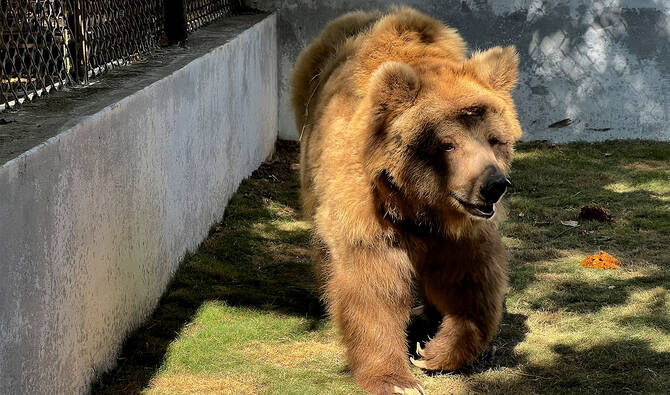
A female Himalayan brown bear named Rano walks at a quarantine enclosure in Margalla Wildlife Rescue and Rehabilitation Center, after a court ordered to have her relocate from Karachi Zoo, following a welfare petition, in Islamabad, Pakistan on November 6, 2025. (REUTERS)
Short Url
Updated 08 November 2025
Follow

After years in captivity, brown bear ‘Rano’ begins journey to recovery at Islamabad facility

  • Rano was relocated from Karachi to Islamabad this week after court petition documented stress, injuries she suffered in unsuitable enclosure
  • Wildlife officials say Himalayan brown bear being offered soft food, medical attention in quarantine as she undergoes recovery at rescue center

Islamabad: On a warm winter afternoon, Rano, the 25-year-old Himalayan brown bear, sat peacefully in her new enclosure as she ate fruit from a bowl near her. This was Rano’s first day at her temporary sanctuary in Islamabad, where she arrived after living in deplorable conditions for seven years.

Rano was airlifted in a Pakistan Air Force (PAF) aircraft and brought to the Islamabad Wildlife Management Board (IWMB) facility in the capital on Wednesday. Rano was relocated in compliance with a court directive, after a welfare petition documented distress, behavioral trauma and injuries linked to her captivity in an unsuitable tropical enclosure at the Karachi Zoo.

This is the first phase of her relocation as wildlife officials hope to move Rano to a sanctuary in the northern Gilgit-Baltistan region. The environment there more closely resembles her native mountain habitat. 

Alina Umair, the rescue operations and feed in-charge at the IWMB, told Arab News it was standard procedure to keep rescued animals in quarantine for a limited time to ensure they are delivered the best health care.

“Right now, Rano has come from a stress situation and we are making her get used to this environment,” Umair told Arab News on Thursday. “So that she can get comfortable in our quarantine area.”

The rescue center was set up on court orders in 2020, when the Islamabad Zoo was formally converted into a wildlife rescue and rehabilitation center under the IWMB’s supervision. 

The IWMB coordinated Rano’s relocation from Karachi to Islamabad, sending a three-member team to the southern city.

Sana Raja, the in-charge at the rehabilitation facility who led the team that relocated Rano, said the brown bear did not have any “ownership” with the humans at the Karachi Zoo.

“Ownership means that no one has ever called her lovingly,” Raja explained. “Her only interaction with humans was when she was fed and her cage was cleaned.”

Raja said IWMB officials sang in front of the bear while offering food for five hours straight each day in Karachi as they attempted to connect with her and to show Rano that “a person can love as well.”

“Then we flew her. She was monitored continuously in the plane, her oxygen level was checked,” Raja said.

‘RELAXED THE WHOLE NIGHT’

Rano arrived at the Islamabad rescue facility with a “maggot wound,” Umair said.

“Our doctors will come and do a proper health check-up,” she said. “We can tell you about her health and medical status after that.”

Umair said the first time Rano stepped on grass in over seven years was when she arrived at the facility in Islamabad, adding that her enclosure in Karachi had a concrete floor only.

“When she came here yesterday, she slept peacefully and relaxed the whole night,” Umair said.

Animal handler Anees Hussain said Rano is being provided soft food that she can easily swallowed since her teeth are damaged.

Rano’s diet includes fruits such as guava, persimmons and apples as well as flatbread dipped in honey.

“We are feeding her twice a day. Back in Karachi, she was being fed once a day,” Hussain lamented.

He said the bear’s quarantine zone is equipped with a hay bedding, grass floor, benches and stones where she can move about freely. 

REHABILITATION CHALLENGES

Although Rano is in a more favorable environment than her previous captivity, her age and physical condition may prove to be hurdles in her journey further ahead.

“I can’t say anything [about her physical condition] until her blood test is done,” Raja said. “I can tell you from my understanding that she has PTSD trauma.”

Raja said she was not aware of the traumas Rano had suffered in her life and how she survived them.

“Is she capable of going ahead or would she have to be rehabilitated here for the rest of his life,” she wondered. 


Pakistan, global crypto exchange discuss modernizing digital payments, creating job prospects 

Updated 05 December 2025
Follow

Pakistan, global crypto exchange discuss modernizing digital payments, creating job prospects 

  • Pakistani officials, Binance team discuss coordination between Islamabad, local banks and global exchanges
  • Pakistan has attempted to tap into growing crypto market to curb illicit transactions, improve oversight

ISLAMABAD: Pakistan’s finance officials and the team of a global cryptocurrency exchange on Friday held discussions aimed at modernizing the country’s digital payments system and building local talent pipelines to meet rising demand for blockchain and Web3 skills, the finance ministry said.

The development took place during a high-level meeting between Finance Minister Muhammad Aurangzeb, Pakistan Virtual Assets Regulatory Authority (PVARA) Chairman Bilal bin Saqib, domestic bank presidents and a Binance team led by Global CEO Richard Teng. The meeting was held to advance work on Pakistan’s National Digital Asset Framework, a regulatory setup to govern Pakistan’s digital assets.

Pakistan has been moving to regulate its fast-growing crypto and digital assets market by bringing virtual asset service providers (VASPs) under a formal licensing regime. Officials say the push is aimed at curbing illicit transactions, improving oversight, and encouraging innovation in blockchain-based financial services.

“Participants reviewed opportunities to modernize Pakistan’s digital payments landscape, noting that blockchain-based systems could significantly reduce costs from the country’s $38 billion annual remittance flows,” the finance ministry said in a statement. 

“Discussions also emphasized building local talent pipelines to meet rising global demand for blockchain and Web3 skills, creating high-value employment prospects for Pakistani youth.”

Blockchain is a type of digital database that is shared, transparent and tamper-resistant. Instead of being stored on one computer, the data is kept on a distributed network of computers, making it very hard to alter or hack.

Web3 refers to the next generation of the Internet built using blockchain, focusing on giving users more control over their data, identity and digital assets rather than big tech companies controlling it.

Participants of the meeting also discussed sovereign debt tokenization, which is the process of converting a country’s debt such as government bonds, into digital tokens on a blockchain, the ministry said. 

Aurangzeb called for close coordination between the government, domestic banks and global exchanges to modernize Pakistan’s payment landscape.

Participants of the meeting also discussed considering a “time-bound amnesty” to encourage users to move assets onto regulated platforms, stressing the need for stronger verifications and a risk-mitigation system.

Pakistan has attempted in recent months to tap into the country’s growing crypto market, crack down on money laundering and terror financing, and promote responsible innovation — a move analysts say could bring an estimated $25 billion in virtual assets into the tax net.

In September, Islamabad invited international crypto exchanges and other VASPs to apply for licenses to operate in the country, a step aimed at formalizing and regulating its fast-growing digital market.