

UN human rights chief warns states to act fast to halt ‘abominable atrocities’ in Sudan

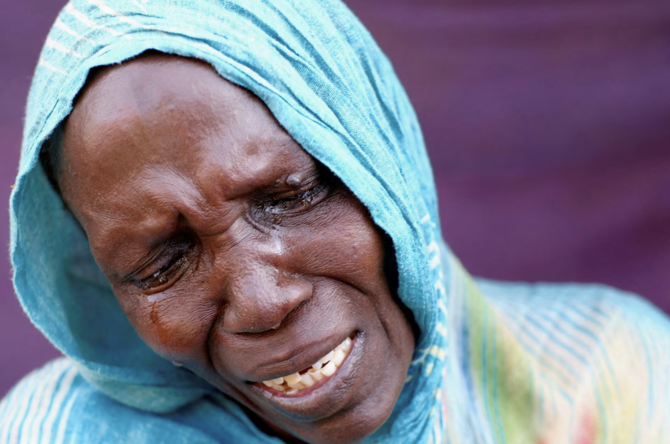
A woman from El-Fasher cries after learning about the killing of her son and brother, in a camp in Al-Dabbah, Sudan, November 3, 2025. (Reuters)
Short Url
Updated 07 November 2025
Follow

UN human rights chief warns states to act fast to halt ‘abominable atrocities’ in Sudan

  • Volker Turk fears ‘summary executions, rape and ethnically motivated violence are continuing’ in city of El-Fasher, where ‘traumatized civilians’ remain trapped
  • Despite hopes for a ceasefire deal, the paramilitary RSF launch fresh drone attacks on the army-held cities of Khartoum and Atbara

NEW YORK CITY: Countries that hold sway over the warring factions in Sudan must act quickly to stop a surge of atrocities, UN Human Rights chief Volker Turk warned on Friday as fighting intensified in Darfur and Kordofan.

“States, especially those who have influence over the parties to the conflict, are put on notice that unless they act quickly and decisively, there will be more of the carnage and atrocities that we have already witnessed,” Turk said.

“The Security Council’s arms embargo is clear: the provision of continuing military support to sustain parties committing serious violations must stop.”

Despite hopes for a potential ceasefire agreement, the paramilitary Rapid Support Forces launched fresh drone attacks on the army-held cities of Khartoum and Atbara on Friday morning.

It came as people who fled El-Fasher after witnessing the recent takeover of the city by the RSF continued to describe horrific killings of civilians, including people shot in the street, as well as drone strikes and brutal beatings.

Turk expressed fear that ‘abominable atrocities’ continue in the city, where hundreds of thousands of people are stuck and facing famine.

“Traumatized civilians are still trapped inside El-Fasher and are being prevented from leaving,” he said.

“I fear that the abominable atrocities, such as summary executions, rape and ethnically motivated violence, are continuing within the city.”

Those who attempt to flee face grave risks as they make their way along escape routes and are confronted by “unimaginable cruelty,” he added.

Turk also voiced alarm over escalating hostilities in Kordofan, citing concern about mounting levels of civilian casualties, destruction and displacement since the capture of El-Fasher.

“There is no sign of deescalation,” he said. “To the contrary, developments on the ground indicate clear preparations for intensified hostilities, with everything that implies for its long-suffering people.”

He urged countries to end any military support they provide to forces accused of serious rights violations, and renewed his plea for an immediate end to the violence.

“Bold and urgent action is required by the international community,” he added.

Fighting between Sudan’s army and the RSF has raged since April 2023, plunging the country into one of the worst humanitarian crises in the world.


Thousands of Gaza children suffer from famine conditions

Updated 7 sec ago
Follow

Thousands of Gaza children suffer from famine conditions

  • “The number of children admitted is five times higher than in February, so we need to see the numbers come down further”

GENEVA: Thousands of children have been admitted for treatment for acute malnutrition in Gaza since an October ceasefire that was supposed to enable a major increase in humanitarian aid, the UN children’s agency said on Tuesday.
UNICEF, the biggest provider of malnutrition treatment in Gaza, said that 9,300 children were treated for severe acute malnutrition in October, when the first phase of an agreement to end the two-year Israel-Hamas war came into effect.

FASTFACTS

• UNICEF, the biggest provider of malnutrition treatment in Gaza, said that 9,300 children were treated for severe acute malnutrition in October. • While this is down from a peak of over 14,000 in August, the number is still significantly higher than during a brief February-March ceasefire.

While this is down from a peak of over 14,000 in August, the number is still significantly higher than during a brief February-March ceasefire and indicates that aid flows remain insufficient, UNICEF spokesperson Tess Ingram told a Geneva press briefing by video link from Gaza.
“It’s still a shockingly high number,” she said.
“The number of children admitted is five times higher than in February, so we need to see the numbers come down further.” Ingram described meeting underweight babies weighing less than 1 kilogram born in hospitals “their tiny chests heaving with the effort of staying alive.”
UNICEF is able to import considerably more aid into the enclave than it was before the October 10 agreement but obstacles remain, she said, citing delays and denials of cargoes at crossings, route closures and ongoing security challenges.
“We have seen some improvement, but we continue to call for all of the available crossings into the Gaza Strip to be open,” she added. There are not enough commercial supplies entering Gaza, she added, saying that meat was still prohibitively expensive at around $20 a kilogram.
“Most families can’t access this, and that’s why we’re still seeing high rates of malnutrition,” she said.
In August, a UN-backed hunger monitor determined that famine conditions were affecting about half a million people — or a quarter of Gaza’s population.
Children were severly affected by hunger as the war progressed, with experts warning that the effects could cause lasting damage.