

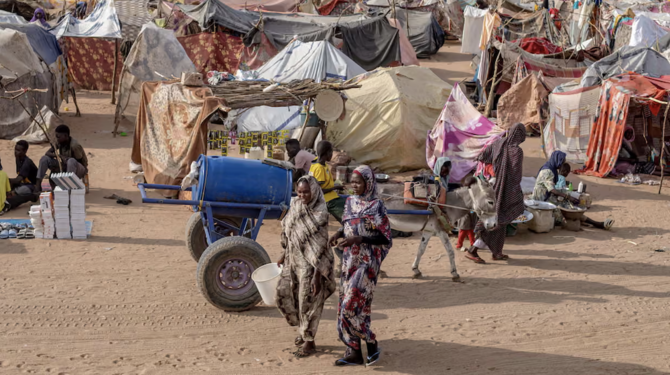

LONDON: The UK rejected a plan to prevent atrocities in Sudan over cuts to its international aid budget.
A report seen by The Guardian showed the government was warned the city of El-Fasher could fall amid risk of ethnic cleansing and possible genocide in Darfur.
Four possible plans were drawn up to increase “the protection of civilians, including atrocity prevention” in Sudan, including one that provided an “international protection mechanism” to stop crimes against humanity and sexual violence.
However, the government opted for the “least ambitious” of them “given resource constraints,” according to a report published in October.
El-Fasher fell to the paramilitary Rapid Support Forces in October, with mass killings and sexual violence reportedly committed against the civilian population.
The UK is the “penholder” for Sudan at the UN Security Council, taking special interest in the area's affairs and leading the council’s activities surrounding Sudan’s ongoing civil war.
The options drawn up for Sudan by the UK were first disclosed in a report by Liz Ditchburn, who heads the body that oversees UK aid spending, the Independent Commission for Aid Impact.
Considering the period from 2019 to the present, her report suggested the Foreign, Commonwealth and Development Office’s “already overstretched country team did not have the capacity to take on a complex new programming area” for Sudan, leading to the dismissal of the first three options.
“The UK has shown credible political leadership and strong convening power on Sudan, but its impact has been constrained by inconsistent political attention,” the report said.
Budget limits and “limited program management capacity” also meant that special attention in protecting women and girls from sexual violence could not be given.
“This (the funding cuts) has constrained the UK’s ability to support stronger protection results within Sudan — including for women and girls,” Ditchburn’s report said, adding that a program for Sudanese women and girls would only be ready “in the medium to long term (from 2026).”
The fourth plan saw the UK instead allocate an additional £10 million ($13.1 million) funding “for various activities, including protection” to the International Committee of the Red Cross and other groups operating in Sudan.
Sarah Champion, chair of the parliamentary International Development Select Committee, said: “I am deeply concerned that in the rush to save money, some essential services are getting cut.
“Prevention and early intervention should be core to all FCDO work, but sadly they are often seen as a ‘nice to have’.”
She added: “In a time of rapidly reducing aid budgets, this is a dangerously shortsighted approach to take.”
Shayna Lewis, a Sudan specialist with human rights organization Paema, told The Guardian: “Atrocities are not natural disasters — they are a political choice that are preventable if there is political will.
“The FCDO’s decision (to pursue the least ambitious option for atrocity prevention) clearly shows the lack of priority this government places on atrocity prevention globally, but this has real-life consequences.
“Now the UK government is complicit in the ongoing genocide of the people of Darfur.”
UK government sources told The Guardian that more than £120 million had been allocated to Sudan in total, and that it was “making a difference on the ground.”


