

Pakistan says decision on Gaza force deployment to be taken by parliament

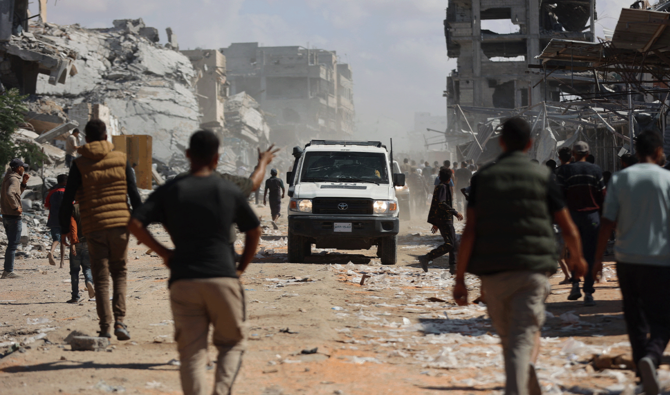
A Red Cross vehicle drives past Palestinians amid widespread destruction due to Israeli bombardment in Khan Yunis in the southern Gaza Strip on October 12, 2025. (AFP/File)
Short Url
Updated 08 November 2025
Follow

Pakistan says decision on Gaza force deployment to be taken by parliament

  • Foreign office says ‘unprovoked attacks’ from Afghanistan undermining efforts to reopen border crossings
  • It maintains Pakistan’s relations with the United States are independent of Washington’s ties with New Delhi

ISLAMABAD: Pakistan will decide “in due course” whether to contribute troops to the proposed international stabilization force for Gaza, with the foreign office saying on Friday the decision on the subject would be taken by the national parliament.

The proposed force is expected to be a multinational security deployment aimed at supporting the post-conflict ceasefire, assisting reconstruction and overseeing a phased withdrawal of Israeli forces from the Gaza Strip. It was introduced as part of the Gaza peace framework developed by the United States administration which also consulted various Muslim-majority states.

Responding to a question about Pakistan’s potential troop contribution, foreign office spokesperson Tahir Andrabi said the matter was still under consideration and would be decided after consultation at the highest level.

“You asked me about the Gaza stabilization process,” he said. “The decision will be taken in due course, as and when required. Certain level of leadership has stated that the decision will be taken with the advice of the government. That is also a fact.”

PAK-AFGHAN BORDER

The spokesperson also said the border crossings between Pakistan and Afghanistan cannot be opened for trade without evaluating the security situation.

Referring to a fresh border clash in Chaman, Balochistan, earlier in the day, Andrabi warned that unprovoked attacks were undermining efforts to reopen the border crossings between the two countries.

“These are the kinds of incidents which are stopping the opening of borders,” he said. “If with closed borders, at the crossings or around the crossings, we face this kind of unprovoked attacks, then obviously the security situation warrants that these border openings are kept closed.”

“As I said last week also, the opening of borders will depend on the evaluation of the security,” he added. “So obviously, today’s incident ... does not contribute any positive assessment to the evaluation of borders that would lead to the opening of these border crossings.”

The spokesperson confirmed the issue would be discussed in Istanbul where the two countries are holding peace talks to finalize details of an Oct. 19 ceasefire that was reached in Doha following some of the worst border clashes in decades.

INDO-US RELATIONS

Asked about the regional diplomatic situation, Andrabi appreciated US President Donald Trump’s “positive role” in defusing tensions, especially during the “90-hour war” in May with India, before a US-brokered ceasefire was announced.

“President Trump has played a positive role in this conflict, particularly in its aftermath, when India asked, requested the US side to end this conflict,” he said. “The role of the president, the US president, was positive. And we hope that it would remain positive in the future also, because the warmongering from India continues.”

He added that some Indian political figures had become “serial war-mongers,” emphasizing the need for restraint and responsible leadership in the region.

Responding to a question about recent interactions between Washington and New Delhi, the spokesperson stressed Pakistan’s engagements with the US were not tied to US-India relations.

“The relations between India and the United States are between the two sovereign countries, so we do not have any particular position on that.

When it comes to Pakistan-US relations, we follow an independent course, not anchored or not dependent on the third country,” he added.


Curfew extended in Gilgit-Baltistan, probe ordered after deadly Khamenei protests

Updated 03 March 2026
Follow

Curfew extended in Gilgit-Baltistan, probe ordered after deadly Khamenei protests

  • At least 15 people were killed in clashes with law enforcement agencies over the weekend in Gilgit-Baltistan
  • Government also announces a de-weaponization campaign, crackdown on hate speech and cybercrime in region

ISLAMABAD: The government in Pakistan’s Gilgit-Baltistan (GB) region on Tuesday extended a curfew in Gilgit district and ordered a judicial probe into violent protests over the killing of Iranian Supreme Leader Ali Khamenei in US-Israeli strikes last week, an official said.

At least 15 people were killed in clashes with law enforcement agencies over the weekend in GB, where protesters torched and vandalized several buildings, including United Nations regional offices, an army-run school, software technology park and a local charity building.

The violence prompted regional authorities to impose curfew in Gilgit and Skardu districts on March 2-4 as officials urged people to stay indoors and cooperate with law enforcers, amid widespread anger in Pakistan, particularly among members of the Shiite minority, over Khamenei’s killing.

On Tuesday, the GB government convened to review the situation and announced the extension of curfew in Gilgit among a number of security measures as well as ordered the establishment of a judicial commission to investigate the weekend violence in the region.

“The government has made it clear that the law will strictly take its course against elements involved in vandalism at government institutions, private properties and incidents of vandalism in Gilgit and Skardu and no kind of mischief will be tolerated,” Shabbir Mir, a GB government spokesperson, said in a statement.

“In view of the security situation, curfew will remain in force in Gilgit, while the decision to extend the curfew in Skardu will be taken keeping the ground realities and the changing situation in view.”

The statement did not specify how long the curfew will remain in place in Gilgit.

Besides the formation of the judicial commission to investigate the violent clashes, the government also decided to launch a large-scale de-weaponization campaign in the entire Gilgit district, for which relevant institutions have been directed to immediately complete all necessary arrangements, according to Mir.

In addition, a crackdown has been ordered on hate speech, spread of fake news and cybercrime.

“The aim of these decisions is to ensure the rule of law, protect the lives and property of citizens and crack down on miscreants,” he said. “Approval has also been given to immediately survey the affected infrastructure and start their restoration work on priority basis.”

Demonstrators in Pakistan’s southern port city of Karachi also stormed the US Consulate on Sunday, smashing windows and attempting to burn the building. Police responded with batons, tear gas, and gunfire, leaving 10 people dead and more than 50 injured.

Pakistani authorities have since beefed up security at US diplomatic missions across the country, including around the US consulate building in Peshawar, to avoid any further violence.