

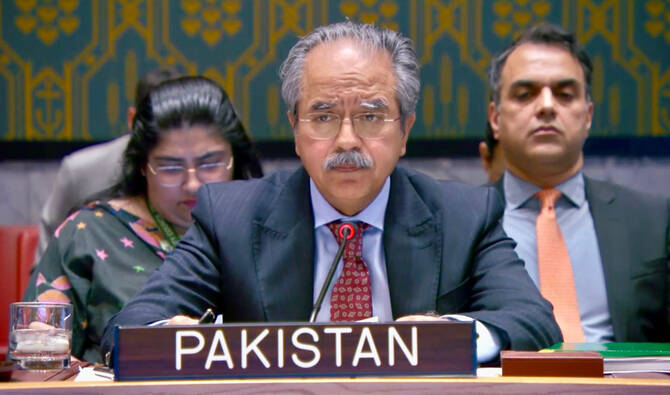

ISLAMABAD: Pakistan’s permanent representative to the United Nations (UN) Ambassador Asim Iftikhar Ahmad on Thursday called for compliance of the 1960 World Bank-mediated Indus Waters Treaty (IWT) between Islamabad and New Delhi, which India announced suspending in April.
The IWT divides control of the Indus basin rivers between the two nuclear-armed neighbors. India said in April it would hold the treaty “in abeyance” after a gun attack in Indian-administered Kashmir killed more than 26 tourists. New Delhi blamed the assault on Pakistan, Islamabad denied it.
In August, the International Court of Arbitration rendered an award on issues of general interpretation of the IWT, explaining the designed criteria for the new run-of-river hydropower projects to be constructed by India on the western rivers of Chenab, Jhelum and Indus, which Islamabad said vindicated its stance.
Speaking at Security Council briefing on environmental impacts of armed conflicts, Ambassador Ahmad said noted millions of tonnes of rubble, explosive remnants of war, contaminated water, degraded soils and deforestation as some harmful impacts of conflicts, which he said erode governance, fuel displacement and deepen humanitarian crises.
“Of even greater concern is the deliberate weaponisation of shared natural resources. A textbook example is the unilateral suspension of the Indus Waters Treaty by India earlier this year,” he said.
“The Court of Arbitration’s 2025 award reaffirmed the continuing validity of the Treaty and its dispute-settlement mechanisms, upholding Pakistan’s position that all issues must be resolved within its legal framework. We therefore expect full respect for the Treaty and an early return to compliance and normal functioning through the established channels.”
The IWT grants Pakistan rights to the Indus basin’s western rivers — Indus, Jhelum, and Chenab — for irrigation, drinking, and non-consumptive uses like hydropower, while India controls the eastern rivers — Ravi, Beas, and Sutlej — for unrestricted use but must not significantly alter their flow. India can use the western rivers for limited purposes such as power generation and irrigation, without storing or diverting large volumes, according to the agreement.
The South Asian neighbors have been arguing over hydroelectric projects on the shared Indus river and its tributaries for decades, with Pakistan complaining that India’s planned hydropower dams will cut its flows.
In its findings, the Court of Arbitration declared that India shall “let flow” the waters of the western rivers for Pakistan’s unrestricted use. In that connection, the specified exceptions for generation of hydro-electric plants must conform strictly to the requirements laid down in the Treaty, rather than to what India might consider an “ideal” or “best practices approach,” according to the Pakistani foreign office.
The Court’s findings on low-level outlets, gated spillways, intakes for the turbines, and free-board are in line with Pakistan’s interpretation of the relevant provisions of the treaty. The award also limits India from maximizing the pondage volume.
Notably, the Pakistani foreign office said in August, the Court had observed that the awards of a Court of Arbitration are “final and binding on the parties (India and Pakistan),” and have a controlling legal effect on subsequent Courts of Arbitration and neutral experts.
Ambassador Ahmad noted that Pakistan has consistently maintained that no provision of the IWT, which has ensured equitable sharing of the Indus basin’s waters between Pakistan and India for over six decades, permits “unilateral suspension or modification.”
“India’s unlawful unilateral decision to suspend this framework undermines the letter and spirit of the Treaty, threatens ecosystems, disrupts data-sharing, and endangers the lives of millions who depend on the Indus river water system for food and energy security, for their survival,” he said.
“Such acts do not just harm one country; they weaken confidence in international water law and set a precedent for resource-based and driven coercion elsewhere. This should be of grave concern for every member of this Council and for the international community as a whole.”


